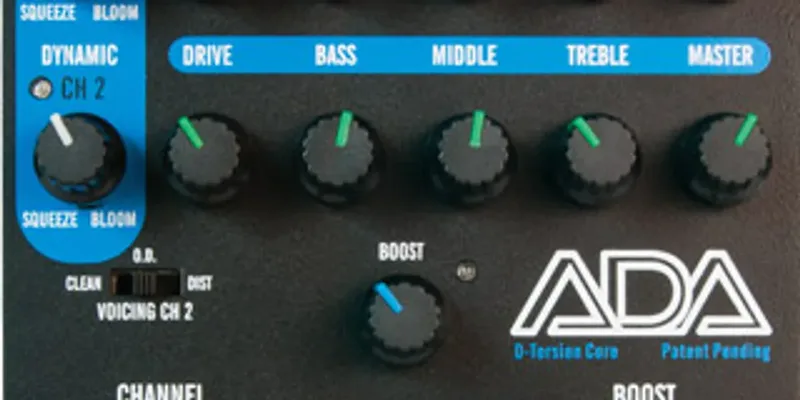


The ADA APP-1 is a two-channel solid-state analog preamp pedal, sitting in the wider field of preamp pedals. Premier Guitar describes it as "essentially a 2-channel preamp with independent channel voicings and EQs," giving players two separate amplifier-style channels in one box, each with its own gain character and tone controls1.
How it works
Each channel has three voicing options: clean, overdrive, and distortion. That gives six combinations across the pedal's two channels, so a player can pair, for example, a clean voice on one channel with a distortion voice on the other and switch between them mid-song1.
The controls follow the same layout on each channel: drive, bass, middle, treble, and master knobs. The EQ controls are derived from a Fender-style tone stack, the same family of circuit found in Fender amplifiers, which shapes the bass, middle and treble response1.
At the heart of the design, the APP-1 takes two Fender Twin-style tone stacks and pairs them with ADA's patent-pending D-Torsion Core technology, which is designed to help tailor an amplifier's reactivity. In practice, that means the circuit is aimed at how the preamp responds to picking dynamics and volume changes, not just at a static EQ curve1.
Analog design and build
The APP-1 uses all solid-state analog circuitry and analog potentiometers. There are no tubes and no digital modeling in the unit; the voicings and tone shaping are done in analog circuitry, and the knobs are conventional analog controls1.
The enclosure is made of heavy-gauge, cold-rolled steel, the kind of construction associated with pedals built to withstand stage use1.
What reviewers said
Premier Guitar's review came away impressed by the pedal's range relative to its cost1:
"Incredible dynamic and tone-shaping capabilities for the money."
The same review found the APP-1 "especially good at conjuring Fender and Mesa/Boogie models," with British-style growl available from the overdrive voice. For a player, that positions the pedal as covering American clean and hot-rodded territory, with a British-flavored option in the overdrive setting1.
Videos
Brett Kingman
Guitar Interactive Magazine
Brett Kingman
Questions
Is the ADA APP-1 analog or digital?
The APP-1 uses all solid-state analog circuitry with analog potentiometers, according to Premier Guitar's review. There is no digital modeling or DSP in the signal path, so the tone shaping happens in the analog circuit itself, and the knobs work like the controls on a conventional amplifier or stompbox.
How many channels does the ADA APP-1 have?
The APP-1 is a 2-channel preamp, with each channel carrying its own independent voicing and EQ settings. That lets a player set up two distinct sounds, such as a clean rhythm tone and a higher-gain lead tone, and move between them without resetting controls.
What voicings does the ADA APP-1 offer?
Each of the two channels has three voicing options: clean, overdrive, and distortion. With two channels and three voicings each, the pedal covers a wide range of gain levels, from uncluttered clean tones through pushed overdrive to fuller distortion.
What is D-Torsion Core on the ADA APP-1?
D-Torsion Core is ADA's patent-pending technology in the APP-1, designed to help tailor an amplifier's reactivity. It is paired with two Fender Twin-style tone stacks, so it works alongside the EQ section to shape how the preamp responds to a player's picking dynamics.
Does the ADA APP-1 use tubes?
No. The APP-1 is built entirely with solid-state analog circuitry and analog potentiometers. There are no tubes in the design, which means no tube replacement or warm-up, while the voicings aim at amplifier-style tones.
Sources (1)
- ADA APP-1 Pedal Review, Premier Guitar, 2012-09-05