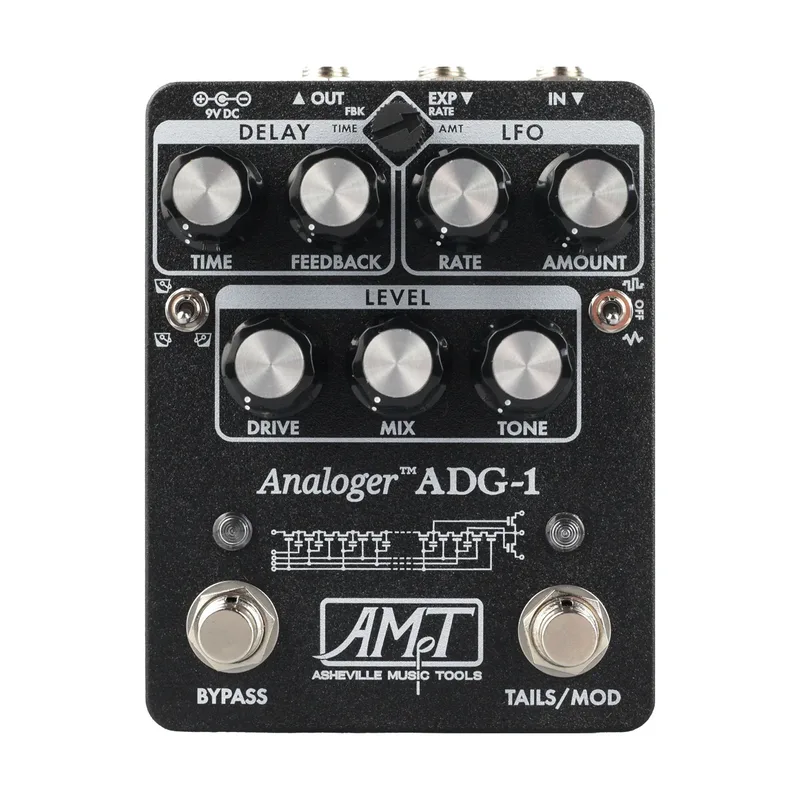


The Asheville Music Tools Analoger ADG-1 is an analog delay pedal with modulation. Two toggle switches set the shape of the modulation, Square or Triangle, and select subdivisions for the delay1. A second footswitch switches the modulation off, and when held it turns the tails on or off, so a player can keep echoes ringing after bypass or cut them dead1. Reviewers have described the modulation as very pleasant1.
The pedal offers repeats from 16ms to 700ms with modulation, and its signal path is 100% analog12. Asheville Music Tools positions it as a compact analog delay in the Analoger series, and it sits alongside a now-retired special edition, the ADG-1 SE, which extended the delay time past a second3.
How it works
The ADG-1 is built on two reissue bucket brigade delay lines using MN3005 BBDs, the classic delay chip family that stores your signal as charge moving through a chain of capacitors, one "bucket" at a time, under the control of a clock. Here the clock is analog, with what Pedal of the Day describes as "exponential modulation technology"4. The maker says the pedal includes over 400 carefully selected components, with premium audio-grade op amps and high-tolerance, non-microphonic capacitors throughout the signal chain2.
A Bucket toggle sets the time range by choosing how many of the delay lines are in use: two buckets for longer delays, one bucket for slapback and faux chorus or flange sounds2.
Controls
| Control | What it does |
|---|---|
| Time | Delay time: 35ms to 700ms with the Bucket switch down (all BBDs), or 17ms to 350ms with the switch up (half the BBDs). Extended to 900ms down to 27ms with an expression pedal, control voltages or an LFO2 |
| Drive | Input drive: saturation reminiscent of a tape echo pushed to the limit, or lo-fi tones with darker Tone settings1 |
| Tone | Placed inside the feedback loop: counterclockwise for the muted warmth of classic analog delays, clockwise for a bright, magnetic-style echo tone2 |
| Feedback | Amount of repeats, tapered to reach infinite repeats without runaway or self oscillation, for evolving ambient washes2 |
| Bucket toggle | Sets the time range: 2 buckets for longer delays, 1 bucket for slapback and faux chorus/flange sounds2 |
| Modulation wave toggle | Selects Square or Triangle modulation waves1 |
| Subdivision toggle | Selects delay subdivisions1 |
Two footswitches handle the rest. The second footswitch switches the modulation off, and when held it turns the delay tails on or off1.
The Drive and Tone knobs
The Drive knob is the pedal's character control. Delicious Audio reports that it "allows to create some saturation reminiscent of a tape echo pushed to the limit, or deliver some lo-fi" tones when paired with darker Tone settings1. Because Tone sits inside the feedback loop, it shapes each repeat as it recirculates: rolled back it gives the muted warmth of classic analog delays, rolled forward a bright, magnetic-style echo tone2. Feedback is tapered so you can push into infinite repeats without runaway or self oscillation2.
Modulation
A toggle selects between Square and Triangle modulation waves, and a second toggle selects delay subdivisions1. Delicious Audio's write-up, which added the pedal to the site's list of the Best Tape-Style Delay Pedals, found that "The modulation is very pleasant"1.
The ADG-1 SE
The ADG-1 SE was a special edition of the standard ADG-1 that added a third high-voltage Xvive analog delay bucket, allowing switching between delay times of 16ms to 350ms or 50ms to 1.055sec, extendable up to 1.35sec with control voltages or an expression pedal, for over 1.1 seconds of total delay time with modulation3. It also added a bonus delay insert loop3.
Players comparing versions should know how the modulation controls work. The toggle switch selects between Square and Triangle modulation waves, and a second toggle selects subdivisions for the delay1. The second footswitch switches the modulation off entirely, and when held it turns the tails on or off1.
The SE shared the standard pedal's 100% analog signal path and carried its own specifications, including a maximum input level of +15dBµ (4.3V RMS), maximum output level of +14dBµ (3.9V RMS), maximum drive of over 22dB covering attenuation to gain, and 2:1 broadband noise reduction with 12dB HF emphasis3.
Where it came from
The ADG-1's control layout reflects how its designer approached analog delay. The modulation section offers two wave shapes, Square and Triangle, chosen by toggle switch, while a second toggle selects subdivisions for the delay1. The second footswitch gives direct control over the modulation, switching it off, and when held it turns the tails on or off1. The modulation itself has been described as very pleasant1.
What reviewers said
Videos
Asheville Music Tools
Mike Hermans
collector//emitter
Questions
Is the Analoger ADG-1 fully analog?
Yes. Asheville Music Tools describes the ADG-1 as having a 100% analog signal path, built around a pair of studio grade MN3005 bucket brigade delay chips running on a high voltage 15V power supply. The modulation is generated by an analog clock with exponential modulation technology rather than a digital LFO.
Is the Asheville Music Tools ADG-1 SE discontinued?
Yes. The ADG-1 SE was a limited special edition that added a third high-voltage analog delay bucket for over 1.1 seconds of delay time. Fall 2023 was its last production run, with a few more built in early 2024 from remaining inventory, and Asheville Music Tools states it has been retired with no current plans to build it again.
What does the Drive knob do on the Analoger ADG-1?
The Drive knob sets the input drive into the delay line. Delicious Audio reports it can create saturation reminiscent of a tape echo pushed to its limit, or deliver lo-fi tones when paired with darker Tone settings. The SE version's maximum drive is listed at over 22dB, covering both attenuation and gain.
What is the delay time range of the Analoger ADG-1?
The standard ADG-1 offers 16 to 700ms of delay. With the Bucket switch down, using both BBD lines, the Time knob sweeps 35ms to 700ms; with the switch up it covers 17ms to 350ms for slapback and faux chorus or flange sounds. Expression pedal, control voltages or an LFO extend the range to 900ms down to 27ms.
What modulation waveforms does the ADG-1 offer?
A toggle switch selects between Square and Triangle modulation waves. Delicious Audio's write-up calls the modulation very pleasant, and a second footswitch switches the modulation off entirely, or, when held, turns the delay tails on or off.
Sources (5)
- Asheville Music Tools Analoger ADG-1 Analog Delay, Delicious Audio, 2026-05-28
- ADG-1 Analog Delay, Asheville Music Tools
- ADG-1 Special Edition (Discontinued), Asheville Music Tools
- Asheville Music Tools ADG-1 Analog Delay, Pedal of the Day, 2024-05-19
- Asheville Music Tools APH-12 Plus, Asheville Music Tools