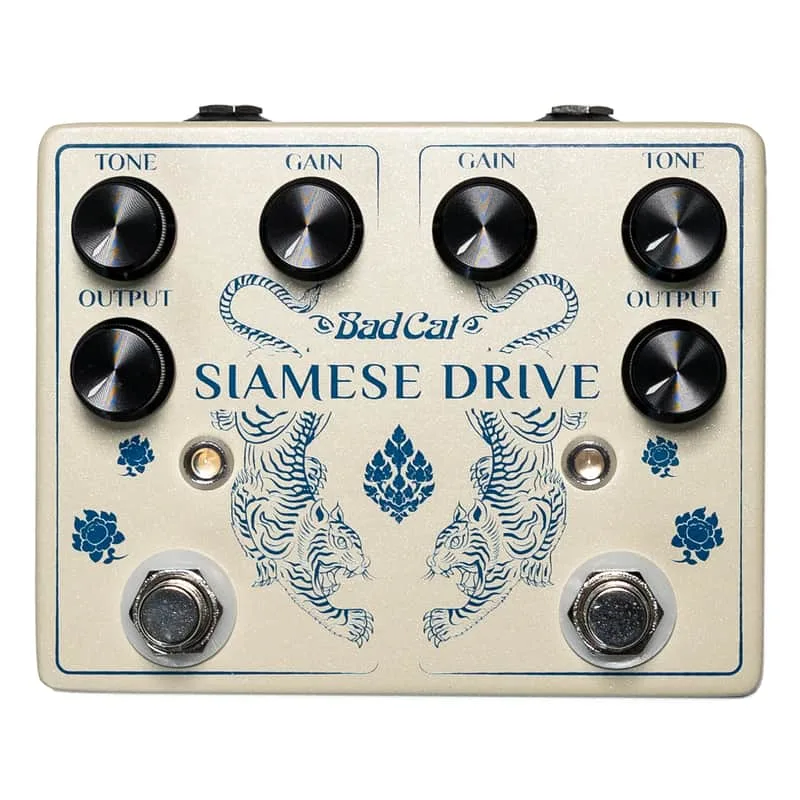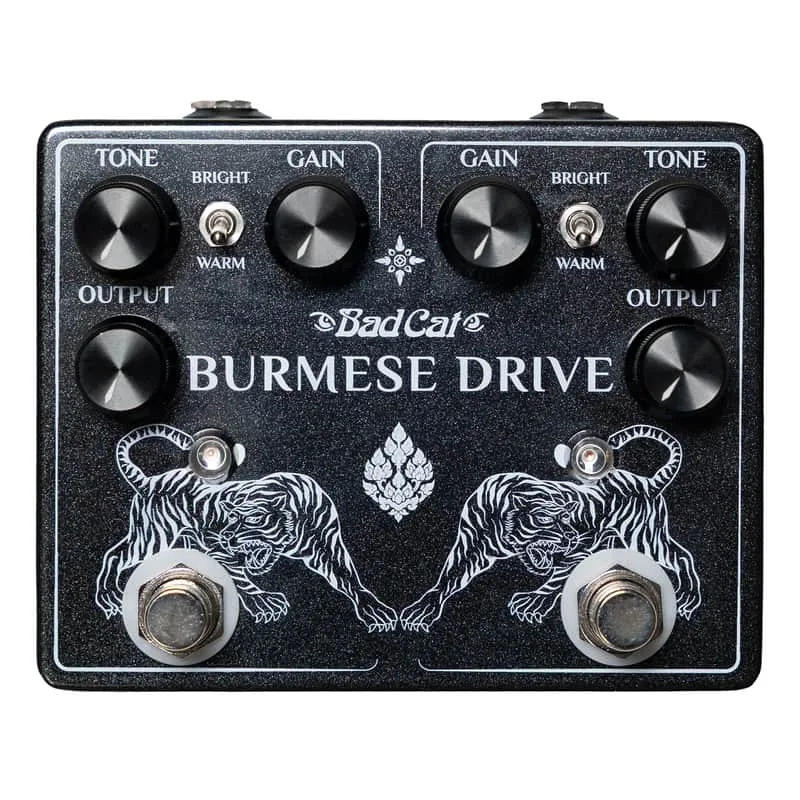


The Bad Cat Burmese Drive is a dual-overdrive pedal: two independent, identical overdrive circuits in one enclosure, released by Bad Cat Amplifiers alongside its sibling, the Bad Cat Siamese Drive. Each channel has its own controls, so the pedal can work as two separate overdrives on one board, or both circuits can be stacked into one thicker voice. Bad Cat says the Burmese Drive is rooted in the legendary BB-style overdrive circuit and delivers a transparent response, articulate gain structure, and wide tonal sweep1. It sits in the same family as other overdrive pedals built around a mid-forward, low-gain-friendly circuit.
Controls and channels
Each channel carries the same set of controls, which means either side can be set up independently for rhythm or lead work1:
| Control | What it does |
|---|---|
| Gain | Sets the amount of overdrive on that channel |
| Tone | Shapes the channel's treble character |
| Output | Sets the channel's level |
| Bright/Warm toggle | Tailors the feel and response of the channel, per Bad Cat |
The Bright/Warm toggle is per channel, so one side can be voiced bright for rhythm and the other warmer for leads. Bad Cat describes the stacking option as a way to get "lush, saturated drive and increased harmonic complexity" when both circuits run together1.
Design and build
The pedal is housed in a rugged black sparkle powder-coated chassis with custom Bad Cat tiger print graphics1. It runs on 9V to 12V DC center-negative power, so a standard pedalboard supply covers it1.
The Burmese Drive is one of a pair: the Siamese Drive was announced at the same time as a companion dual-overdrive pedal. Both carry the same $269.99 street price1.
Where it came from
Bad Cat Amplifiers released the Burmese Drive and Siamese Drive together as a pair of dual-overdrive pedals, both hand-crafted in Southern California1. The Burmese Drive's circuit is rooted in the BB-style overdrive, a design with a long history among players who want an articulate, transparent overdrive rather than heavy compression1.
Videos
Palen Music Center
N Stuff Music
Andertons Collective
Questions
Is the Bad Cat Burmese Drive true bypass?
Yes. According to Bad Cat's announcement, the Burmese Drive operates in true bypass, so when the pedal is off, your guitar's signal passes through without the overdrive circuitry loading it down. That matters on a pedalboard where the pedal sits between the guitar and the amp even when it is not being used.
What power supply does the Bad Cat Burmese Drive need?
The Burmese Drive runs on 9V to 12V DC center-negative power. A standard center-negative pedal supply works, and the pedal accepts anything in that range. As with any center-negative pedal, do not power it from a center-positive supply or a battery adapter wired the wrong way.
Can you stack both channels of the Burmese Drive?
Yes. Bad Cat says the two channels can be run separately or stacked together. Stacking both overdrive circuits pushes the pedal into what the company describes as lush, saturated drive with increased harmonic complexity, which is a common way players use dual-overdrive pedals for lead tones.
What does the Bright/Warm switch do on the Burmese Drive?
Each channel has a Bright/Warm toggle that Bad Cat says tailors the feel and response of that channel. It lets you set one channel up for rhythm tones and the other for lead, or match the pedal to a darker or brighter amp.
Where is the Bad Cat Burmese Drive made?
Bad Cat builds the Burmese Drive by hand in Southern California. The company announced it alongside the Siamese Drive, a companion dual-overdrive pedal, and both are hand-crafted there.
Sources (1)
- Bad Cat Burmese and Siamese Drive Pedals, Premier Guitar, 2025-11-11