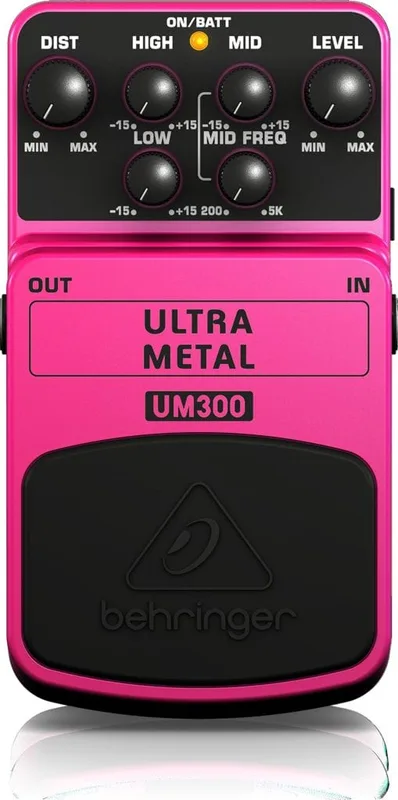


The Behringer Ultra Metal, sold as the UM300, is a distortion effects pedal from Behringer aimed at hard rock and heavy metal players. Behringer describes it as delivering "super-thick, tube-like distortion" with "virtually endless sustain," covering ground from aggressive traditional metal to modern crunch1.
What sets the UM300 apart from most budget distortion boxes is its midrange control. Instead of a fixed EQ curve, you choose which midrange frequency the pedal emphasizes or scoops, which is the kind of tone shaping normally found on more expensive metal pedals1.
The controls
Like most distortion boxes, the UM300 has Distortion and Level controls: Distortion sets the gain, Level sets the output volume1. The rest of the panel is a three-band EQ, and the middle band is the interesting one.
| Control | What it does |
|---|---|
| Distortion | Sets the amount of gain, as on most distortion boxes1 |
| Level | Sets the output volume1 |
| Low | Dials in the amount of bottom end1 |
| Mid Frequency | Selects a midrange frequency from 200 Hz to 5 kHz, then boosts or cuts it by up to 15 dB1 |
| High | Dials in the amount of top end1 |
The Mid Frequency control is the pedal's main feature. Behringer says it lets you "select a midrange frequency (from 200 Hz - 5 kHz)" and "boost/cut it by up to 15 dB"1. In practice that means you can scoop mids for a classic scooped-metal rhythm sound, or boost a narrow band to cut through for solos, and choose exactly where in the midrange that happens. A sweep from 200 Hz to 5 kHz covers the range from the low-mid body of a guitar up past the presence region.
"We've given the UM300 a Mid Frequency control, allowing you to select a midrange frequency (from 200 Hz - 5 kHz) and boost/cut it by up to 15 dB."
A status LED shows when the pedal is active1.
Power and bypass
The UM300 runs on Behringer's PSU-SB DC power supply, which is not included, or on a 9 V battery1. If you use a power supply, you need the maker's own PSU-SB unit rather than a generic adapter.
Behringer does not call the UM300 true bypass. The maker says "a top-quality on/off switch maintains highest signal integrity in bypass mode," which is a claim about signal quality, not a true bypass design1.
Where it sits in Behringer's distortion range
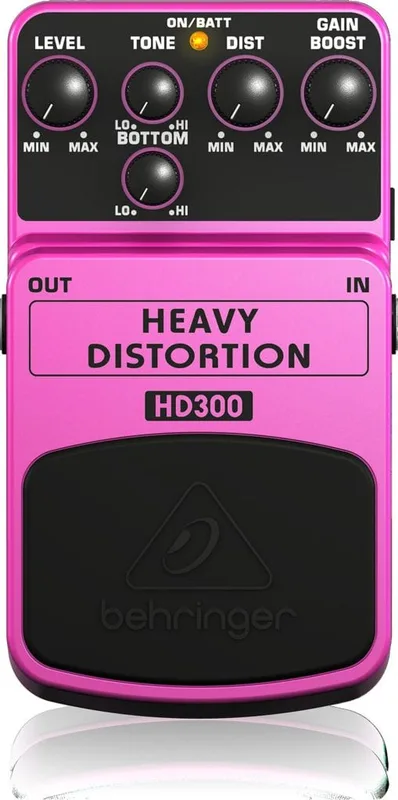
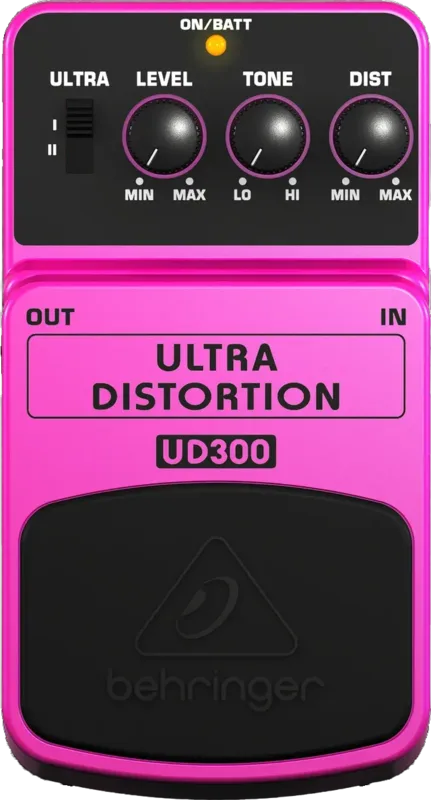
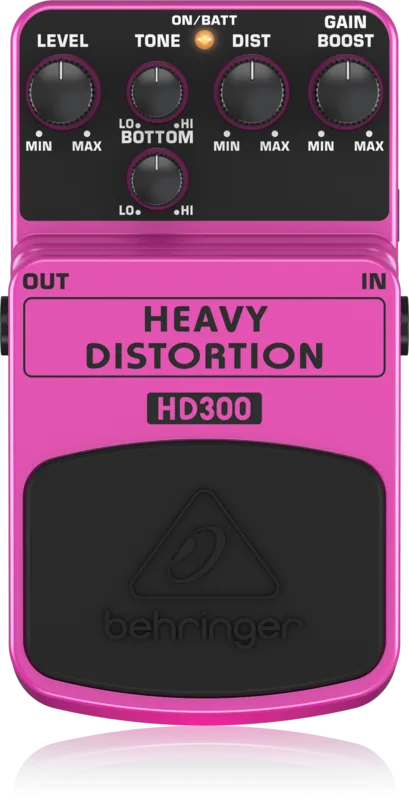
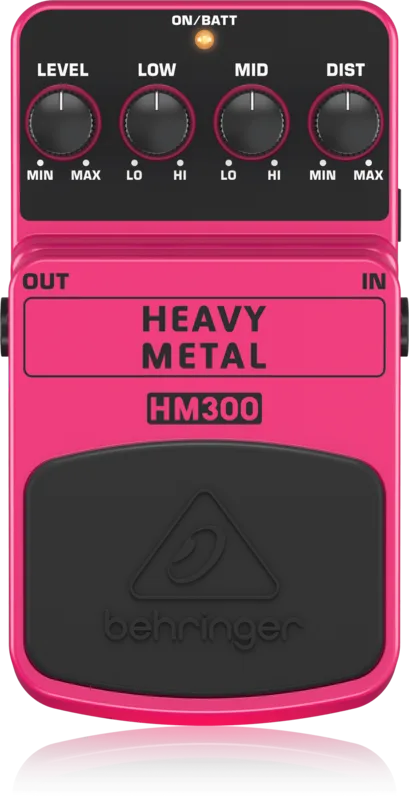
Behringer makes several distortion and overdrive pedals at similar prices, and the UM300 is the metal-voiced one. Siblings include the Behringer Heavy Distortion, the Behringer UD300 Ultra Distortion, the Behringer HD300, the Behringer HM300, and the Behringer OD300, along with the Behringer Overdrive Distortion and the Behringer OD100. The sweepable midrange is what distinguishes the UM300 from the simpler boxes in the line1.
Videos
Behringer
Taylor Danley
Erik Z
Questions
Does the Behringer UM300 take a 9V battery?
Yes. Behringer says you can pop in a 9 V battery, or run the pedal from its PSU-SB DC power supply, which is sold separately. Either way the pedal needs power to pass signal and light its status LED.
What power supply does the Behringer Ultra Metal use?
Behringer specifies its own PSU-SB DC power supply, which is not included with the pedal. A 9 V battery is the other power option the maker lists.
Is the Behringer Ultra Metal true bypass?
Behringer does not describe the UM300 as true bypass. The maker says a top-quality on/off switch maintains the highest signal integrity in bypass mode, which is a buffered bypass rather than a true bypass claim.
Sources (1)
- UM300 | Behringer, Behringer