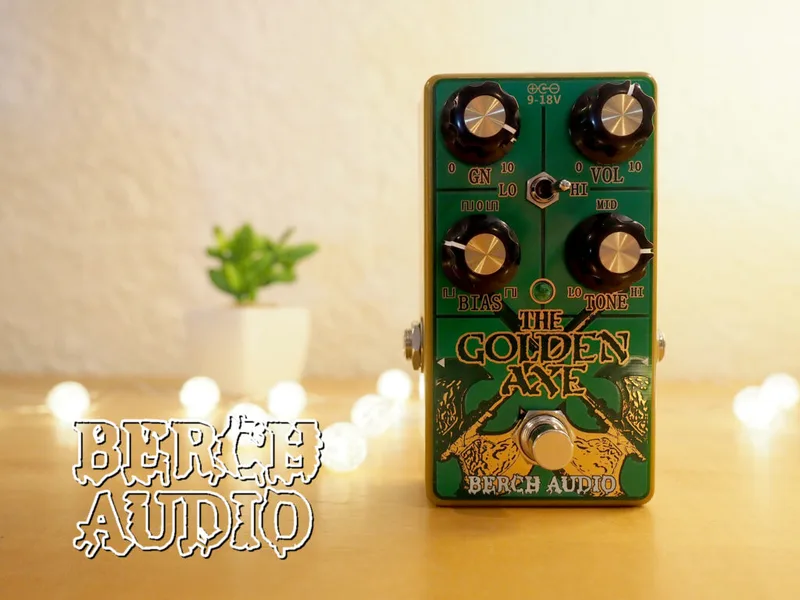



Berch Audio's The Golden Axe is a pedal that combines aspects of fuzz, overdrive and boost in one medieval-themed enclosure. Its range runs from a boost to an overdrive to a distortion to a fuzz, and anywhere in between, which makes it a single box that can sit at several different points on a board's drive section. The circuit is loosely based on the classic OCD circuit, extended with high gain op-amp boosting, a JFET clipping circuit and a passive output tone control1.
The controls
The Golden Axe carries four knobs and one toggle switch, and each control reaches across a wide span of the pedal's range1.
| Control | What it does |
|---|---|
| GN | Adjusts the distortion amount1 |
| VOL | Sets your output level1 |
| TONE | Balances out your high and low end frequencies to taste1 |
| BIAS | A bias/starvation control, cutting or boosting the voltage to the transistors1 |
| Lo/Hi toggle | Offers two different options for a vast output tonal range1 |
The BIAS knob is the control that sets this pedal apart from a straightforward drive. Because it cuts or boosts the voltage reaching the transistors, rolling it back starves the circuit and opens up experimental sound textures that sit outside the usual boost-to-fuzz sweep1.
The Lo/Hi toggle works with the passive output tone control to shape the pedal's voicing, giving two distinct output options before the TONE knob fine-tunes the high and low balance1.
Where it sits among fuzz and overdrive
Because the circuit blends fuzz, overdrive and boost behavior, it overlaps with several pedal families: it can do the work of a boost pedal at one end of its range, an overdrive pedal in the middle, and a fuzz pedal at the top, with distortion territory in between1. Pedal of the Day summed up the flexibility this way:
"The wide-ranging control panel ensures you'll be able to get virtually any dirty sounds you want out of this beauty"
Videos
Pedal of the Day
Demos In The Dark
Hank Haus Recordings
Questions
What does the BIAS knob do on The Golden Axe?
BIAS is a bias or starvation control that cuts or boosts the voltage going to the pedal's transistors. Running the voltage down starves the circuit and produces experimental sound textures, while boosting it pushes the transistors harder. Pedal of the Day called it a fun addition to the control panel.
What does the Lo/Hi toggle do?
The Lo/Hi toggle switch offers two different options for a vast output tonal range, letting you choose between two voicings of the pedal's output. It works alongside the passive output tone control to shape the high and low end of the pedal's sound.
Is The Golden Axe based on the Fulltone OCD?
Loosely, yes. Pedal of the Day describes The Golden Axe as loosely based on the classic OCD circuit, but it extends that foundation with high gain op-amp boosting, a JFET clipping circuit and a passive output tone control, plus the added BIAS knob.
Is The Golden Axe a fuzz or an overdrive?
Both, and more. Berch Audio's pedal combines aspects of fuzz, overdrive and boost in one enclosure. Its range runs from a boost to an overdrive to a distortion to a fuzz, and anywhere in between, depending on how the controls are set.
What type of clipping does The Golden Axe use?
The Golden Axe uses a JFET clipping circuit. JFET clipping is paired with high gain op-amp boosting and a passive output tone control in the pedal's signal path.
How many knobs does The Golden Axe have?
The Golden Axe has four knobs and one toggle switch. The knobs are GN for distortion amount, VOL for output level, TONE for balancing high and low frequencies, and BIAS for the voltage starvation control. The toggle is the Lo/Hi switch.
Sources (1)
- Berch Audio The Golden Axe Fuzz Overdrive Boost, Pedal of the Day, 2021-10-13