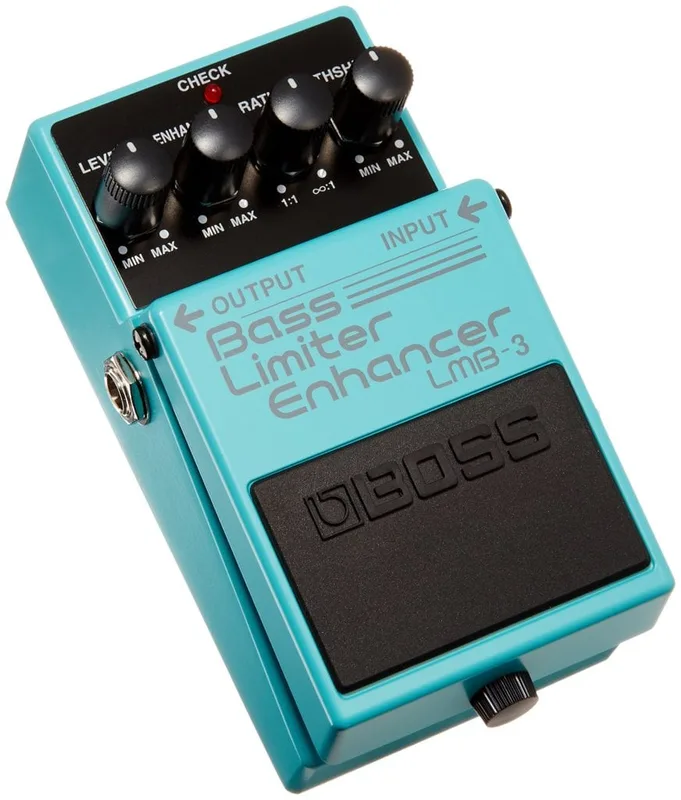


The Boss LMB-3 Bass Limiter/Enhancer is an analog compressor pedal built for electric bass. Boss describes it as giving "complete control over a bass guitar's dynamic range using a limiter effect and an enhancer circuit designed specifically for electric bass"1. In practice it is two things in one box: a limiter/compressor that can smooth out your note-to-note volume, and an Enhance circuit that shapes the high end of your tone.
The Ovnilab review calls it "one of the most reliable and versatile compressors in its price range," and notes that its tone is very clean and dry rather than a fattening effect, with little added noise unless the Enhance knob is turned up2.
What it does to your sound
The limiter side of the LMB-3 controls dynamics. Its ratio can be adjusted anywhere from 1:1, which is a clean uncompressed boost, through light to medium smoothing and squeezing, all the way to infinity:1, where the pedal acts as a true peak limiter that clamps hard transients2. The threshold knob covers a decent range, letting you choose how much of your signal the pedal affects2.
The Enhance side is an EQ-shaping circuit. With Enhance off, the pedal rolls down the high frequencies in a long, wide slope, which can effectively work as a bass boost depending on your output level. Turning the knob up brings in cuts and boosts at higher frequencies, across a wider slope, with a steeper effect across the range of the knob's travel3.
One thing the pedal does not have: there is no LED to indicate the signal crossing the threshold, so you set it by ear2.
How it compares to the Boss LM-2B
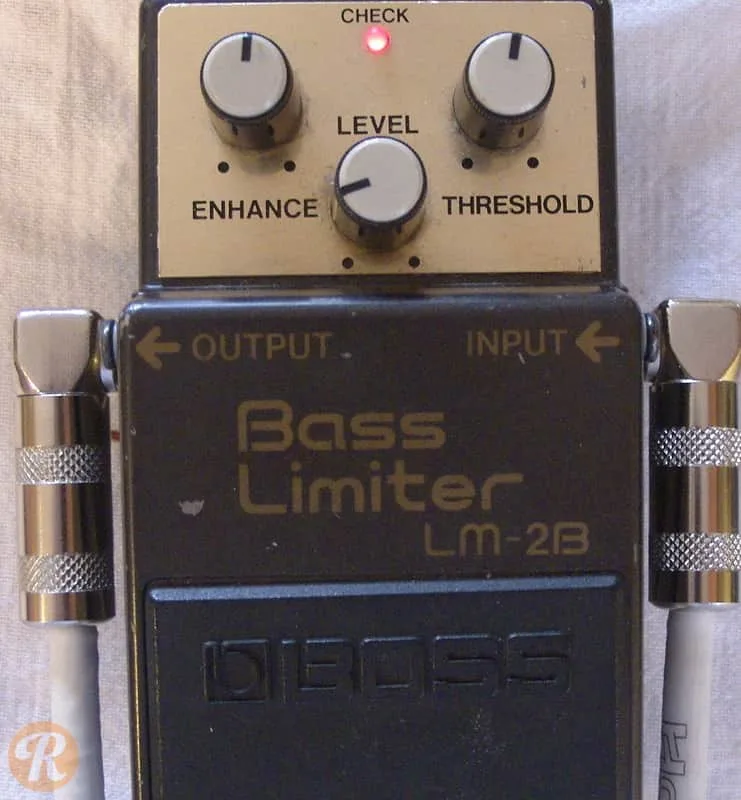
The LMB-3 is the successor to the Boss LM-2B, an older version of the same idea3. The predecessor was more accurately called a limiter because it had a fixed very high ratio2. The two pedals use nearly identical components aside from the VCA chips, and both are built with the classic hard-to-kill Boss ruggedness3.
| Boss LMB-3 | Boss LM-2B | |
|---|---|---|
| Ratio | Fully variable, 1:1 to infinity:123 | Fixed, very high2 |
| VCA chip | THAT 21593 | dbx 12523 |
| Enhance behavior | Cuts and boosts at higher frequencies, wider slope, steeper effect across the knob's range3 | Cuts around 1 KHz, boosts at 2 KHz, a steep narrow mid cut followed by a steep narrow boost3 |
| Enhance off | Rolls down the high frequencies in a long wide slope3 | Rolls down the highs even more than the LMB-33 |
The reviewer at Ovnilab found tradeoffs in both directions. The LM-2B does not boost nearly as much in the range above 4 KHz, so it does not amplify noise quite as badly as the LMB-33. On the other hand, the LMB-3's variable ratio gives it a range of light or medium compression the fixed-ratio LM-2B cannot match3. The reviewer's overall preference went to the older pedal:
"Overall I like the LM-2B better than the LMB-3, because of the smoother action, and because I prefer the sound of its Enhance (in moderation); but the tradeoff is its fixed high ratio."3
The Steve McKinley "Thunder" mod
There is a well-known modded version of the LMB-3, the Steve McKinley "Thunder" modded version2. The mod mainly consists of replacing several electrolytic capacitors in the signal path with non-polar box capacitors, changing some of the values2. His price for this mod is $592.
The reviewer found the modded pedal retains the high frequencies better, with the low frequencies compressed more strongly, for a tighter, brighter sound that is more effective as a peak limiter, at a lower output volume than stock2. However, the review is measured about the mod's claims:
"The noise level is NOT improved, and I'm not sure what he even means by 'integrity' here, but the tone is not any more transparent."2
The reviewer's verdict was that the mod is worthwhile only for those specific qualities, not for any general improvement in noise or transparency2.
Power, bypass and price
The LMB-3 runs on 9V DC with a center-negative plug and draws 25mA1. It is not true bypass: the bypass is buffered, though the reviewer found it transparent, at unity gain, with a perfectly flat frequency response2.
The LMB-3 is discontinued, so it is found on the used market. Ovnilab cites about $50 for a used LMB-34. Boss still hosts the English owner's manual on its support site5.
For context on price, the same review site points players who cannot afford the $50 a used LMB-3 costs toward cheaper new alternatives4.
Videos
BOSSchannel
The Bass Channel
Reverb
Questions
What VCA chip is in the Boss LMB-3?
The LMB-3 uses a THAT 2159 VCA chip. Its predecessor, the Boss LM-2B, used a dbx 1252 VCA instead. Aside from the different VCA chips, the two pedals use nearly identical components, and both share the classic hard-to-kill Boss enclosure construction.
How much current does the Boss LMB-3 draw?
The LMB-3 draws 25mA, running on 9V DC with a center-negative plug, the standard Boss compact-pedal power arrangement. That is modest enough for most isolated pedalboard power supplies, though it is worth checking against a small supply's per-output limit.
Is the Boss LMB-3 true bypass?
No. The LMB-3 uses a buffered bypass, which the Ovnilab review measured as transparent, at unity gain, with a perfectly flat frequency response. So while it is not true bypass, the reviewer found the bypassed signal passes through without coloration.
Does the LMB-3 have a threshold LED?
No. There is no LED to indicate the signal crossing the threshold, so you set the threshold by ear rather than by watching a light. Players who like a visual cue for how hard the pedal is working will miss it.
How is the LMB-3 different from the LM-2B?
The LMB-3 has a fully variable ratio from 1:1 up to infinity:1, while the LM-2B had a fixed very high ratio that made it more accurately a limiter. The Enhance knob also behaves differently: the LM-2B cuts around 1 KHz and boosts at 2 KHz, while the LMB-3 cuts and boosts at higher frequencies across a wider slope.
What does a used Boss LMB-3 cost?
Around $50 on the used market, as cited by Ovnilab in 2026. There is also a modded version, the Steve McKinley Thunder mod, priced at $59 for the mod itself, which changes several capacitors in the signal path for a tighter, brighter character.
Sources (5)
- LMB-3 Bass Limiter Enhancer by BOSS, RockBoard (www.rockboard.de), 2026
- Boss LMB-3, ovnilab.com
- Boss LM-2B, ovnilab.com
- Behringer BLE100, ovnilab.com
- BOSS - Support - LMB-3 - Owner's Manuals, boss.info