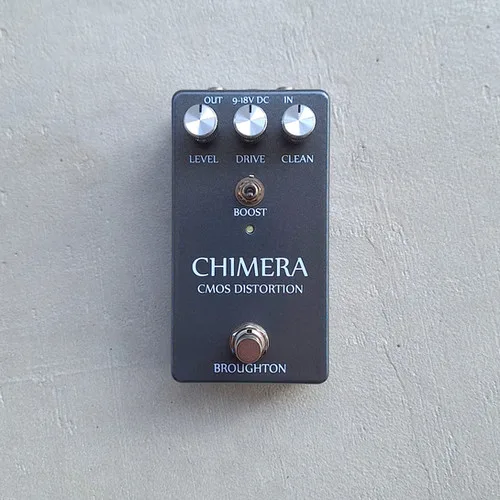
The Broughton Audio Chimera is a distortion pedal built around hex inverter gain stages, with two separate signal paths, a clean signal and a distortion signal, that are mixed together at the output. Broughton Audio says the design generates a thick harmonic distortion and calls it an excellent drive pedal for bass players. The pedal is based on the discontinued Schumann Lion, a CMOS distortion from the early 2000s.1
Two signal paths: clean and distortion
The Chimera's circuit splits the guitar or bass signal in two. The distortion path carries the hex inverter gain stages that produce the pedal's thick harmonic distortion, while the clean path carries an unclipped copy of the signal. The two are mixed together at the output, so the clean signal sits underneath the distortion rather than being clipped with it.1
The supply voltage changes how the two paths behave. Broughton Audio notes that there is more clean headroom in the clean path of the pedal with higher voltages, but the distortion signal is unaffected. Running the pedal at 18V instead of 9V therefore gives the clean side more room before it clips, while leaving the distortion side sounding the same.1
Controls
| Control | What it does |
|---|---|
| Drive | Determines the amount of gain in the distortion signal1 |
| Level | Determines the volume of the distortion signal1 |
| Clean | Affects the clean signal only, from unity gain to +24 dB1 |
| Boost switch | Maximizes the gain of the distortion by a factor of 10; the Drive knob will not affect the gain with the Boost on1 |
The Clean control is the one that shapes how much unclipped signal sits under the distortion. At unity gain it matches the input level, and turned up it adds up to +24 dB of clean signal, which is where the pedal's usefulness for bass comes from: the low end can be kept intact under the drive.1
With the Boost switch engaged, the Drive knob has no effect on the gain. Boost sets the distortion to its maximum, a factor of 10 over the normal range.1
Power and bypass
The Chimera runs on a DC supply of at least 9V but no greater than 18V, and the supply is not included. The connector must be a boss style, 2.1mm barrel, center negative polarity. Current draw is 10mA.1 The pedal has a true bypass switch, so its circuit drops out of the chain when it is off.1
Availability and warranty
Broughton Audio lists the Chimera at US$185.00. Products are covered for one year to the original owner.1
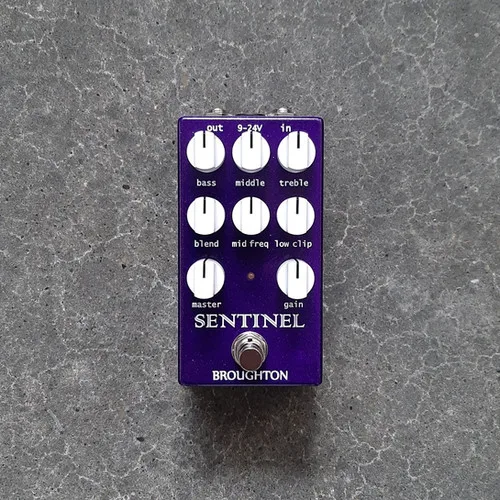
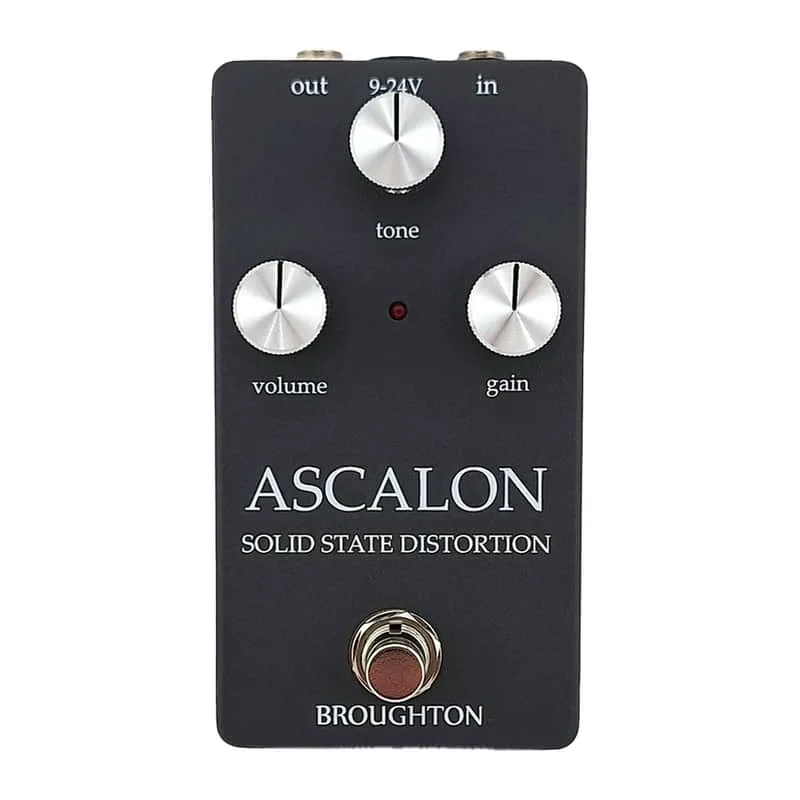
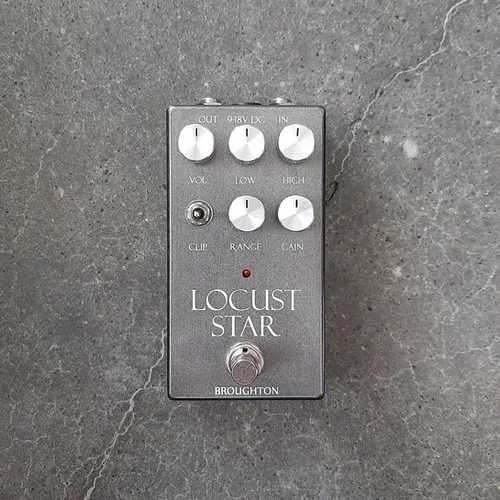
Broughton Audio also builds other drive-oriented pedals, including the Broughton Audio Sentinel, the Broughton Audio Ascalon and the Broughton Audio Locust Star. For the wider field, see Distortion Pedals, Overdrive Pedals and Bass Pedals.
Questions
Is the Broughton Audio Chimera good for bass?
Broughton Audio describes the Chimera's hex inverter gain stages as generating a thick harmonic distortion, and calls it an excellent drive pedal for bass players. The separate clean path, which runs from unity gain up to +24 dB, lets the low end of the bass sit under the distortion signal rather than being clipped along with it.
What does the Boost switch do on the Chimera?
The Boost switch maximizes the gain of the distortion by a factor of 10. With Boost engaged, the Drive knob no longer affects the gain, so the pedal sits at its maximum distortion setting regardless of where the Drive control is set.
Is the Chimera true bypass?
Yes. Broughton Audio states that the Chimera has a true bypass switch, so the pedal's circuit is removed from the signal path when it is off.
How much current does the Broughton Chimera draw?
The current draw is 10mA, according to Broughton Audio. The pedal needs a supply of at least 9V but no greater than 18V DC, with a boss style 2.1mm barrel connector in center negative polarity. The supply is not included with the pedal.
What is the Schumann Lion?
The Schumann Lion was a CMOS distortion pedal from the early 2000s that has been discontinued. Broughton Audio says the Chimera is based on it, using hex inverter gain stages to generate a thick harmonic distortion.
Sources (1)
- Chimera | Broughton Audio, Broughton Audio