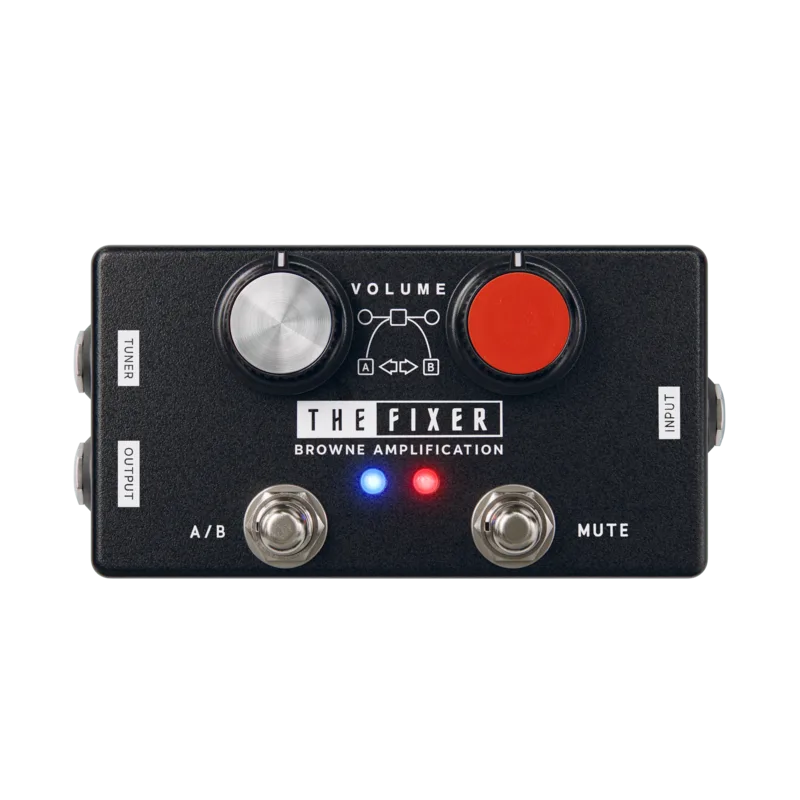


The Fixer is a dual boost and buffer pedal from Browne Amplification, designed to be added to the front of your pedalboard1. It is part buffer, part booster: the buffer is always on, working to fix impedance issues across the rig, while two identical clean boost circuits give you two preset volume levels you can flip between with a footswitch12.
The idea came from Dave, Browne's designer, who spent years on the road as a tech for touring guitarists and realized the need for a pedal that would solve the problems he kept seeing on real boards12. The Fixer was announced in September 2022 as a utility pedal aimed squarely at players who use more than one guitar2.
A double boost and buffer
The Fixer is built around a simple premise: a player with two guitars, say a single-coil instrument and a humbucker instrument, normally gets a volume jump when swapping between them because the two outputs differ. The Fixer has two identical boost circuits, each with its own level knob, so you can set a different boost volume for each instrument and switch between them instantly with the A/B footswitch, preventing those volume changes24.
The buffer is the other half of the job, and Browne treats it as a central piece of the circuit rather than an afterthought. The maker says it delivers more responsive, tighter lows and smoother highs while fixing the impedance issues a long cable run and a board full of pedals can create12. Guitar World's reviewer, Paul Riario, found that it does exactly that in practice:
"As a buffer, you can hear how much it adds restorative life and vigorous feel to your rig."3
Guitar.com's Richard Purvis tested the boost side with channel A set as an always-on buffer. At noon on the knob it sounds, in his words, "reassuringly absent", but a small twist to one o'clock produces an audible full-frequency gain boost4. He also found channel B works perfectly well as a straightforward solo booster in a one-guitar setup, so the two-channel concept is not only for players carrying two instruments4.
The pedal is designed to sit just ahead of your pedalboard in the signal chain, first in line from the guitar4.
The controls
The front panel is minimal: two knobs and two footswitches3.
| Control | What it does |
|---|---|
| A Volume | Sets the level of boost channel A3 |
| B Volume | Sets the level of boost channel B3 |
| A/B footswitch | Soft-switch that toggles between the two boosts, to add more punch or match outputs between guitars3 |
| Mute footswitch | Silences the output for silent tuning or guitar swaps32 |
Both boost circuits are identical, and unity gain sits at around the noon position on each knob14. Because the two channels are separate, you can set them at different levels and flip between them with the A/B footswitch rather than bending down to adjust a knob between songs4.
The Mute footswitch prevents unwanted noise while you are unplugging and plugging in guitars, and the always-on tuner output keeps your tuner live even when the main output is muted32. Guitar.com's reviewer had a blunt assessment of the tuner output: "There's not much to say about the tuner output except that it works"4.
The Fixer does not have a bypass switch. Browne states that it is always on1, and Guitar.com's review confirms there is no bypass option4. If you want a pedal you can switch completely out of your signal chain, this is not it: the always-on buffer is the point of the design.
Power and specifications
The Fixer requires standard 9V DC center-negative power and draws only 8 to 10mA, light enough for almost any power supply1. Guitar.com describes it as powered by a 9-volt mains supply only, so there is no battery option4. Its input impedance is over 1 megaohm, and its output impedance is under 10Kohm after the boosters, with the actual buffer output under 1Kohm and the tuner out under 1Kohm1. The box measures 2.64" x 4.8" x 2.25" including knob height1, which Guitar.com lists as 129 x 67 x 57mm4.
What reviewers said
Guitar.com called the Fixer "a handy little pedal to have around, thoroughly good at its job and a highly effective option at a great made-in-USA price"4. The reviewer felt the concept makes the most sense for anyone using two guitars with unequal output levels, and noted that the build feels just as well made as the other Browne pedals the publication had used4. Guitar World's Paul Riario likewise found it more than a garden-variety boost, praising its transparency and clarity as both a buffer and a volume boost3.
On price, the sources differ slightly: Browne's own page lists the Fixer at $179.00 USD as of October 20261, while Guitar World's review lists $/£149 and Guitar.com's 2023 review lists £149 for the UK34.
Videos
Browne Amplification
Browne Amplification
Browne Amplification
Questions
Does the Browne Amplification Fixer have a bypass switch?
No. Browne states plainly that the pedal does not have a bypass switch and is always on. That is deliberate: the buffer is meant to work constantly at the front of your board, and the two boost channels are switched between rather than switched off. Guitar.com's review confirms there is no bypass option.
How much current does the Browne Fixer draw?
Browne lists a power draw of 8 to 10mA, which is light enough to share a spot on most isolated power supplies. It runs on a standard 9V DC center-negative supply, and Guitar.com describes it as powered by a 9-volt mains supply only, so there is no battery option.
What does the mute switch do on the Fixer?
The Mute footswitch silences the output so you can tune silently or swap guitars without unwanted noise. The always-on tuner output keeps working while muted, so your tuner stays active. Guitar World describes it as useful for silent tuning or switching guitars mid-gig.
Where is the Browne Amplification Fixer made?
Both Guitar World and Guitar.com list its origin as the USA. Guitar.com's reviewer called it a highly effective option at a great made-in-USA price, and said it feels just as well made as the other Browne pedals the publication had used.
What is the Browne Amplification Fixer for?
It is a utility pedal that combines an always-on buffer with two identical clean boost circuits. The main use is running two guitars with different output levels: you set a boost volume for each and flip between them with the A/B footswitch. It also works as a solo boost in a one-guitar setup.
Does the Browne Fixer have a true bypass?
No. The Fixer has no bypass of any kind, true or otherwise. Browne says the pedal is always on, because the buffer is a central part of what it does: it is designed to fix impedance issues across your whole board, not to be switched out of the chain.
Sources (4)
- The Fixer, Browne Amplification
- New Pedal: Browne Amplification Fixer Double Boost+Buffer, Delicious Audio, 2022-09-23
- Browne Amplification The Fixer and The Carbon review, Guitar World, 2023-04-26
- Browne Amplification Fixer review: making switching guitars totally painless, Guitar.com, 2023-05-08