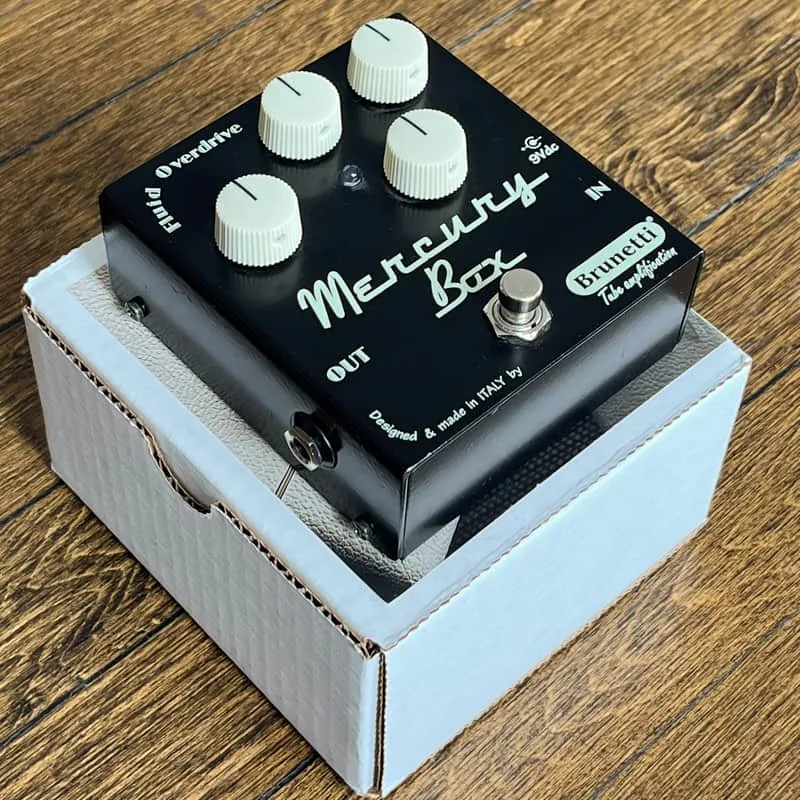


The Brunetti Mercury Box is an analog overdrive and distortion stompbox that puts the channel 2 voicing of the company's CustomWork Mercury amplifier into a small metal enclosure. RockBoard's PedalPedia describes its range as running from clear and defined crunch sounds to hard rock "liquid" distortion that stays clean and respectful of the instrument's timbre even at high gain1. For a player, it belongs with the amp-style designs on the overdrive and distortion pages rather than with pedals modeled on another maker's box.
Where the circuit comes from
Brunetti is explicit that the Mercury Box is not a copy of another pedal. The maker's product information says "a small metallic box holds together the qualities of the well-known CustomWork Mercury's channel 2," making it a channel-in-a-box take on the company's own amplifier1. The designer is credited as Marco Brunetti, with the pedal described as arising from his careful design and long lasting research1.
The circuit has a second life among DIY builders. The Guitar FX Layouts community has shared builds of the Mercury Box, and one contributor, Guilherme, described the pot values he settled on: 100k linear for the gain, 500k linear for the body and 100k logarithmic for the volume2.
"I've using it in my pedalboard as my main od/distortion pedal since then"
How it sounds and how it is controlled
Brunetti attributes the pedal's response to FET technology, which RockBoard's PedalPedia says is there to reproduce tube behavior and dynamics as accurately as possible1. The controls are described as soft and sensitive but effective, interacting thoroughly with each other as in a real tube amplifier1. In practice that means the gain, body and volume controls are meant to be voiced together rather than set independently, in the way an amp's channel controls interact.
Power and current draw
The Mercury Box runs on 9V DC with center negative polarity and draws 14mA1. That is a light load by pedalboard standards, well within what any standard isolated supply output handles.
The maker's information lists 9V DC center negative power with a 14mA draw1. No battery option is mentioned, so plan on a DC supply.
The DIY layout and builder notes
For players who build their own effects, the Guitar FX Layouts thread is the main place to find the circuit. The layout was posted on 29 April 2016, verified by Alltrax74, with Frank_NH later uploading another verified, slightly modded version in the forum section2. A follow-up confirmation on 6 May 2016 noted one correction: the volume and gain leads 1 and 3 needed swapping2.
Builders also settled a few component questions along the way:
- A 4k7 resistor from Body 2 and 3 to ground is the corrected value, replacing the 10k shown on earlier schematics2.
- One builder ended with 100k linear for gain, 500k linear for body, and 100k logarithmic for volume2.
- Biasing notes vary: one builder biased the drains at 8.2V and got 16.4V out from the TL071, another matched JFETs to .01 volts, and a later contributor recommended J201s reading VP .71 and IDSS .03 or .04 with the 22k drain resistor2.
Videos
GregsGuitars - Gregor Hilden
Sam Vilo
choicenation
Questions
Is the Brunetti Mercury Box analog?
Yes. The Mercury Box is an analog circuit, according to the maker's product information. It uses FET technology, which Brunetti says is there to reproduce the behavior and dynamics of tubes as accurately as possible. That places it among the analog overdrive and distortion pedals rather than digital modelers, and it runs on a standard 9V DC supply at a modest 14mA current draw.
Who designed the Brunetti Mercury Box?
The pedal is credited to Marco Brunetti. According to the maker's product information, the Mercury Box arises from his careful design and long lasting research, and it carries the qualities of channel 2 from Brunetti's CustomWork Mercury amplifier in a compact stompbox format.
What polarity does the Brunetti Mercury Box use?
The Mercury Box runs on 9V DC with center negative polarity, the same convention as most modern pedalboard power supplies. Its current draw is listed at 14mA, which is light enough for nearly any supply. There is no indication in the maker's information of battery operation, so plan on a DC power source.
Is the Mercury Box a clone of another pedal?
No. The maker describes it as a small metallic box that holds together the qualities of channel 2 of the well-known Brunetti CustomWork Mercury amplifier. Its circuit lineage runs back to that amp channel rather than to another manufacturer's stompbox, so it is best understood as an amp-channel-in-a-box design from Brunetti rather than a clone of a well-known pedal.
What pot values have builders used in the Mercury Box?
One builder on the Guitar FX Layouts forum reported finishing a stripboard build with 100k linear for the gain control, 500k linear for the body control, and 100k logarithmic for the volume. The same thread also corrected an earlier schematic value, settling on a 4k7 resistor from Body 2 and 3 to ground in place of the 10k shown earlier.
Sources (2)
- Mercury Box by Brunetti, RockBoard PedalPedia, 2026
- Guitar FX Layouts: Brunetti Mercury Box, Guitar FX Layouts (tagboardeffects.blogspot.com), 2016-05-01