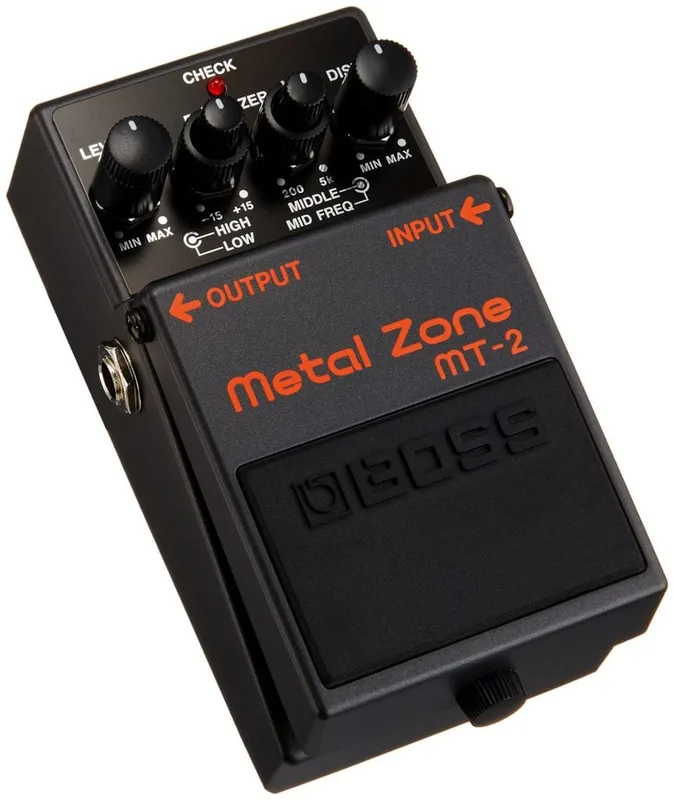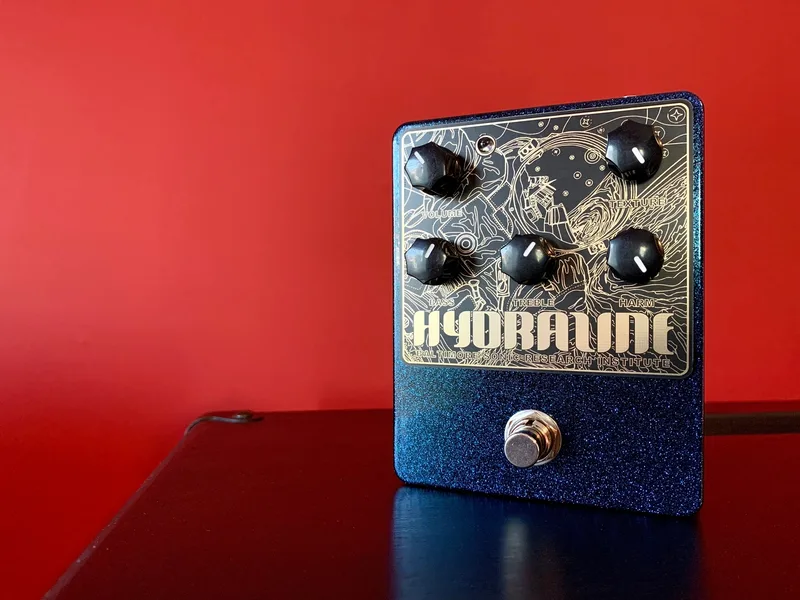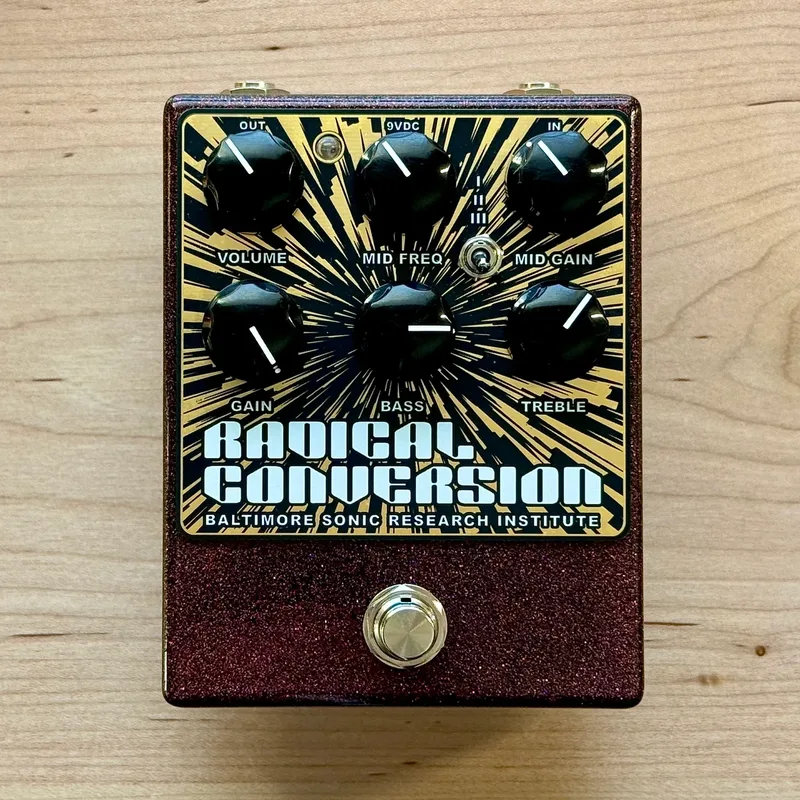
The BSRI Audio Radical Conversion is a distortion pedal that takes the circuit of the Boss MT-2 Metal Zone and rebuilds it without a single integrated chip. BSRI Audio describes it as "a completely discrete, 27-transistor alternate universe homage to the Metal Zone, including the semi-parametric active EQ circuit," using multiple discrete opamp architectures, including the classic Boss-design1. It sits in the maker's line alongside fuzz designs like the BSRI Audio Hydrazine Harmonic Percolator Fuzz, and belongs to the wider family of distortion pedals.
The controls and the preamp voicing toggle
The Radical Conversion keeps the Metal Zone's control layout in spirit: a semi-parametric active EQ circuit plus a preamp voicing toggle that shapes what reaches the gain stage1.
| Control | What it does |
|---|---|
| Preamp voicing toggle, I | The traditional MT-2 preamp voicing adds a cutting midrange boost before the primary gain stage |
| Preamp voicing toggle, II | Tight preamp boost for a razor sharp low end response in the gain stage |
| Preamp voicing toggle, III | Fat preamp boost feeds more low end into the gain stage for added compression |
| Treble | Shelving treble boost/cut |
| Bass | Peaking low end boost/cut |
| Volume | Sets the output volume of the pedal. Crank this one up |
| Activate | True bypass soft-click footswitch to turn the effect on and off |
The three voicing positions are the pedal's main departure from the original. Where the MT-2 fixes its pre-distortion tone shaping, the toggle lets a player choose between the stock midrange-forward voicing, a tighter low end, or a fatter, more compressed entry into the gain stage1.
From the Metal Zone circuit to a 27-transistor build
To see what the Radical Conversion is rebuilding, it helps to know how the original works. Tom at Electric Druid, in a detailed technical analysis of the MT-2, lays out the signal path as "the input buffer, the pre-distortion tone shaping circuit, the gain stage and clipping diodes, the post-distortion tone shaping, the High and Low tone controls, the sweepable Mid tone control, the output buffer"2. His measurements show how aggressive that pre-distortion shaping is: the stage he labels 3B measures a gain of 63x at peak, with a Q of 1.66, centered at 960 Hz2.
The Radical Conversion's approach is to take those stages and build each opamp from individual transistors rather than an IC. The maker's "Discrete Opamp Distortion" name refers to that construction: the opamp architectures are discrete, not chip-based1. For players, the practical differences are the three-way voicing toggle before the gain stage and the semi-parametric active EQ, both carried over from the Metal Zone concept but reworked in the discrete build1.
BSRI Audio specifies a regulated 9V DC negative tip power supply for the pedal. Use a supply of that polarity, as with most standard pedal power setups1.
Questions
Is the BSRI Audio Radical Conversion based on the Boss Metal Zone?
Yes. BSRI Audio describes the Radical Conversion as a completely discrete, 27-transistor alternate universe homage to the Metal Zone, including the semi-parametric active EQ circuit. Where the original Boss MT-2 uses integrated op-amp chips, the Radical Conversion builds the equivalent stages from individual transistors in multiple discrete opamp architectures, including what the maker calls the classic Boss-design.
What are the three voicings on the Radical Conversion?
The preamp voicing toggle has three positions. Position I is the traditional MT-2 preamp voicing, which adds a cutting midrange boost before the primary gain stage. Position II is a tight preamp boost for a razor sharp low end response in the gain stage. Position III is a fat preamp boost that feeds more low end into the gain stage for added compression.
Is the Radical Conversion true bypass?
Yes. The pedal's Activate footswitch is a true bypass soft-click switch that turns the effect on and off, according to BSRI Audio's product page.
What power supply does the Radical Conversion need?
BSRI Audio says to always use a high quality regulated 9V DC negative tip power supply with the pedal. That is the standard center-negative polarity used by most pedal power supplies and daisy chains.
Does the Radical Conversion use op-amp chips?
No. Despite the Discrete Opamp Distortion name, the pedal does not use integrated op-amp chips. BSRI Audio builds its opamp stages from discrete transistors, 27 of them in total, using multiple discrete opamp architectures including the classic Boss-design.
Sources (2)
- Radical Conversion, BSRI Audio
- Boss MT-2 Metal Zone pedal analysis, Electric Druid (electricdruid.net), 2016-01-22