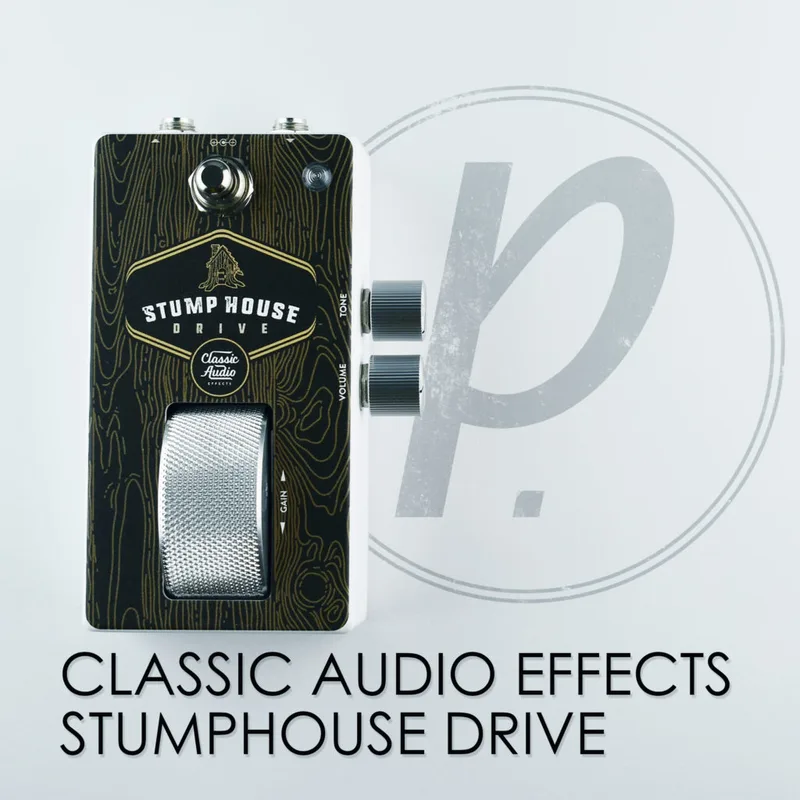

The Stumphouse Drive is a medium-gain overdrive from Classic Audio Effects, and its defining feature is a gain roller wheel set where the footswitch normally sits. Rolling it with your foot adjusts the amount of overdrive pushed into your signal while both hands stay on the guitar1. Delicious Audio's Paolo De Gregorio noted that nobody had done this in a regular stompbox enclosure before2.
The roller and the controls
The layout is deliberately unconventional. The gain roller wheel sits in the usual footswitch position, so rocking your foot back and forth changes the drive level in real time12. The Volume and Tone knobs are placed on the side of the pedal, keeping the top surface clear for the roller1. A conventional footswitch is still included, mounted on the top of the effect2.
| Control | Position | What it does |
|---|---|---|
| Gain roller wheel | Where the footswitch normally sits | Adjusts the amount of overdrive pushed into the signal, by foot12 |
| Volume | Side of the pedal | Output level1 |
| Tone | Side of the pedal | Tone shaping1 |
| Footswitch | Top of the effect | Conventional bypass switching2 |
The power requirement is tip negative at 9V1, which differs from the center negative standard most pedalboard supplies use. Check polarity before connecting this pedal to a shared supply.
Circuit and lineage
The pedal builds on the technology Classic Audio Effects started with its line of Volume Roller pedals1. Under the hood, it uses three cascading opamp stages and a symmetrical silicon clipping scheme2. The roller design is the thread running through the maker's range: Pedal of the Day has noted how the Stumphouse Drive and the Transponder Delay worked with that same innovation3.
What reviewers said
Pedal of the Day called it "a wonderfully warm and rich gain pedal"1. De Gregorio at Delicious Audio described the clipping scheme as yielding "the perfect mix of clarity and grit"2. Both reviews date from the pedal's release period in late 2016 and early 2017, when it was new12.
Videos
Eirik Stordrange
Pedal of the Day
Questions
Is the Stumphouse Drive true bypass?
Pedal of the Day's review lists the pedal as using Soft Touch Relay Bypass rather than a conventional mechanical true bypass switch. Relay bypass uses an electronic relay to switch the signal, which pairs naturally with the pedal's unusual layout, since the roller wheel occupies the spot where a footswitch would normally sit.
What power supply does the Stumphouse Drive need?
The pedal runs on 9V at 45 mA with tip negative polarity, according to Pedal of the Day. Tip negative is the opposite of the center negative standard used by most modern pedals, so players should make sure their supply matches before plugging in.
How does the Stumphouse Drive relate to the Classic Audio Effects Volume Roller?
Pedal of the Day describes the Stumphouse Drive as building on the technology Classic Audio Effects started with its line of Volume Roller pedals. The roller wheel concept carries over, but here it controls the amount of overdrive pushed into the signal rather than volume.
What kind of clipping does the Stumphouse Drive use?
Delicious Audio's Paolo De Gregorio reports that the circuit uses three cascading opamp stages and a symmetrical silicon clipping scheme, which he says yields the perfect mix of clarity and grit.
Sources (3)
- Classic Audio Effects Stumphouse Drive, Pedal of the Day, 2016-12-21
- New Pedals: Classic Audio Effects Stumphouse Drive, Delicious Audio, 2017-01-06
- Classic Audio Effects Yukon Reverb Roller, Pedal of the Day, 2017-05-22