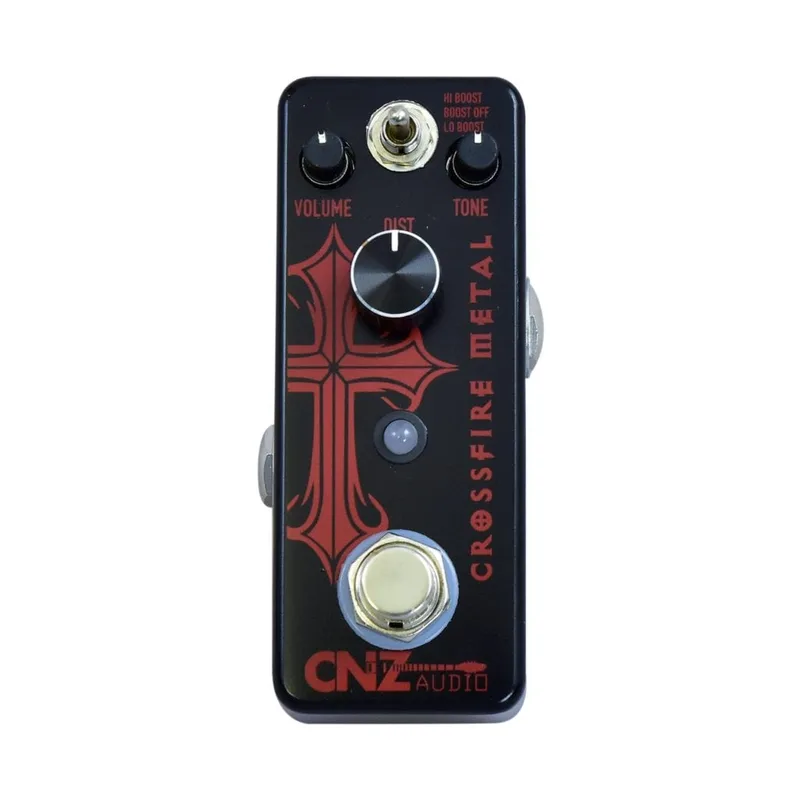


The CNZ Audio Crossfire Metal (SCM-20) is a compact distortion pedal from CNZ Audio, a maker that describes it as "created with Hard Rock and Metal Guitarists in Mind." CNZ says it provides super long sustain and distortion with a saturated and full tone, and the maker calls it "about as versatile as they come"1.
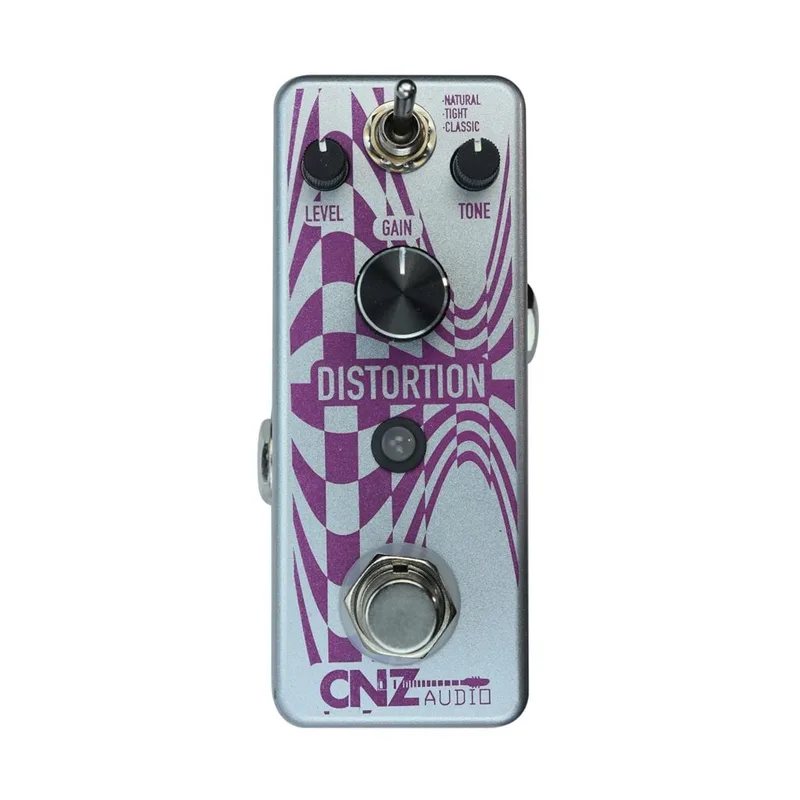
It sits alongside CNZ's other distortion, the GDS-20, which the maker positions as a classic low to mid range distortion covering a broad range of the distortion spectrum, from a slight rough edge to classic heavy metal2. The Crossfire Metal is the more focused of the two: CNZ says it follows a similar layout to the GDS-20, but swaps the gain knob for a distortion adjustment and makes the toggle an adjustable boost1.
The controls
The Crossfire Metal has three knobs and one toggle, laid out much like the GDS-201:
| Control | What it does |
|---|---|
| Volume | Controls the overall pedal volume |
| Distortion | Changes the overall saturation of the distortion effect |
| Tone | Adjustes the brightness and clarity of the signal |
| Toggle | Selects Hi-Boost, Boost-Off or Lo-Boost |
The Distortion knob is the main difference from the GDS-20's gain control: where the GDS-20 lets you dial from a slight edge into heavier territory, the Crossfire Metal's single saturation control is aimed squarely at high-gain metal sounds, with the toggle shaping the voicing rather than the gain structure12.
The boost toggle
The three-position toggle is where the pedal gets its range. CNZ Audio describes the three settings this way1:
- Hi-Boost: a bit less body and more treble
- Boost-Off: a more mid-range meaty tone
- Lo-Boost: a very full mid and deep tone
In practice the toggle works as a voicing switch: Hi-Boost for cutting through with brightness, Boost-Off for a straightforward mid-focused distortion, and Lo-Boost for a thicker, deeper foundation, useful for dropped tunings or rhythm parts that need weight1.
Power and connections
The pedal runs on a 9V DC input with a center negative plug, listed at 10 mA with a 25 mA working current1. That low draw makes it easy to run from most isolated power supplies or a daisy chain with room to spare. It has a single 1/4 inch input at 1M ohms impedance and a single 1/4 inch output at 470 ohms, and the housing is solid aluminum on all sides with a firm foot switch1.
The power spec is center negative, the standard for most modern pedal power supplies. A center positive supply will not work and can damage the pedal.
Videos
Aaron J Livecchi
Angry Tones Riff Clips
Rickord
Questions
Is the CNZ Audio Crossfire Metal true bypass?
Yes. CNZ Audio lists the Crossfire Metal (SCM-20) as true bypass, which the maker says provides a transparent tone when the pedal is switched off. That means it should not color your clean signal when disengaged, though long cable runs after several true bypass pedals can still benefit from a buffer elsewhere in the chain.
What do the Hi-Boost and Lo-Boost settings do?
The three-position toggle selects Hi-Boost, Boost-Off or Lo-Boost. CNZ Audio describes Hi-Boost as having a bit less body and more treble, Boost-Off as a more mid-range meaty tone, and Lo-Boost as a very full mid and deep tone. It effectively gives you three voicings of the same distortion setting.
How big is the CNZ Crossfire Metal?
The enclosure measures 3.75 inches long by 1.77 inches wide by 1.9 inches high, and it weighs .53 lbs including the box. That is a compact mini-pedal footprint, so it fits easily on a crowded pedalboard, and it shares the same dimensions as CNZ's GDS-20 distortion.