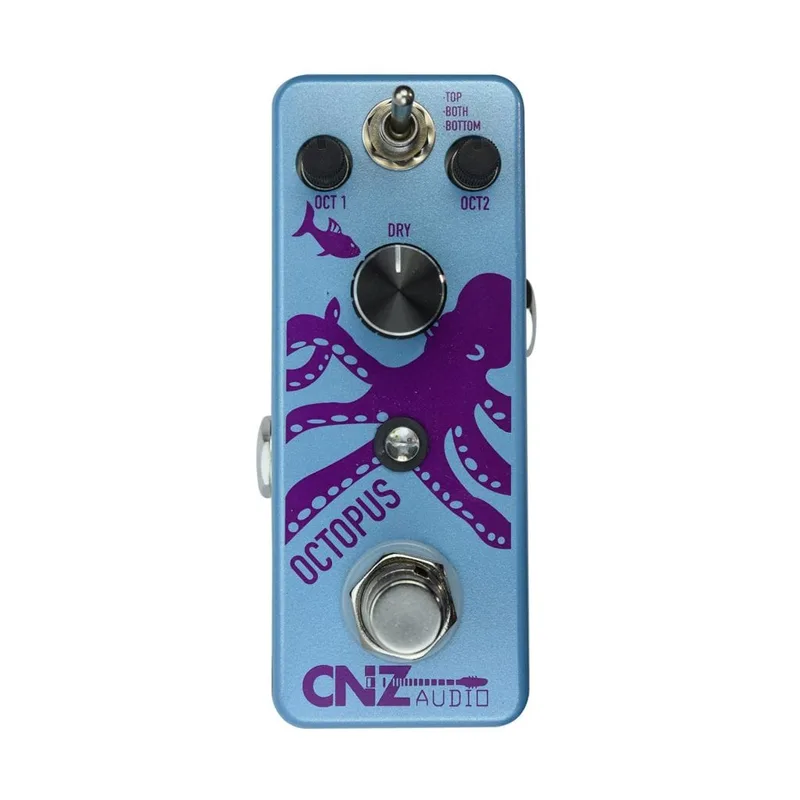


The CNZ Audio SOC-10 Octopus is a compact octave pedal that generates tones one or more octaves above and below what you play, blending them with your dry signal. Made by CNZ Audio, it carries the company's description of "Classic Octave Tones" in a small enclosure aimed at players with limited pedalboard space1. Pedal of the Day reviewed it in March 2020, calling it "Small and extremely pedalboard-friendly" and noting it "won't take up much room in your rig"2.
What sets the Octopus apart from most pedals at its price is a hidden preset function: you can store one favorite setting and recall it with a double tap of the footswitch. Pedal of the Day's reviewer found this "a welcome addition" that you "usually don't see... in pedals near this price point"2.
What the Octopus does
The pedal produces octave tones both above and below your original note. A three-position toggle selects Low, High or Both octaves1. According to CNZ Audio, the top position chooses a very high octave, the bottom a very low octave, and Both combines the two1.
There is more range here than the three positions suggest. CNZ Audio says the top and bottom switch positions each encompass two octaves, so in the Both position the pedal actually produces four octaves at once, provided both the Oct1 and Oct2 knobs are turned up1. Pedal of the Day described the pedal as offering "Upper and Lower octave modes, each with their own volume control," with a BOTH mode that blends the high and low octave circuits together2.
The finish is metallic blue with a purple octopus and sea setting artwork, in a solid aluminum housing on all sides1.
The controls
The Octopus keeps its control set simple: two knobs for the octave voices, one for your dry signal, and the mode toggle1.
| Control | What it does |
|---|---|
| Oct1 knob | Controls the volume of the low octaves1 |
| Oct2 knob | Controls the volume of the high octaves1 |
| Dry knob | Adjusts the fullness of the octave effect1 |
| Toggle switch | Selects Low, High or Both octaves1 |
In Both mode, which uses all four octaves, Oct1 controls the lowest of the two octave pairs and Oct2 the highest1. That means you can balance the sub-octave rumble against the shrill upper voices independently, then set how much of your original guitar signal sits underneath them with the Dry knob.
The preset function
The Octopus can store one preset at a time. A green light on the pedal indicates that you can modify the sound; to save the current setting, hold down the stomp switch1. To recall the stored preset, tap the Bypass switch twice quickly, which brings up a red LED and your saved sound1.
Pedal of the Day highlighted this as the pedal's surprise feature:
"A nice addition is the hidden Preset feature, which lets you call up your favorite setting just by tapping the Bypass switch twice"
The reviewer noted that a feature like this is unusual in pedals near this price point, "and was therefore very welcome indeed"2.
Power and connections
The Octopus runs on a 9V DC input with center negative polarity and draws 10 mA1. It connects with standard 1/4 inch input and output jacks, with 470K ohms input impedance and 470 ohms output impedance1.
The power requirement is 9V DC with a center negative plug. As with any pedal specified this way, check your power supply's polarity before plugging in.
What reviewers said
Pedal of the Day reviewed the SOC-10 Octopus in March 2020, describing it as an octave guitar effects pedal with true bypass, upper and lower octave modes each with their own volume control, and a BOTH mode blending the two circuits2. The reviewer's overall take was positive on the pedal's size and its preset feature, treating the $60 price as the context for judging it: "it not the end of the world for a $60 pedal"2.
Videos
Pedal of the Day
Alan Brown
Questions
Is the CNZ Audio Octopus true bypass?
Yes. CNZ Audio lists the SOC-10 Octopus as true bypass, which the company says provides transparent tone when the pedal is switched off. Pedal of the Day's review also describes it as a true bypass pedal.
What does the Both position on the Octopus toggle do?
The toggle's Both position combines the high and low octave circuits. Because the top and bottom positions each cover two octaves, Both gives you four octaves at once, with the Oct1 knob controlling the lowest of the two pairs and Oct2 the highest.
How do you save a preset on the CNZ Octopus?
Hold down the stomp switch while the green light is on to save your current setting. Only one preset can be stored at a time. To recall it, tap the Bypass switch twice quickly, which lights a red LED and brings back the saved sound.
How much does the CNZ Octopus cost?
The list price is $60 USD, as given on CNZ Audio's product page and confirmed in Pedal of the Day's 2020 review, which called it a $60 pedal.
Sources (2)
- SOC-10 | Octopus Octave Pedal | CNZ Audio, CNZ Audio
- CNZ Audio SOC-10 Octopus Octave, Pedal of the Day (www.pedal-of-the-day.com), 2020-03-03