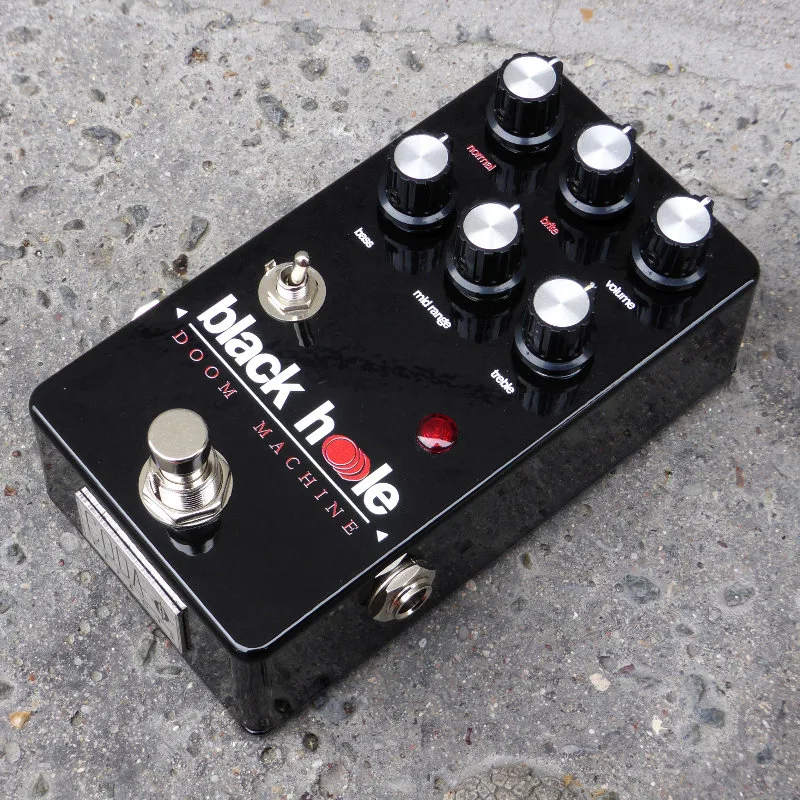


The Coda Effects Black Hole is a preamp pedal that puts the Sunn Model T preamp in a stompbox. Coda Effects describes it as "my version of the almighty Sunn Model T preamp," a JFET reproduction of the circuit that made the Model T amp a favorite of heavy players1. It is built for players who want that thick, amp-like front end on a pedalboard, and Coda Effects says it is optimized for guitar and bass1.
The pedal was first presented in December 2017, when the builder announced it with a waiting list and a PCB for self-building2. It is made by hand in Paris, France, with Wima and Panasonic capacitors, Fairchild semiconductors and Amphenol jacks1. The maker's page lists it at a price of 207 €1.
The Coda Effects Black Hole is priced at 207 € on the maker's product page1. A DIY PCB version is sold separately, though its page carries a notice that the product has moved to a new store3.
A Sunn Model T preamp in a pedal
The Sunn Model T is an amp with a following among doom and heavy players, and the Black Hole exists to put its preamp section on a board. Coda Effects' own technical write-up explains the goal: "The preamp is wired with both channels added for more gain"2. The result sits somewhere between a preamp, an overdrive and a distortion pedal, depending on how the channels are set.
The maker's description of what it can do is direct:
"Put a Rat before this and be ready to spit antimatter doom riffs!"
Coda Effects product page1
With the built-in boost engaged, the builder describes the sound as "super heavy, almost fuzzy drive that sounds actually quite like the Sleep Dopesmoker album"2. That puts it in the territory where fuzz and doom tones overlap, driven by the pedal's own gain staging rather than a fuzz circuit.
The controls
The Black Hole has seven controls on the PCB version3, centered on two channels and a shared EQ.
| Control | What it does |
|---|---|
| Normal channel gain | Sets the level of the Normal channel, a bassier voicing32 |
| Brite channel gain | Sets the level of the Bright channel, a different voicing and gain3 |
| Three-band EQ | Bass, mids and treble to sculpt the sound13 |
| Volume | Output level, with "plenty on tap"3 |
| Boost switch | Activates an LPB1 boost for more gain13 |
The two channels are the heart of the pedal. Each has a different voicing and gain, and they can be used one at a time or both at the same time3. Mixing them in parallel gives a heavier sound1. Turning a dial up makes that channel louder, and putting a pot at zero cuts the channel entirely2.
The boost switch is worth a note for players chasing heavy tones: it "activates a LPB1 boost to have more gain and go to doom territory"3. The LPB1 is a classic simple boost circuit, and here it pushes the preamp harder rather than acting as a standalone boost.
Inside the circuit: JFETs and a passive tonestack
The Black Hole is an all-JFET design, and Coda Effects has documented how it works in detail2.
The signal path runs through the two channel stages and into a gain stage:
- The Normal channel has a low pass filter (R7 and C4) that removes some treble for a bassier sound, and its biasing resistor was removed for more gain2.
- The Bright channel input has a 1M resistor that raises input impedance and avoids pop noises when the effect is switched on2.
- A 470pF capacitor in the bright channel removes a bit of treble; increasing its value gives more treble in that channel2.
- A trimpot biases the first JFET of the bright channel correctly, with a 220uF capacitor adding a bit of gain2.
After the channels, the two signals meet: "The JFET Q3 is smashed with the amplified signals of both channels, and start to saturate. It is this transistor which creates the gain of the pedal," followed by another transistor that re-amplifies the signal before the tonestack2. This is where the drive character comes from, and it is why running both channels together gives a heavier result.
The EQ is a classic passive tonestack: "basically three low pass RC filters that will cut bass, mids and trebles respectively," the same style made popular by Marshall amps2. Passive tonestacks cut rather than boost, so the EQ section shapes the sound by trimming frequencies.
On components, the builder notes that genuine through-hole JFETs are difficult to find and most sold online are fakes, so the design uses Fairchild SMD J201 JFETs, though through-hole transistors are also possible2. The PCB version can be ordered presoldered with genuine Fairchild Semiconductors J201 SMD JFETs, which Coda Effects describes as best in class3.
The DIY PCB version
Alongside the finished pedal, Coda Effects sells the Black Hole as a PCB for self-building3. The board is described as "the infamous Sunn Model T preamp in a box, with a boost to make it even louder and heavier"3.
What the PCB version offers:
- Seven controls, the same channel and EQ layout as the finished pedal3
- Spaced pads for easier soldering3
- A presoldered board option with genuine Fairchild J201 SMD JFETs3
- A detailed build document3
- Layout compatible with SMD JFETs or through-hole transistors2
The PCB product page carries a notice that the product has moved to a new store3, so builders looking for it should expect a redirect.
Videos
Benoit M
Korey FY!EP
Theo And His Pedals
Questions
Is the Coda Effects Black Hole true bypass?
Yes. Coda Effects fits an Alpha 3PDT switching footswitch, chosen for durability and reliability, so the pedal is true bypass and your clean signal passes untouched when it is off.
What power does the Black Hole need?
It runs on a standard 9V DC supply, center negative, drawing less than 50mA. That makes it compatible with typical pedalboard power supplies, and it is light enough to share an isolated output with other low-current pedals.
Can the Black Hole be used with bass?
Yes. Coda Effects says the pedal is optimized for guitar and bass. The Normal channel also has a low pass filter (R7 and C4) that removes some treble for a bassier sound, which suits bass players.
Where is the Coda Effects Black Hole made?
Each pedal is made in Paris, France, by Coda Effects, built with Wima and Panasonic capacitors, Fairchild semiconductors and Amphenol jacks. A DIY PCB version is also available for players who want to build it themselves.
Can both channels be used together?
Yes. The Normal and Brite channels each have their own gain control and can be used one at a time or mixed in parallel for a heavier sound. Turning a dial up makes that channel louder, and setting a pot to zero cuts the channel.
Is the Black Hole analog?
Yes. RockBoard's PedalPedia lists the Black Hole as an analog circuit, and the design is a JFET reproduction of the Sunn Model T preamp with a passive tonestack, not a digital model.
Sources (4)
- Coda Effects, Coda Effects, 2026
- Coda Effects, Coda Effects, 2017-12
- Coda Effects, Coda Effects, 2026
- Black Hole by Coda Effects, RockBoard PedalPedia, 2026