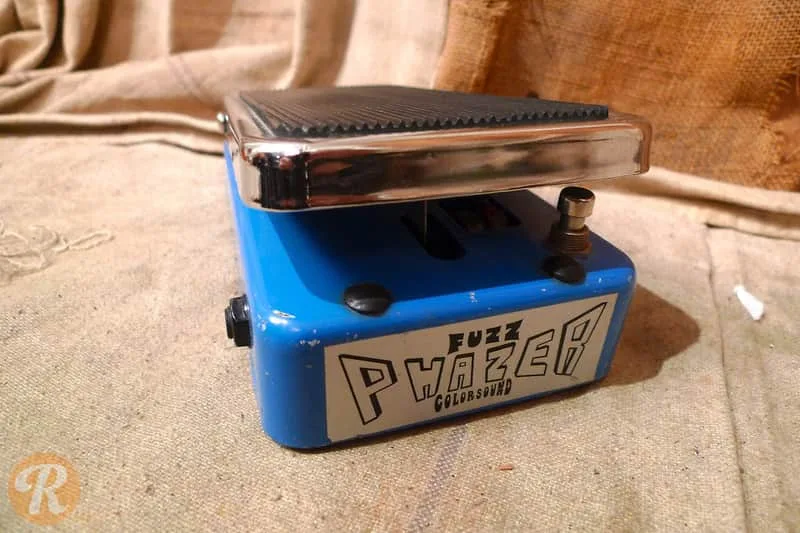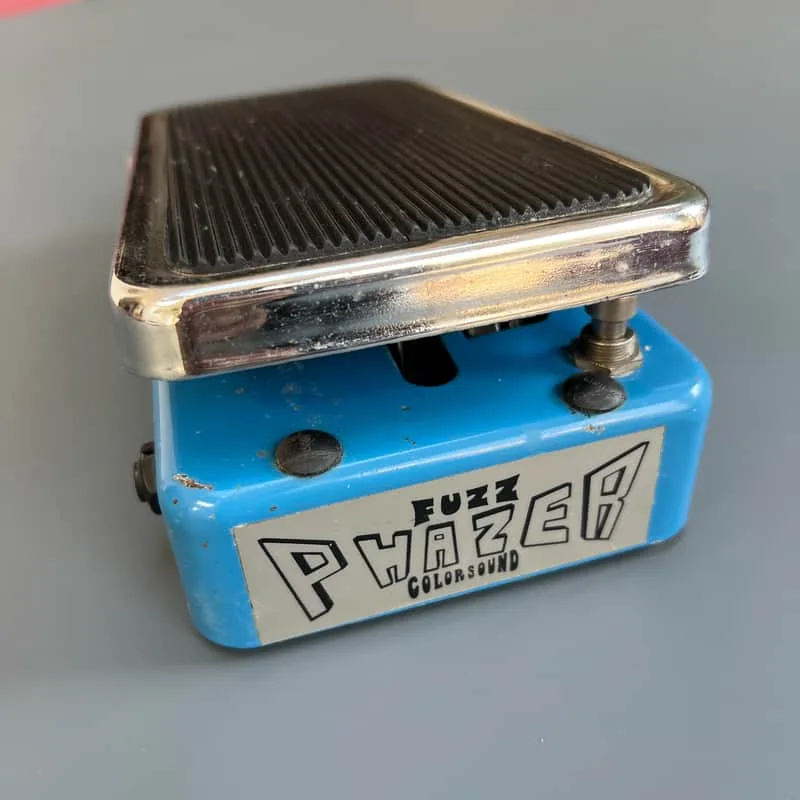

The Colorsound FuzzPhaze is a fuzz and phaser combination pedal made in England by Sola Sound in 1976. It puts two effects in one enclosure: a fuzz built from the three SI-transistor B&M Fuzz Unit circuit, and a phaser built from the Phase 4 circuit. TONEHOME calls it "a unique combination" of those two circuits1.
What it does
The pedal combines two effects in one box. The fuzz side comes from the B&M Fuzz Unit circuit, which uses three silicon (SI) transistors, and the phaser side comes from the Phase 4 circuit1. For a player, that means a single pedal covering both a fuzz voice and a phaser sweep, an arrangement that was unusual when it was built.
The FuzzPhaze and the Fuzz Phazer
The name invites confusion with the earlier Colorsound Fuzz Phazer, but the two are different pedals. The Fuzz Phazer was made in England by Sola Sound in 1973, three years before the FuzzPhaze2. TONEHOME's verdict on the relationship is blunt: "It's a completely different beast than the preceding Fuzz Phazer"1.
The Fuzz Phazer works differently too. A switch underneath its rocker turns the fuzz on and off, and its phase effect, according to TONEHOME, "sounds rather different to my other phase pedals. It appears more like a wah/swell effect"2. TONEHOME sums it up as "not a very versatile pedal, but definitely somewhat more than a sole Fuzz effect"2. The 1976 FuzzPhaze, by contrast, is built from a distinct fuzz circuit and a distinct phaser circuit rather than a rocker-controlled hybrid.
TONEHOME notes that you don't see the FuzzPhaze very often. It is a rare pedal, and examples seldom come up for sale1.
Videos
melodicchaotic
Jem Soar
Questions
What is the Colorsound FuzzPhaze?
It is a combination pedal made in England by Sola Sound in 1976, built from the three SI-transistor B&M Fuzz Unit circuit joined to the Phase 4 circuit. In one enclosure it delivers both a fuzz effect and a phaser, which was an unusual pairing for its time.
How is the FuzzPhaze different from the Fuzz Phazer?
The FuzzPhaze of 1976 is a completely different design from the earlier Fuzz Phazer of 1973, despite the similar names. The Fuzz Phazer's phase effect sounds more like a wah or swell effect, and TONEHOME describes the FuzzPhaze as a different beast altogether.