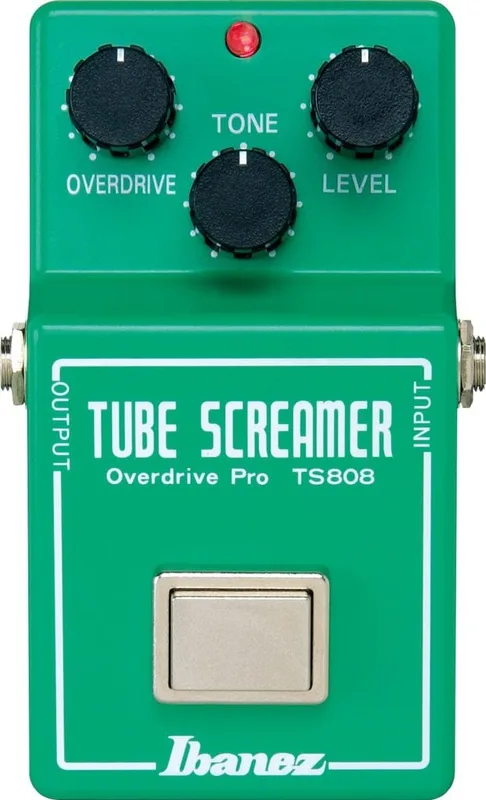



The Cusack Screamer is an overdrive pedal from Cusack Music, built around the classic Ibanez Tube Screamer circuit but voiced to stand apart from it. Cusack Music describes it as a "clean" overdrive with about twice the gain of a typical Tube Screamer, and the design story is straightforward: Jon Cusack, who founded the company to take what Delicious Audio calls "a true engineer's approach to guitar pedal design," started with a Tube Screamer circuit to see if he could improve it12.
Guitar World's review put the result in player terms: compared with a stock Tube Screamer it sounds "rounder, fuller, and darker," feels more responsive and less compressed, and carries roughly double the gain3. The current version is the Screamer V3, released 20 years after the V1, at a list price of $1851.
A Tube Screamer with about twice the gain
The Screamer is openly a Tube Screamer derivative. Guitar World called the original "admittedly a Tube Screamer copy," and Cusack Music's own pages frame it the same way, as their take on a classic overdrive with about twice the gain of a typical TS-style pedal34. What separates it from the crowd of TS copies is the set of changes Cusack made to the circuit: lower noise, increased clarity, more gain, and a clipping selector, as the maker's own description of the enhancements puts it5.
Josh Scott of JHS Pedals, who says he has known designer John Cusack for a while, went further in a piece on underrated overdrives6:
"Yes, there's a secret as to why it has better note clarity and lower non-harmonic distortion than any other Tube Screamer [copy]"6
Josh Scott, JHS Pedals6
For a player, that combination means the Screamer covers the same midrange-forward pushing duties as a Tube Screamer but with more available drive and, in the view of both the maker and the press, more note separation when the gain is up. Delicious Audio's writeup of the V3 said this is where the Screamer "offers much more clarity than a typical overdrive," and noted that it stands out in a crowded field of TS-inspired pedals2.
The controls and clipping toggle
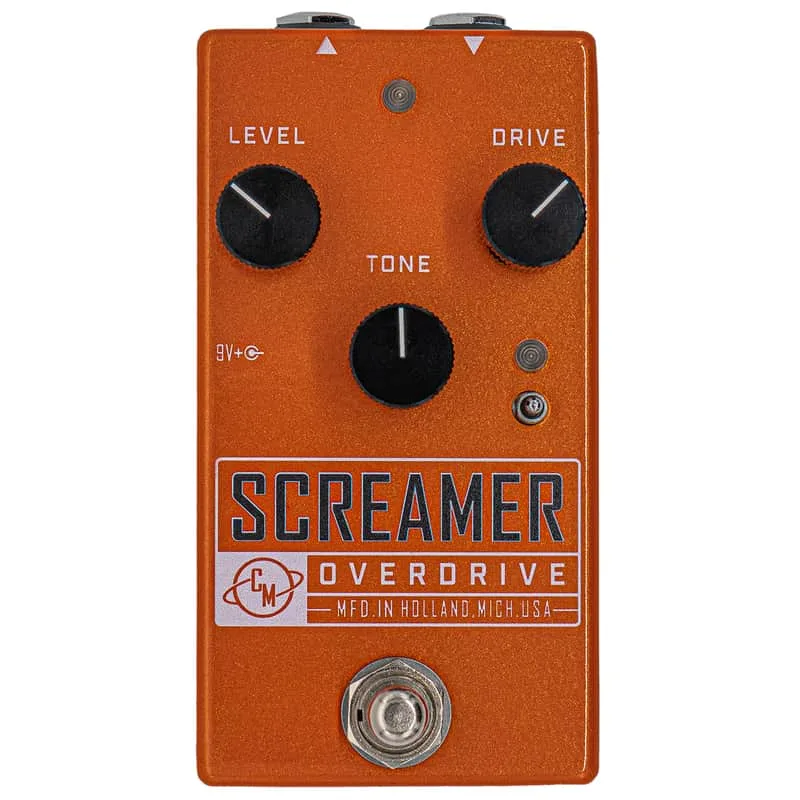
The control layout is the familiar three-knob arrangement plus one extra switch. The V3's knobs, as described by Delicious Audio from the maker's documentation2:
| Control | What it does |
|---|---|
| Drive | Adjusts the amount of gain and overdrive |
| Tone | Controls the tonal balance; left is bassier, right is brighter |
| Level | Sets the output level |
| Clip toggle | Selects the clipping diodes: silicon, LED, or Schottky |
The toggle is the pedal's signature feature. On the V3, the left position is classic silicon diodes, the middle is an LED for a louder, punchier, brighter overdrive (the LED also lights up while you play), and the right is Schottky diodes for what the maker describes as a crushed, compressed tone1. The V2 used the same three positions: silicon on the left, asymmetrical LED in the center, Schottky on the right4.
Premier Guitar's review of the V2 found the three clipping voices genuinely useful, writing that the toggle "selects between standard, 'crushed,' and asymmetrical LED clipping" and "adds a welcome wrinkle" to the pedal's tonal range, with standard mode yielding a bristling, harmonically rich and very versatile distortion and asymmetrical mode a smoother character7. The same review was less fond of the V2's extras, calling the "clip-o-meter" distracting and the dual-color status LED confusing7.
Power: 9V DC, safe at 18V
The Screamer V3 runs on a standard center negative 9V DC power supply or a 9V battery, neither of which is included1. The maker's documentation adds that the pedal is safe to run at 18V DC5. Current draw is light: about 6mA on the V3 and about 9mA on the discontinued V214, so it shares comfortably on a multi-pedal supply.
On battery power, the pedal protects itself as the battery fades. Guitar World's review found that at approximately 6.5V the pedal goes into bypass until you change the battery3.
The true-bypass switching is worth a note of its own. Rather than a mechanical footswitch in the audio path, the Screamer uses a telecommunications relay to do the bypassing, which Guitar World described as small, sturdy and mechanically silent3.
History and versions
The timeline is short and unusual by pedal standards:
- Screamer V1 (early 2000s): Jon Cusack built the original with ceramic capacitors, grounding the design, as Delicious Audio put it, "in the reality of physics and electrical principles"2.
- Screamer V2: The second version carried the same core circuit with the three-way clip toggle; it is now discontinued4. Premier Guitar reviewed it at a street price of $1857.
- Screamer V3 (2023): Released 20 years after the V1, the V3 swaps the ceramic capacitors for metal film capacitors, gets new knobs and an orange candy sparkle metallic finish, and lists at $18512.
The V3's reason for existing is a demonstration. Cusack Music released it with metal film capacitors "only to prove a point," that it sounds exactly the same as the ceramic-built original1. Delicious Audio's take on the change: metal film capacitors are less microphonic and their performance is impacted less by temperature changes, but the sound is unchanged2.
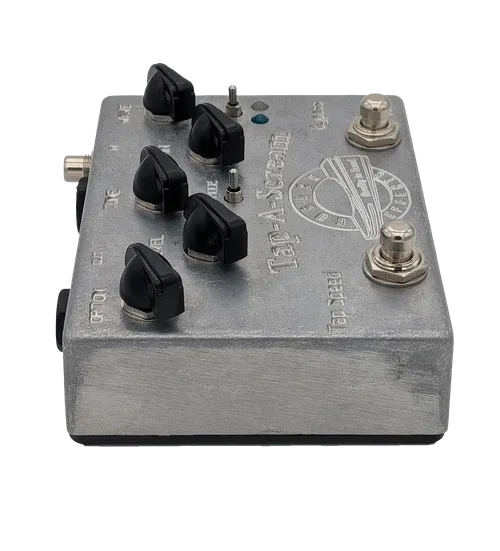
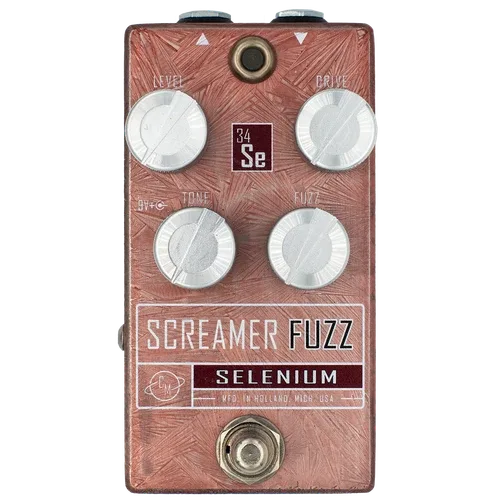
The Screamer also spun off a family of related pedals. The Cusack Screamer Bass is a Tube Screamer-inspired overdrive for bass, drawing about 8mA, with the same three-way clipping toggle8. The Cusack Tap-A-Scream adds tap tempo to the Screamer concept, and the maker has called the Screamer one of the most renowned TS-inspired pedals on the planet9. A separate line, the Screamer Fuzz, pairs the Screamer's overdrive with a fuzz circuit, including the limited Screamer Fuzz Selenium, built around vintage selenium rectifiers that Jon Cusack sourced while working on a repair for a vintage amplifier10.
What reviewers said
Published reviews across the pedal's life have been consistent about its character:
- Guitar World (2008) found it rounder, fuller and darker than a Tube Screamer, more responsive and less compressed, with about twice the gain. The review noted the overdrives "don't clean up all the way when you back off your guitar volume, but they sure sound great when you turn it up"3.
- Premier Guitar praised the V2's "intriguingly flexible tone possibilities" while flagging the distracting clip-o-meter and confusing dual-color status LED7.
- Delicious Audio (2023) highlighted the V3's clarity compared with a typical overdrive2.
- JHS Pedals' Josh Scott credited it with better note clarity and lower non-harmonic distortion than any other Tube Screamer copy6.
Who uses it
Cusack Music's V3 page carries an endorsement from Samurai Guitarist, who says he has been playing a Cusack Screamer for 9 years1.
Videos
Cusack Music
ThomasSchuber
intheblues
News
Questions
What is the difference between the Cusack Screamer V2 and V3?
The V3 came out 20 years after the V1 and replaces the ceramic capacitors of the original with metal film capacitors, which are less microphonic and less affected by temperature. Cusack Music says it sounds exactly the same. The V3 also gets new knobs and an orange candy sparkle metallic finish, while the V2 is discontinued.
Can the Cusack Screamer run on a 9V battery?
Yes. Both the V2 and V3 accept a 9V battery, though one is not included with the pedal. Guitar World's review noted that when the battery drops to approximately 6.5V the pedal goes into bypass until you change it, so a fresh battery matters for consistent operation.
Is the Cusack Screamer true bypass?
Yes. Guitar World's review describes a small, sturdy, mechanically silent true-bypass switch that bypasses the effect using a telecommunications relay. The relay approach means the footswitch itself makes no mechanical click in the audio path.
What does the Cusack Screamer Selenium edition change?
The Selenium edition is actually a variant of the Cusack Screamer Fuzz, not the Screamer overdrive. Cusack Music owner Jon Cusack sourced vintage selenium rectifiers while working on a repair for a vintage amplifier, and the pedal was built around those parts.
How much current does the Cusack Screamer draw?
The V3 draws about 6mA, while the discontinued V2 drew about 9mA. Either way it is a light load that shares comfortably with other pedals on a typical 9V DC power supply.
Sources (10)
- Screamer V3 Tube Style Overdrive Pedal, Cusack Music
- Updated Pedal: Cusack Screamer V3 Overdrive, Delicious Audio, 2023-01-25
- Cusack Screamer & Screamer Fuzz, Guitar World, 2008-03-27
- Screamer V2 Tube Style Overdrive Pedal, Cusack Music
- Screamer v3 single, Cusack Music, 2022
- UNDERRATED OVERDRIVES, JHS Pedals
- Quick Hit: Cusack Screamer V2 Review, Premier Guitar, 2016-11-29
- Screamer Bass Overdrive Pedal for Bass Guitar, Cusack Music
- Tap-a-Scream Tap Tempo Overdrive, Cusack Music
- Screamer Fuzz Selenium, Limited Run of 20, Cusack Music (cusackmusic.com)