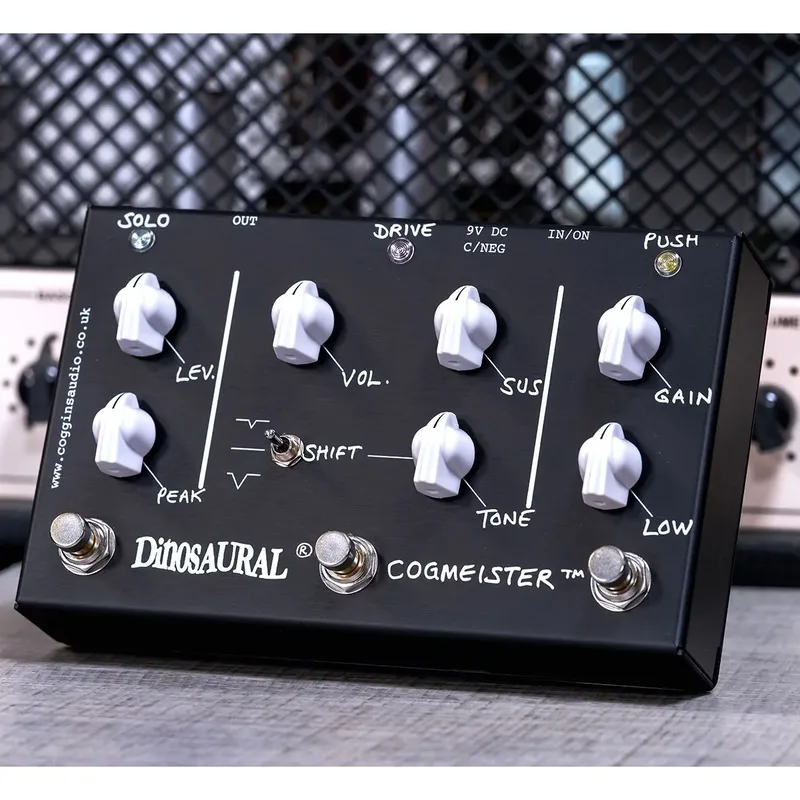


The Dinosaural Cogmeister is a single analog guitar pedal that combines a boost, an overdrive and a second boost in one enclosure. Dinosaural describes it as a "single guitar booster/overdrive/distortion/fuzz pedal," built from three compatible gain sections arranged in a fixed series pattern: Push, Drive and Solo, named from left to right across the front panel1. Each section has its own true/hard-wire bypass footswitch and LED, so you can run any one, any two, or all three at once1.
The idea is gain staging. GuitarPlayer's reviewer described it as "three independent yet highly chainable and gain-stageable boost and overdrive circuits," letting you stack the sections to move from a clean push to a full drive sound without swapping pedals2. Delicious Audio called it the flagship drive pedal designed by Dan Coggins, the engineer best known for the now rare and sought-after Lovetone pedals3.
Three gain sections in one pedal: Push, Drive and Solo
The three sections do different jobs, and the order matters because they are wired in a fixed series1.
- Push is an input treble booster. Guitar World's Trevor Curwen described it as "a late-60s-style single silicon transistor treble booster that basically excites the upper midrange" and is designed to push anything after it5.
- Drive is the heart of the pedal, a transistor-based overdrive circuit that is actually a refined version of the Dinosaural Tube Bender5.
- Solo is an output midrange booster3. It is a two-knob section using Zener diode clipping, and it sits last in the signal chain5.
Because the sections are independent, you can leave Drive off and use Push and Solo as a clean boost pair, or run all three for the full stacked sound. Delicious Audio noted that the three circuits "were tweaked to perfectly integrate each other," providing three gain stages that can be mixed and matched to deliver a variety of tones, dynamics and levels3.
Guitar World's review was positive about the concept: "The Cogmeister is an excellent pedal. While there are plenty of dual-drive pedals around, to put three gain sections in one pedal is inspired," with the reviewer finding the sections slot together brilliantly5. GuitarPlayer's Dave Hunter went further on the sound: "It's simply one of the most seamless, natural and organic-sounding solid-state overdrive pedals I've ever played"2.
The controls and footswitches
Each section has its own control set, and each has its own true-bypass footswitch with an indicator LED12.
| Section | Controls | What they do |
|---|---|---|
| Push | Gain, Low | Gain turns up the level of the treble boost; Low shapes the bottom end52 |
| Drive | Sustain, Tone, Volume, Shift switch | Sustain sets the drive amount; Shift is a three-way EQ switch2 |
| Solo | Level, Peak | Level sets the output; Peak shapes the midrange boost2 |
The Drive section's three-way Shift switch selects between a slight mid scoop, a bigger lower-mid scoop, or flat mids2. Guitar World characterized the three positions by feel: a flat setting with a full midrange reminiscent of a 1960s-vintage Marshall, a midrange scoop with a distinct Fender amp flavor, and a smaller scoop that sits between the two5.
One practical note from GuitarPlayer: "The foot switches on the Push and Solo channels might be a little close to the knobs for some big-toed players"2. Worth knowing if you stomp with the front of your foot.
Power: 9V DC, 16mA
The Cogmeister runs on a standard 9-Volts DC (12-Volts max) center-negative dc barrel external connection, or on a regular internal 9-Volt battery1. Current draw is 16mA1, low enough that a battery is a realistic option and any isolated supply will run it without strain. ThorpyFX's product page for the pedal lists the same power spec: 9-Volts DC (12-Volts max), center-negative dc barrel external connection1.
The maker specifies a 12-Volts maximum on the external DC connection, so the Cogmeister should not be run above that. Stick to a standard 9V DC center-negative supply, or the internal 9-Volt battery.
From the Tube Bender to the Cogmeister
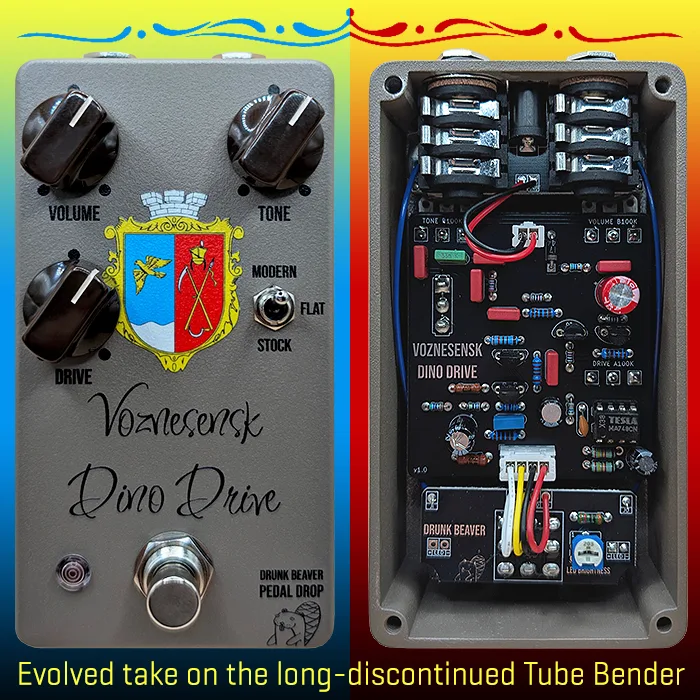
The Tube Bender was a silicon transistor overdrive designed by Dan Coggins of Dinosaural, who was formerly of Lovetone6. The circuit was similar in character to a silicon Tone Bender, and grew out of a design Coggins did for Guitar and Bass Magazine7. The original pedal had a two-way switch8.
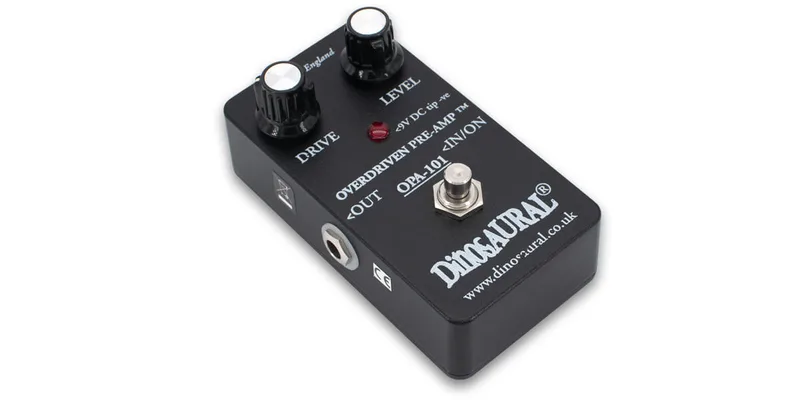
The Tube Bender later turned into the OPA-1018. The OPA-101 Overdriven Preamp was developed as an updated version of the Tube Bender: an op-amp input gain stage and output buffer replaced the Tube Bender's discrete stages, while the middle two-transistor clipping stage was kept the same9.
The Cogmeister carries the lineage forward as an analog pedal1. Its Push section is a late-60s-style single silicon transistor treble booster that excites the upper midrange and is designed to push anything after it in the signal chain, while the two-knob Solo section, using Zener diode clipping, is last in the chain5.
The Tube Bender's circuit has continued to evolve since: the old Tube Bender's two-way switch was superseded along the way as the design turned into the OPA-1018.
Videos
AndyDemos
AndyDemos
Sasha Ivantic
Questions
Can the Dinosaural Cogmeister run on a battery?
Yes. The pedal runs on a regular internal 9-volt battery, or on an external supply through a center-negative DC barrel jack at 9 volts DC, with a 12-volt maximum. Current draw is 16mA, so a standard 9V battery lasts a long time and most isolated pedalboard supplies can run it easily.
Is the Dinosaural Cogmeister true bypass?
Yes. Each of the three sections, Push, Drive and Solo, has its own true/hard-wire bypass footswitch with a corresponding LED, so any section can be switched in or out independently while the others stay active in the fixed series signal path.
Who designed the Dinosaural Cogmeister?
Dan Coggins, the engineer best known for the sought-after Lovetone pedals of the 1990s and later for Dinosaural's Tube Bender and OPA-101. He describes the Cogmeister as his gain masterpiece, and it is manufactured in the UK in collaboration with ThorpyFX Ltd.
How much does the Dinosaural Cogmeister cost?
Guitar.com listed the Cogmeister at £359.99/$399 in August 2026. It is built in the UK by Dan Coggins' Coggins Audio in collaboration with ThorpyFX, which is reflected in the price compared with mass-produced overdrives.
Sources (9)
- Cogmeister by Dinosaural, RockBoard PedalPedia, 2026
- “One of the most seamless, natural and organic-sounding solid-state pedals we've ever played”: Crank it up to 11 with Dinosaural's award-winning three-channel Cogmeister Overdrive, GuitarPlayer (www.guitarplayer.com), 2023-11-18
- Cogmeister Dinosaural Drive + Double Boost, Delicious Audio, 2024-04-05
- T-Rex TwinBlaze review, Guitar.com, 2026-08-28
- Dinosaural Cogmeister review, Guitar World, 2023-12-19
- Cog in the Box, JedsPeds (jedspeds.co.uk)
- Tracing Journal: Dinosaural OTC-201 Opticompressor, Aion FX, 2019-08-03
- Dinosaural Hypoid Drive review, guitar.com, 2025-10-29
- Ixora Amp Overdrive / Dinosaural OPA-101, Aion FX, 2020-11-16