

What it is and what it does to your sound
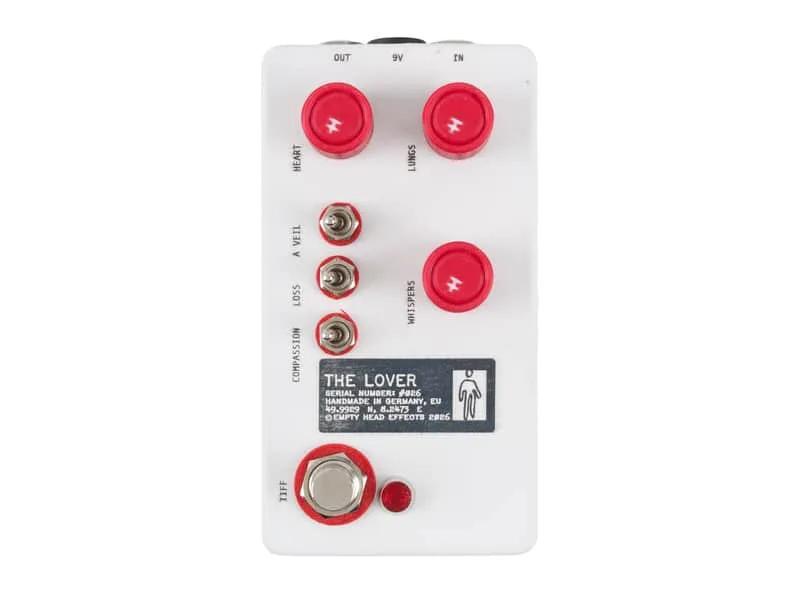
The Lover sits in the overlap between drive and fuzz. Delicious Audio describes it as a two-stage transistor true-bypass drive pedal2, while Guitar Pedal X characterizes its output as "mostly a fuzzy-drive in its output profile - with a sort of proto fuzz sound at its peak"3. In practice that means low gain settings give you a textured, still-transparent drive, and pushing the gain moves the pedal toward a saturated, proto-fuzz character rather than a smooth overdrive.
The two-stage design is the heart of it. Each stage is a single transistor: one 2N4124 and one 2N2222A, with four silicon diodes handling the clipping3. That topology is closer to the old transistor fuzzes than to a modern diode-clipped overdrive, and it is why the pedal responds so strongly to the guitar's volume knob. As Karlsson put it, "this 2-Transistor format cleans up amazingly well courtesy of your guitar volume control"3. Roll the guitar back and the fuzz recedes into drive; open it up and the saturation returns.
The controls: Heart, output, and the Compassion switch
The circuit gives you three rotary controls and three toggle switches, plus internal trimmers for deeper tweaking1.
| Control | What it does |
|---|---|
| Heart | Gain, the drive/output gain control32 |
| Variable diode clipping | Sets the character of the clipping1 |
| Output level | Overall output volume1 |
| Compassion switch | Bias, setting the overall gain; Guitar Pedal X describes it as the input gain control32 |
| Low-pass filter toggle | Rolls off top end1 |
| High-pass filter toggle | Thins the low end1 |
The Compassion switch is the personality control. Karlsson found it "sounds sharper and more clipped when to the left, and more open and searing to the right"3. Left gives a tighter, more clipped attack; right opens the bias up for a more searing, fuzz-forward voice.
Both filter toggles have internal trim pots behind them, so you can set where each filter actually sits rather than living with a fixed frequency1. Guitar Pedal X measured the ranges:
- Low-pass filter (A Veil): 24kHz on the left down to 1.4kHz on the right, with the default set mid-way around 11.3kHz3
- High-pass filter (Loss): 23kHz on the left down to 120Hz on the right, with the default at the least cut, 23kHz3
That is a wide sweep on the high-pass side, from essentially full-range at 23kHz down to a genuinely thin 120Hz, which makes the trimmers a real voicing tool for matching the pedal to a bright single-coil or a dark humbucker rig3.
From the landscape V1 to the portrait V2
The Lover began in what Guitar Pedal X calls a Zvex-style landscape format, a horizontal enclosure, at a time when nearly every other builder positioned pedals vertically in portrait mode3. The V2, released on 28 April 2026, keeps the core circuitry and values unchanged and moves to a portrait enclosure with the jacks relocated to the top edge, a change Karlsson had himself suggested for a more elegant control layout3. The V2 is priced at €195 on the Empty Head Effects webstore3.
The €195 price is the maker's webstore price in euros as reported by Guitar Pedal X in April 2026. No US dollar list price is on record.
If you already know a V1 unit, the sound is the same design; the V2 is a rehousing and refinement, not a circuit revision3.
Power and bypass
The Lover runs on 9V DC, center negative, and draws 100mA1. It uses true-bypass switching, so the pedal is fully out of the signal path when disengaged1.
At 100mA, The Lover draws more current than many small transistor fuzzes. Check that your isolated power supply can deliver 100mA on the output you plan to use.
What reviewers said
Guitar Pedal X's review of the V2, published 28 April 2026, is the fullest published assessment. Karlsson's verdict:
"it's a really distinct and interesting sounding Drive / Fuzz with plenty of shaping options. It sounds fantastic really"
The V2's coverage also detailed its internal trimmers, with the LPF adjustable from 24kHz on the left down to 1.4kHz on the right, and the HPF from 23kHz down to 120Hz, set by default mid-way for the LPF (A Veil) around 11.3kHz and at the least cut for the HPF (Loss)3. The same review noted the Compassion switch (Input Gain) sounds sharper and more clipped to the left and more open and searing to the right, and reported the Lover V2 2-Stage Transistor Drive at €195 on the Empty Head Effects Webstore3.
Videos
Empty Head Effects
Empty Head Effects
collector//emitter
News
Questions
What transistors are in The Lover?
The two gain stages are built on one 2N4124 and one 2N2222A silicon transistor, with four silicon diodes in the clipping circuit. It is an all-silicon, analog transistor design, not an op-amp or digital drive.
Does The Lover clean up with the guitar volume?
Yes. Guitar Pedal X's reviewer found that the two-transistor format cleans up amazingly well using the guitar's volume control, so you can pull back from fuzz into lighter drive without touching the pedal.
Is The Lover true bypass?
Yes. The maker states the pedal operates with true-bypass switching, so it is out of the signal path entirely when disengaged.
How much current does The Lover draw?
The Lover draws 100mA from a 9V DC center-negative supply. That is a real draw for a drive pedal, so plan a power supply output that can deliver it rather than a small battery-style source.
Sources (3)
- The Lover by Empty Head Effects, RockBoard PedalPedia, 2026
- New Pedal: Empty Head Effects The Lover Overdrive, Delicious Audio, 2024-09-25
- Guitar Pedal X, Guitar Pedal X, 2026-04-28