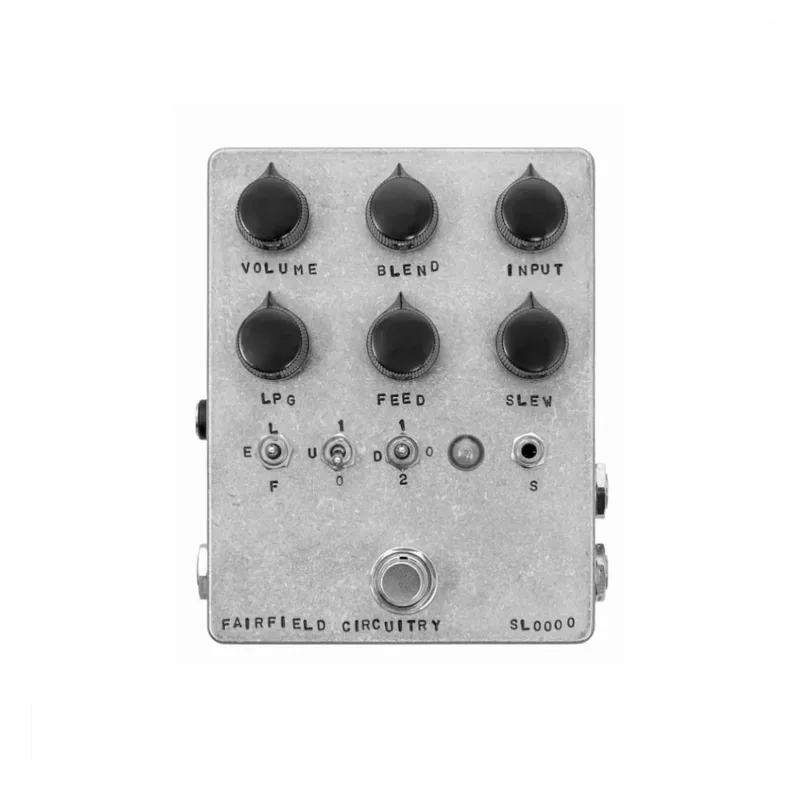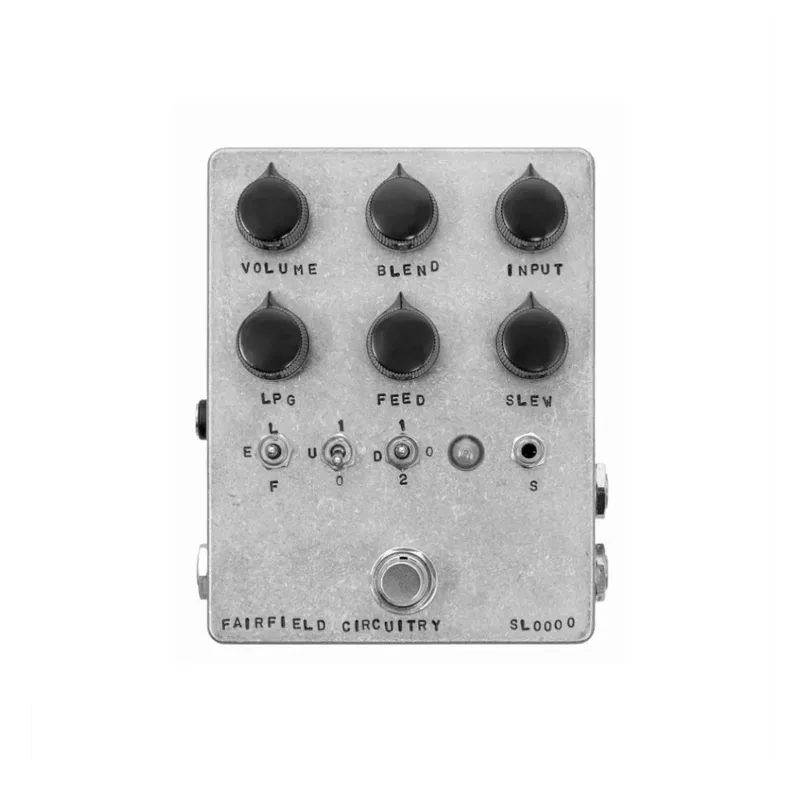


The Fairfield Circuitry 20% More is a distortion pedal with an unusual engine: instead of the clipping stages found in most distortion circuits, it applies a slew limiter, a circuit normally found in modular synthesizers, to shape guitar and other audio signals1. The result, as the Quebec-based maker describes it, is a "Slew Limiting Distortion" that behaves less like a conventional overdrive and more like a filter that distorts as it works2.
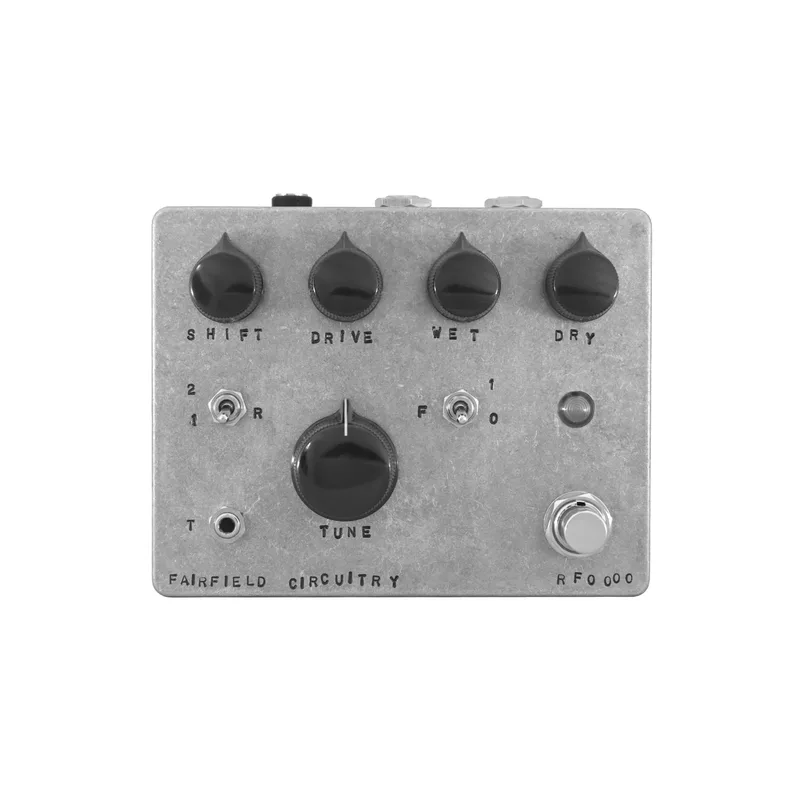
Fairfield Circuitry, a Quebec-based pedal maker with a reputation for unconventional designs3, positions the 20% More alongside pedals like the Roger That RF-inspired distortion: a different style of distortion rather than another take on a familiar sound4. Note that the pedal is currently listed as sold out on the maker's own product page2.
What a slew limiter does to guitar
A conventional distortion pedal clips: it chops off the peaks of the waveform to add harmonics. The 20% More takes another route. As Fairfield Circuitry explains on its product page:
"A slew limiter smoothes out how quickly incoming voltage can change, limiting it to a fixed v/sec. slope. Since time and frequency are intrinsically linked, this acts as a steep, somewhat distorted low pass filter."2
In practical terms, the circuit caps how fast the signal's voltage can rise or fall. Fast-moving content, which corresponds to high frequencies, gets rounded off, while slower content passes through. The maker says that when the circuit resonates, those fixed slopes become triangle wave oscillations, which is what gives the pedal its particular character2.
Guitar Pedal X's Stefan Karlsson described the outcome as "a sort of Distorted Low Pass Filter, with elements of wave folding," and noted it delivers "a cool somewhat clangy distortion voicing"4. Delicious Audio's Paolo De Gregorio framed the same idea from the synth side: at the pedal's core is a slew limiter, "a circuit typically used in modular synths to shape control voltages"5.
The pedal also includes a CV input for the slew limiter frequency4, which opens the door to controlling the filter cutoff from outside the pedal, the way a modular player would.
The controls
The control set mixes standard distortion controls with the slew limiter's own parameters. Guitar Pedal X lists the full layout4:
| Control | What it does |
|---|---|
| Volume | Sets the output level |
| Blend | Mixes the effected signal with the dry signal1 |
| Input | Sets the level going into the circuit |
| Slew | Controls the slew limiter's frequency cutoff |
| Low Pass Gate | Sets the low-pass gate on the output1 |
| Feedback | Controls the feed amount1 |
| Envelope (LPG / FEED) | Selects what the envelope follower controls |
| Octave Up (On/Off) | Activates a full-wave rectifier for an upper octave |
| Octave Down (On/Off) | Engages a sub-octave |
The octave up switch is worth a closer look. Delicious Audio explains that it "activates a full-wave rectifier circuit, which produces an upper-octave effect by doubling the frequency of the input signal, adding grit and harmonic complexity"5. That puts it in the territory of octave and pitch pedals, but as a switchable color on the distortion rather than a dedicated octave effect.
The envelope follower is the other distinctive element. As De Gregorio describes it, it "dynamically adjusts either the Feed amount or the output's low-pass gate (LPG) based on playing intensity"5. The Envelope knob selects which of the two it tracks, so playing harder can either push the feedback or open and close the low-pass gate, giving the pedal a touch-responsive, almost filter-like behavior.
Where the circuit came from
The origin story is unusual even by Fairfield Circuitry's standards. The maker's product page describes the project as24:
"Explorations around a schematic found among old papers of mysterious origin, suspiciously similar to a datasheet sq/tri oscillator."2
Guitar Pedal X tells the same story: the project started as a study of a mysterious old schematic that looked like a datasheet square/triangle oscillator, and what Fairfield Circuitry ended up with was the distorted low-pass-filter distortion the pedal became4. The maker's note that the fixed slopes become triangle wave oscillations when the circuit resonates2 connects directly to that square/triangle oscillator heritage.
Price and availability
The pedal entered wide international distribution in April 2025, when Guitar Pedal X reported it at S$389 CAD (about $270 USD at the time) on the Fairfield Circuitry webstore4. Delicious Audio covered it as the maker's latest offering in September 20255. As of October 2026, the maker's own page lists it at a regular price of $455 CAD and shows it sold out2.
Videos
Fairfield Circuitry
ambienttrash
SpiralCasterPlaysPedals
Questions
What is a slew-limiting distortion pedal?
Instead of clipping the signal like a normal distortion pedal, it uses a slew limiter to restrict how fast the voltage of your signal can change. Because time and frequency are linked, the result acts as a steep, somewhat distorted low-pass filter. Fairfield Circuitry describes the 20% More as a Slew Limiting Distortion built around this modular-synth circuit.
Is the Fairfield Circuitry 20% More analog?
Yes. RockBoard's PedalPedia entry, which carries the maker's specifications, lists the 20% More as an analog circuit. Its clipping comes from JFETs, and the pedal also uses pseudo-wavefolding alongside the slew limiter to shape the signal.
What power does the 20% More need?
It runs on 9V DC with a center-negative plug and draws 20mA. That current draw is low enough for most isolated pedalboard power supplies, and the center-negative polarity matches the standard used by the majority of modern effects pedals.
Does the 20% More have an octave function?
Yes, both directions. An Octave Up switch activates a full-wave rectifier circuit that doubles the frequency of the input signal for an upper-octave effect with added grit, and there is also an Octave Down switch for a sub-octave. Both are on/off switches rather than knobs.
Where can I find the 20% More manual?
The manual is published as a PDF and linked from the pedal's RockBoard PedalPedia entry, which reproduces the maker's product information. It is hosted on Fairfield Circuitry's own CDN at cdn.shopify.com, under the file name SL-prog.pdf.
Sources (5)
- 20% More by Fairfield Circuitry, RockBoard PedalPedia, 2026
- 20% More, Fairfield Circuitry
- Fairfield Circuitry Long Life EQ, Delicious Audio, 2021-07-22
- Guitar Pedal X, Guitar Pedal X, 2025-04-03
- Fairfield Circuitry 20% More Limiting Distortion, Delicious Audio, 2025-09-10