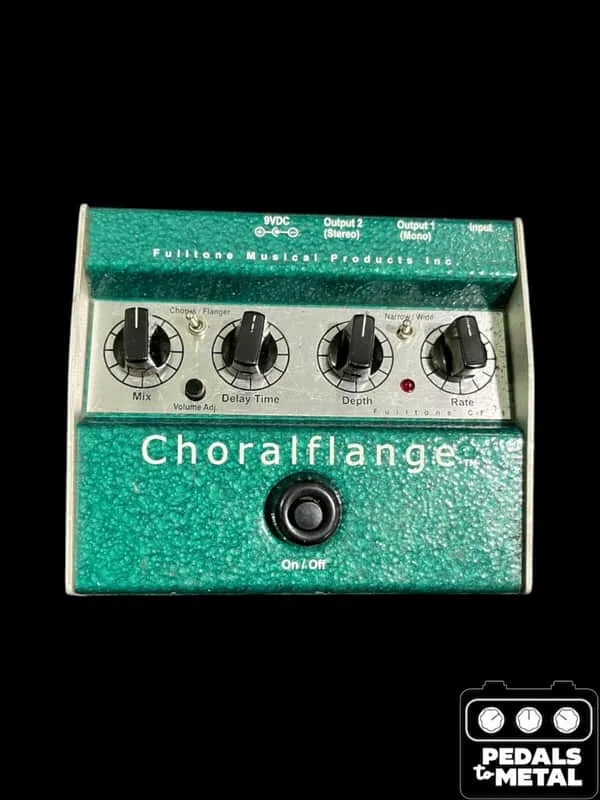
The Fulltone CF-1 Choralflange is an analog chorus and flanger pedal made by Fulltone (Fulltone Musical Products Inc)1. It is housed in a metal case constructed of brushed aluminum and green enamel-coated hammered aluminum, and it carries a five year warranty1. A reviewer found the effects smooth and silky, without the tinny, unwanted sound in the higher ranges of modulation that similar effects tend to throw in1.
Vintage Guitar reviewed it and found the effects smooth and silky, as you would expect from analog circuitry, without the thin, unwanted sound in the higher ranges of modulation that the reviewer said similar effects tend to produce1.
Controls and switching
The Choralflange keeps its control set small. Depth sets how saturated the effect is, and a mini Volume Adj knob balances the signal's volume level when the effect is engaged, so switching it on does not jump out louder or quieter than your clean sound1.
| Control | What it does |
|---|---|
| Depth knob | Adjusts the saturation of the effect1 |
| Volume Adj mini knob | Balances signal volume when the effect is engaged1 |
| Mode switch | Selects between chorus and flange modes1 |
| Range switch | Selects narrow (one octave) or wide (two octaves) range of effect1 |
The stomp switch is surrounded by a thick rubber ring that cushions the impact of your foot, a durability detail aimed at players who stomp hard1. The instruction manual includes a selection of sample settings, which gives a starting point before you dial in your own sounds1.
Bypass and stereo use
The pedal offers selectable true bypass or buffered operation, chosen with a tiny DIP switch inside the box, easily reached by removing the backplate1. The choice matters for how you run it:
- True bypass is available for mono operation only1
- Buffered operation covers mono or stereo, and is recommended when using very long cables1
One caution from the review: the DIP switch settings must not be altered while the unit is plugged in1. With a single input jack and two output jacks, the pedal works in mono and stereo setups1.
Build and power
The Choralflange is housed in a metal case built of brushed aluminum and green enamel-coated hammered aluminum1. Power comes from a 9-volt battery or an AC adapter, so it runs on a board or on its own1.
Where it sits among flangers
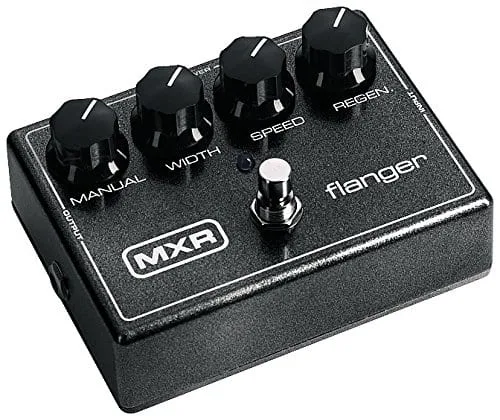
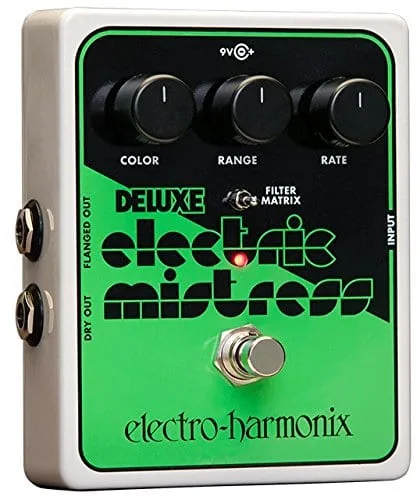
As a combined chorus and flanger with analog circuitry, the Choralflange took a different approach from single-function flangers like the MXR Flanger or the Electro-Harmonix Deluxe Electric Mistress, covering both modulation effects in one enclosure. Its selectable true bypass and stereo outputs were also features not every flanger of its era shared. For more on the effect type itself, see Flanger Pedals and Chorus Pedals.
Videos
BallewsMusic
Questions
Is the Fulltone CF-1 Choralflange true bypass?
It offers selectable true bypass or buffered operation, set by a small DIP switch inside the box behind the backplate. True bypass is available for mono operation only; the buffered mode covers mono or stereo and is recommended with very long cables. The switch must not be changed while the unit is plugged in.
Can the Fulltone CF-1 Choralflange be used in stereo?
Yes. It has a single input jack and two output jacks, and can be used in mono and stereo setups. In stereo, the pedal runs in its buffered mode rather than true bypass.
Does the Fulltone CF-1 Choralflange run on a battery?
Yes. It operates on a 9-volt battery or an AC adapter, so it works on a pedalboard or standalone without a power supply.
Is the Fulltone CF-1 Choralflange discontinued?
Yes. Fulltone discontinued the Choralflange, as reported in 2015, so it is available only on the used market.
How much did the Fulltone CF-1 Choralflange cost?
Its list price was $349 as of December 2001, when Vintage Guitar reviewed it.
What does the range switch do on the Choralflange?
The range switch selects a narrow or wide range of effect: narrow covers one octave and wide covers two octaves. A second small switch selects between chorus and flange modes.
Sources (1)
- Fulltone CF-1 Choralflange, Vintage Guitar magazine, 2003-02-27