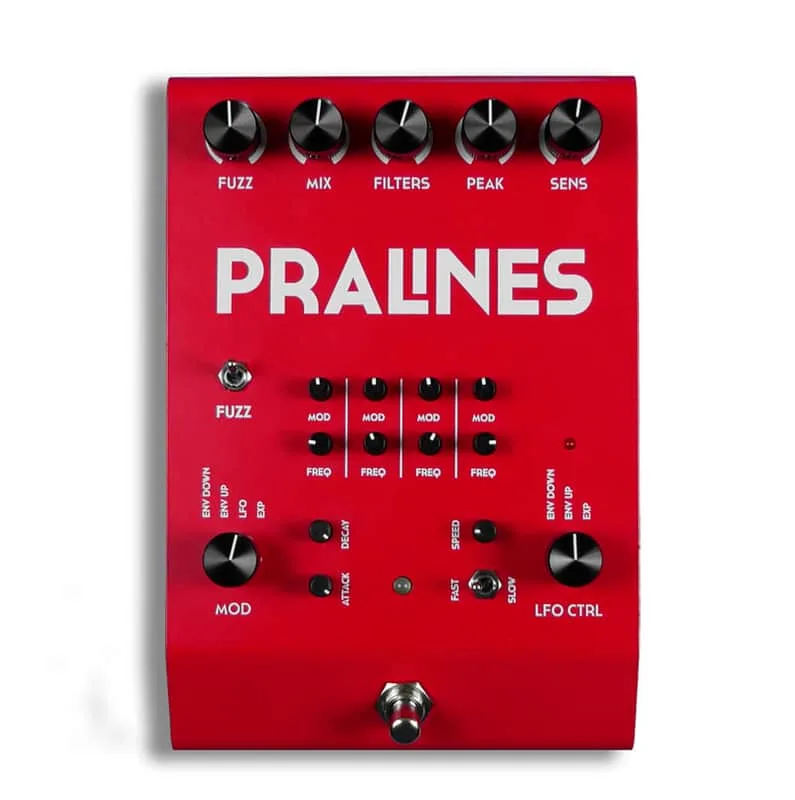


The Glou Glou Pralines is a filter/modulation synth pedal: an effect built around four parallel resonant band-pass filters, each of which can be modulated by an envelope generator, a triangle LFO or an expression pedal, with a gated fuzz section built in. Delicious Audio's Paolo De Gregorio described it as "a very creative pedal that can be used with both guitars and synths to forge sounds from the unconventional to the atmospheric."1 For players of filter pedals and synth pedals alike, it sits somewhere between an envelope filter, a modulation effect and a sound-design tool.
How it works
The heart of the pedal is its set of four parallel resonant band-pass filters. Because the filters run in parallel, phase behavior becomes part of the sound: at low PEAK settings, phase cancellation occurs and the pedal is capable of producing phaser and vibrato sounds, putting it in territory shared with phaser pedals and vibrato pedals. Push PEAK to its maximum and the character changes completely: "When fully CW, filters self-oscillation occurs and you now have 4 controllable sine-wave VCO's."1
The envelope generator is followed by a slew limiter that slows and smooths the envelope on attack and decay, shaping how quickly the filter responds to your playing.1
The controls
| Control | What it does |
|---|---|
| PEAK | Controls the global resonance of the filter; fully clockwise, the filters self-oscillate1 |
| SPEED | Small knob that sets the LFO frequency1 |
| Fast/Slow switch | Selects between the triangle LFO's two frequency ranges1 |
| LFO Modes knob | Bigger knob selecting three LFO modes: Envelop Up, Envelop Down and Expression pedal1 |
| Mod rotary switch | Selects which modulation is applied to the filters: envelope down, envelope up, LFO or expression pedal1 |
| SENS | Sets the sensitivity of the envelope generator1 |
| MOD knobs | One per filter; each makes its filter more or less "wet"1 |
| Fuzz gate | Starts to engage around 12 o'clock1 |
The fuzz section
Alongside the filters, the Pralines carries a fuzz stage, which Delicious Audio describes plainly: "It's a basic PNP transistor gated fuzz."1 The gate is adjustable, starting to engage around 12 o'clock, so the fuzz can run from a loose, open texture to a tightly gated, synth-like stutter. Players looking for a dedicated dirt pedal would look instead at fuzz pedals or distortion pedals; here the fuzz is one voice inside a larger filter instrument.
Where it comes from
The Pralines is made by Glou Glou, a French manufacturer whose earlier Rendez Vous pedal Delicious Audio had covered previously, calling the maker's work "truly remarkable."1 The Pralines extends that approach into four-filter territory with full modulation options.
Videos
Glou Glou
Glou Glou
Glou Glou
Questions
What does the Peak knob do on the Glou Glou Pralines?
The PEAK knob controls the global resonance of the filter. At low PEAK settings, phase cancellation occurs and the pedal is capable of producing phaser and vibrato sounds. Turned fully clockwise, the filters self-oscillate and the pedal effectively gives you four controllable sine-wave VCOs.
Can the Pralines self-oscillate?
Yes. With the PEAK knob fully clockwise, filter self-oscillation occurs, and the pedal then behaves as four controllable sine-wave VCOs, turning the Pralines into a drone and sound-design tool as well as a filter.
Is the Pralines a fuzz pedal?
Not primarily. The Pralines is a filter/modulation synth pedal, but it includes a fuzz section, which Delicious Audio describes as a basic PNP transistor gated fuzz. The gate starts to engage around 12 o'clock on its control.
Can the Pralines be used with synths?
Yes. Delicious Audio called it a very creative pedal that can be used with both guitars and synths to forge sounds from the unconventional to the atmospheric.
How is the Pralines related to the Rendez Vous?
Both come from the French manufacturer Glou Glou. Delicious Audio had previously covered the maker for the Rendez Vous, and the Pralines followed from that same boutique builder.
Can I control the Pralines with an expression pedal?
Yes. The Mod rotary switch selects expression pedal as a modulation source, and the LFO Modes knob includes an Expression pedal mode among its three positions, alongside Envelop Up and Envelop Down.
Sources (1)
- Glou Glou Pralines Filter/Modulation Synth Pedal, Delicious Audio, 2018-12-19