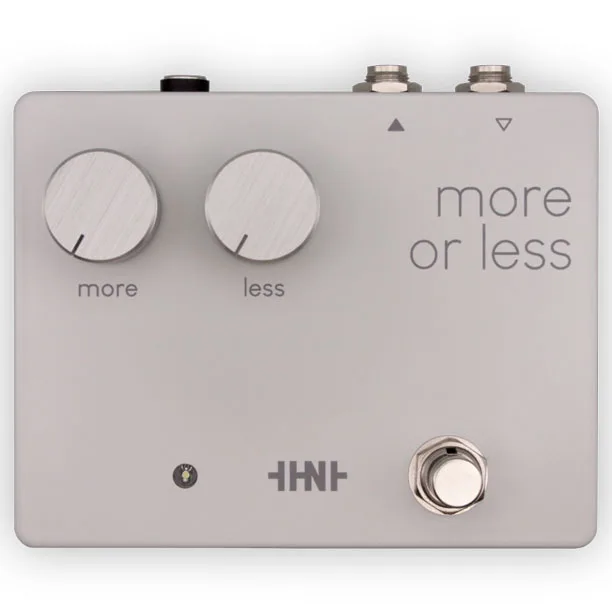



The Homenoise Audio More or Less Boost is a boost pedal with a toneshaping twist, built in Denmark and announced in August 2023. Where a conventional boost pedal simply makes everything louder, Delicious Audio's Paolo De Gregorio described this one as "a low noise gain stage that pushes the front of an amplifier or pedal in multiple ways by not being limited to amplifying a single frequency range."1
The controls: two knobs, two modes
The pedal keeps its face simple: two knobs, called More and Less, and two modes of operation selected by an internal switch. De Gregorio summed it up this way: "With only two knobs and two modes, this pedal can do much more to your tone than initially expected."1
| Control | Mode | What it does |
|---|---|---|
| More | Mode B (boost mode) | 0dB (unity) to +22dB full range boost1 |
| Less | Mode A (toneshaping mode) | -22dB to +22dB high frequencies1 |
| Less | Boost mode | Extra treble control of +/-22dB alongside the boost1 |
In mode B, the circuit acts as a regular booster, pushing the signal up to +22dB through the More knob, with the Less knob serving as an extra treble control in that mode. In mode A, the pedal becomes a bass and treble EQ, pushing or taming frequencies "just on the edge and outside of the" core boost range, as Delicious Audio put it.1
The two knobs carry the maker's own plain-spoken descriptions: "more can do more than it does," while "less does less than more but it does enough."1
The mode switch is inside the pedal. When the More or Less Boost was announced in August 2023, Delicious Audio predicted the switch "will become external in V2," so an external switch is something to watch for in a later version rather than something the first version has.1
Uses beyond straight boost
Delicious Audio frames the pedal as more than a one-trick volume push. According to the announcement, "the More or Less can be used not only to push your amp into the edge of breakup, but also as a fine-tuning equalizer, or" as a buffer when using long cables.1 That buffering role is backed by the pedal's buffered relay bypass switching and its 1 MΩ input and 100 Ω output impedances, the kind of numbers that matter when a long pedalboard chain or cable run is eating high end.1 Players looking at that side of the pedal may also want to read about buffer pedals and equalization pedals more broadly.
Power and setup
The pedal takes 9 to 18V DC center negative and draws 40mA.1 That range means it works with a pedalboard supply at the lower end of its range, while players whose supplies offer 18V outputs can run it at the higher voltage. Its footprint of 119mm x 100mm x 53mm is larger than a typical compact boost, so it is worth checking the space on a crowded board.1
Videos
ambienttrash
Ambient Endeavors
dots.sounds
Questions
Where is the Homenoise More or Less Boost made?
The More or Less Boost is built in Denmark. Delicious Audio reported on the pedal when it was announced in August 2023 and noted its Danish origin, describing the country as the pedal's home.
How much boost does the More or Less offer?
In boost mode, the More knob runs from 0dB, which is unity gain with no boost, up to +22dB of full-range boost. In toneshaping mode, the Less knob covers high frequencies from -22dB to +22dB, so it can push or tame treble rather than simply make the whole signal louder.
Is the mode switch on the outside of the pedal?
No. The mode switch that selects between mode A, the toneshaping mode, and mode B, the boost mode, is internal. When the pedal was announced in August 2023, Delicious Audio predicted the switch would become external in a second version of the pedal.
Does the More or Less Boost work as a buffer?
Yes. Along with pushing an amp toward the edge of breakup and acting as a fine-tuning equalizer, Delicious Audio notes the pedal can be used as a buffer when running long cables. It uses buffered relay bypass switching and has a 1 MΩ input impedance and 100 Ω output impedance.
What voltage does the More or Less Boost take?
The pedal runs on 9 to 18V DC with a center negative power input and draws 40mA. That range means it can sit on a standard 9V pedalboard supply or be run at a higher voltage from a supply that offers 18V outputs.
Sources (1)
- New Pedal: Homenoise More Or Less Boost, Delicious Audio, 2023-08-14