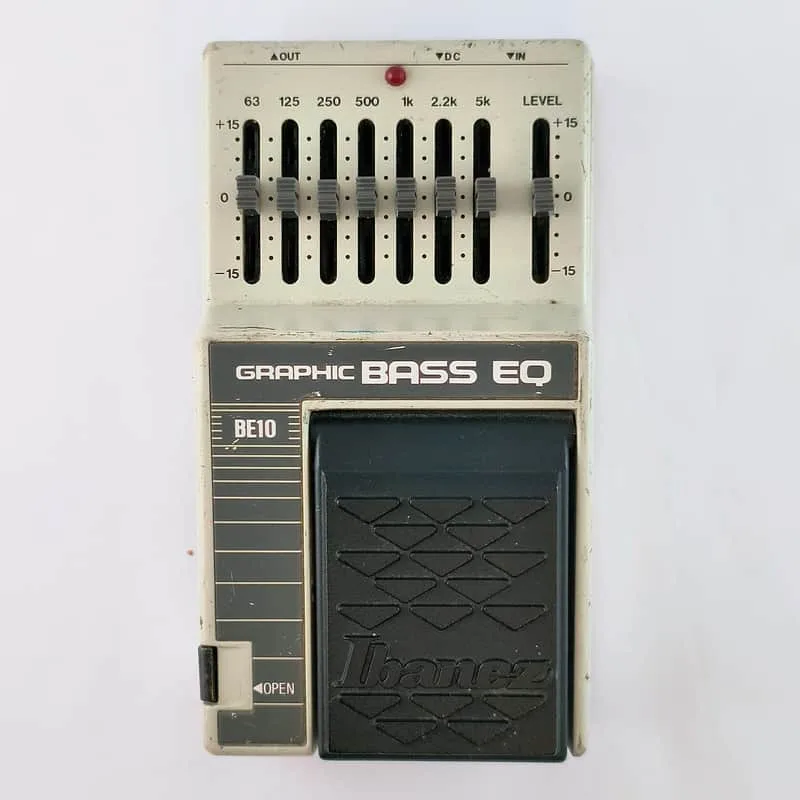
The Ibanez BE10 Bass EQ is a graphic bass equalizer pedal from Ibanez, part of the company's Power Series 10 range. It was produced in Japan from 1986 to 19931. In plain terms, it is a row of sliders that cut or boost fixed frequency bands, letting a bass player reshape their tone without changing the amp or bass.
What sets it apart from the guitar EQs of its era is where its range begins. Guitar graphic EQs start at 100Hz, but the BE10 starts at 63Hz1.
Why the range starts at 63Hz
The reasoning behind the BE10's band layout comes down to the physics of a bass. The open E on a bass resonates at 41Hz, far below the 100Hz cutoff of a guitar EQ. By beginning the equalization at 63Hz, the pedal keeps the tone and punch of the low E while leaving out harmonic rumbling below that point1.
For a player, that means the lowest band can shape the body of the low E and the bottom end of the low B area's upper harmonics without boosting sub-bass noise that a guitar EQ simply could not reach. A guitar EQ starting at 100Hz would leave everything below that flat, which is most of where a bass lives.
How it relates to the GE10
The BE10 is a redesigned version of the Ibanez GE10 for bass guitar1. The GE10, its guitar counterpart, controls seven octave ranges between 100Hz and 6.4kHz with plus or minus 15dB of equalization at each octave2. The BE10 carries the same graphic EQ concept but shifts the range down to serve bass frequencies1.
The GE10's manual gives a sense of how Ibanez intended players to use these sliders, and the same thinking applies to the bass version:
| Band | What it does on the GE10 |
|---|---|
| 200Hz | Influences the overall bass characteristics of the sound; cutting it can emphasize a boost at 100Hz or 400Hz2 |
| 400Hz | A slight boost emphasizes warmth, especially after a distortion device; cutting removes midrange harshness in acoustic-electric guitars2 |
| 1.6kHz | Boosted for presence and clarity; extreme boost emphasizes pick attack, slight cut smooths a rhythm sound2 |
| 3.2kHz | Boosted adds bite and brilliance2 |
| 6.4kHz | Deals with the sizzle or sparkle2 |
How Ibanez suggested using it
The BE10 works more effectively with bass by subtractive equalization, according to Ibanez's own guidance. When a certain region is boosted, a slight cut of the adjacent bands gives the boost proper emphasis1. In practice that means shaping a curve rather than simply pushing one slider up: boost where you want more, trim the neighbors, and the change reads as focus rather than volume.
Availability today
The BE10 has not been reissued1. It is now rare, and its collectibility is rated as average among vintage Ibanez pedals1. Its 1989 list price was 198 DM, the German currency of the time1. Players hunting one today are looking at the secondhand market, and a schematic for the pedal is available for anyone servicing a unit1.
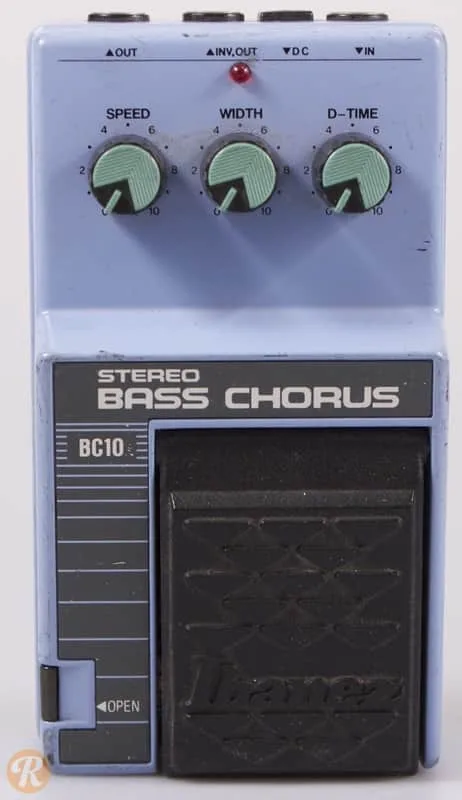
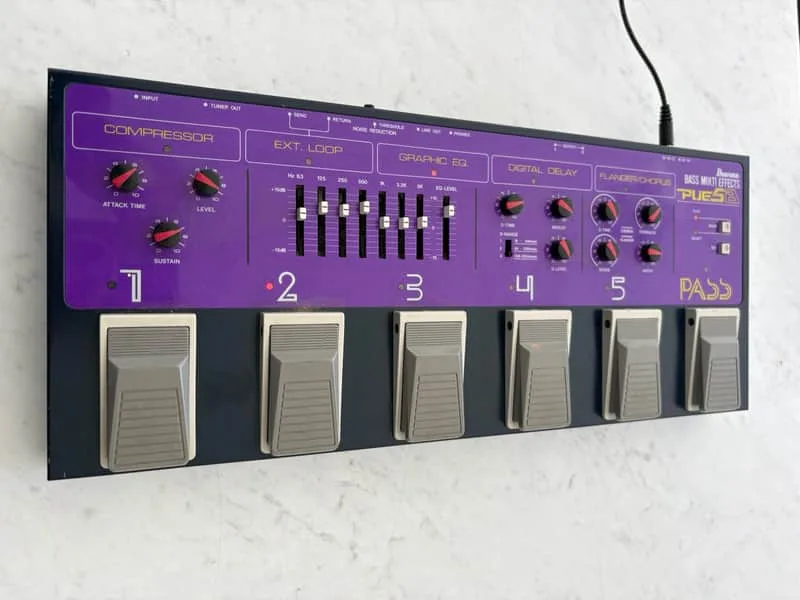
For players exploring other vintage Ibanez bass pedals from the same era, the Ibanez BC10 Bass Chorus and the Ibanez PUE5B are related pages, and the wider world of bass pedals covers the category as a whole.
Videos
Circuit Bending Fool
Searcy String Works
Questions
Is the Ibanez BE10 a guitar EQ or a bass EQ?
It is a bass EQ. The BE10 is a redesigned version of Ibanez's GE10 graphic equalizer, retuned for bass guitar. Its band layout starts at 63Hz rather than the 100Hz floor of a guitar EQ, which keeps the fundamental of the low E string in play.
What is the lowest frequency on the Ibanez BE10?
The lowest band starts at 63Hz. Guitar graphic EQs of the same era typically started at 100Hz, which sits well above the roughly 41Hz resonance of a bass's open low E. Starting at 63Hz lets the pedal shape the low E's tone and punch while leaving out harmonic rumbling below it.
Is the Ibanez BE10 the same as the Ibanez GE10?
No, but they are closely related. The BE10 is a redesigned version of the GE10 for bass guitar. The GE10 covers seven octave bands between 100Hz and 6.4kHz with plus or minus 15dB per band, while the BE10 shifts its range down to start at 63Hz for bass frequencies.
Was the Ibanez BE10 ever reissued?
No. The BE10 was produced from 1986 to 1993 and has not been reissued. It is now considered rare on the secondhand market, with average collectibility among vintage Ibanez pedal hunters.
Where was the Ibanez BE10 made?
The BE10 was made in Japan. It was part of the Ibanez Power Series 10, produced from 1986 to 1993 during the period when Ibanez's effect pedals were manufactured in Japan.
Is there a schematic for the Ibanez BE10?
Yes. A schematic for the Ibanez BE10 Graphic Bass EQ is available online, hosted by the vintage Ibanez reference site ToneHome, which also carries the pedal's product details and Power Series pocket manual information.