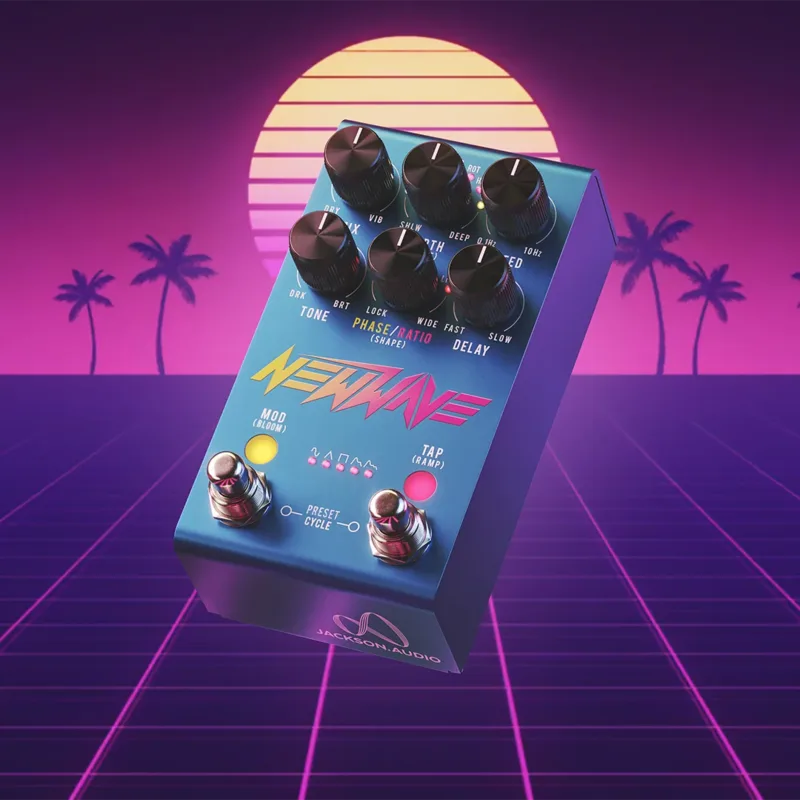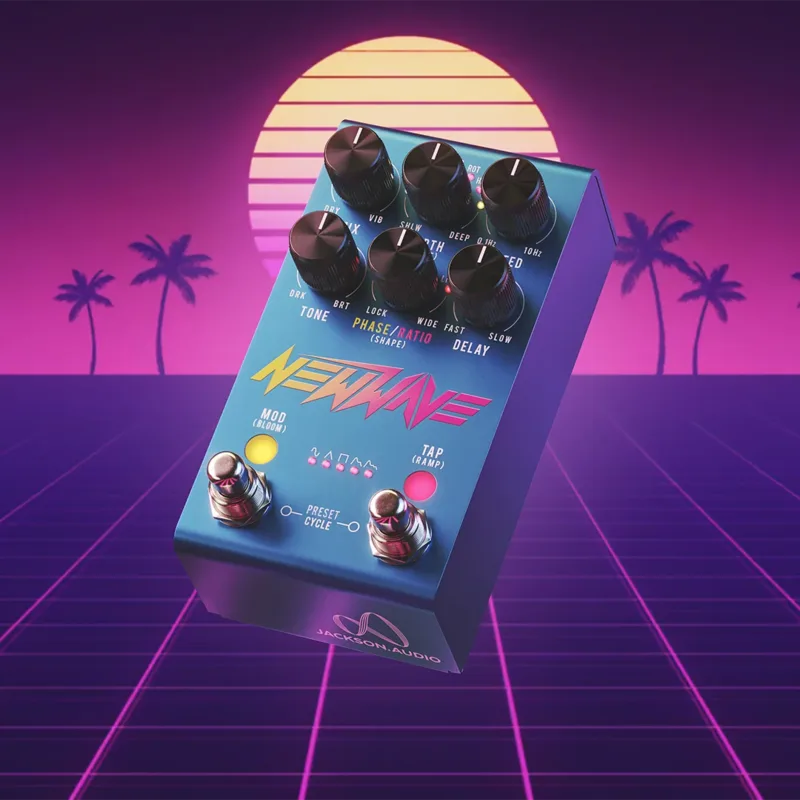


The Jackson Audio New Wave is a stereo analog chorus and vibrato pedal with design input from guitarist Mark Lettieri. Its audio path is fully analog, built around genuine MN3007 bucket-brigade delay chips operating at 15 volts internally, the same approach as classic 80s chorus units, while a digital microprocessor handles the control side: seven savable modes, MIDI, tap tempo and performance features like Bloom and Ramp12.
Announced in February 2023 at $299 USD, the pedal is currently listed new by Jackson Audio at £303 GBP, with orders expected to ship within 3 to 4 weeks21.
Seven modes, from 70's chorus to rotary
The New Wave's seven modes each take a different approach to pitch modulation, and each can be saved with its own settings1.
| Mode | What it does |
|---|---|
| 70'S | Simple, warm mono chorus; the only mono mode. A single LFO moves the left channel against a stationary one1 |
| 80'S | Wide stereo chorus; two LFOs move simultaneously for spacious movement1 |
| RACK | Rack-style modulation character1 |
| VIB | Pure analog pitch movement with the dry signal removed, shaping a classic analog vibrato1 |
| ROT | Pitch modulation and ratio control recreate a rotary cabinet's independent horn and lower rotor1 |
| HRM | One of two custom harmonic LFO shapes inspired by the modulation character of the ARP Solina keyboard1 |
| USER | Access to the complete control set to build your own modulation sound1 |
The two custom harmonic shapes in the HRM modes are inspired by the modulation character of the ARP Solina keyboard, the string machine heard on countless 70s records, which gives the New Wave a flavor beyond standard chorus and vibrato1.
The controls: Mix, Tone, Depth, Delay, Phase and Ratio
Six knobs shape the modulation, and several of them go beyond what a typical chorus pedal offers1.
| Control | What it does |
|---|---|
| MIX | Blends effected and dry signals, moving from dry through balanced chorus to full pitch vibrato1 |
| TONE | Adjusts the tonal character of the modulation, from warm and softened to bright and defined1 |
| DEPTH | Controls the strength of the pitch movement1 |
| DELAY | Changes the BBD clock's center frequency, moving between loose, open chorus and tighter, more compressed textures1 |
| PHASE | Shifts the channels from synchronized movement to 180 degrees out of phase for wider chorus1 |
| RATIO | Changes the speed relationship between the left and right channels for rhythmic and rotary-style movement1 |
The Phase and Ratio controls are the unusual pair here. MusicRadar highlighted the phase/ratio feature at launch, noting that it changes the phase alignment of the two channels from 0 to 180 degrees out of phase, and Ratio then sets different speed relationships between the channels, which is what makes the rotary mode's separate horn and rotor movement possible2.
"Analog MN3007 BBD chips, operating at 15 V internally just like classic '80s units are the centrepiece here"
Tap tempo, Bloom and Ramp
Beyond the knobs, the New Wave carries a set of performance features aimed at playing the modulation live rather than just setting it and forgetting it1.
- Tap Tempo: sets modulation speed by foot1
- Bloom: fades the modulation into the signal1
- Ramp: moves between programmable slow and fast speeds1
- Expression: an expression input controls speed with an expression pedal1
- MIDI: provides external control of modes, presets and performance functions while the audio path remains analog1
Ramp and the expression input are natural partners with the rotary mode, where moving between slow and fast speeds by foot mimics how a rotary cabinet speeds up and slows down. Bloom offers a subtler move, bringing the effect up from underneath the dry signal rather than switching it in at full strength1.
MN3007 bucket-brigade chips at 15 volts
The heart of the pedal is the MN3007 bucket-brigade device (BBD), the same delay chip family used in classic analog chorus designs. A bucket-brigade chip passes the signal along a chain of capacitors one small step at a time, and varying the clock rate of that chain is what produces the pitch wobble of chorus and vibrato. Running the New Wave's MN3007 chips at 15 volts matches the internal operating voltage of the classic 80s units the pedal takes after12.
The MN3007 itself is a 1024-stage BBD with a signal-to-noise ratio of 80dB and low total harmonic distortion of 0.5% typ (V IN = 0.78Vrms), with a supply voltage range from -10 to -15V4. Jackson Audio states that the New Wave's genuine MN3007 chips operate at 15 volts, like classic units1.
The pedal runs on 18V DC, center negative3.
Where it came from
Jackson Audio built the New Wave around analog MN3007 BBD chips operating at 15 V internally, just like classic '80s units, with design input from Mark Lettieri, and launched it at $299 USD / £325 GBP3. The pedal blends that analog chorus and vibrato circuit with a Mix knob that moves from dry signal through balanced chorus to full pitch vibrato, and a Ramp function that shifts between programmable slow and fast speeds1. Jackson Audio describes the design goal plainly:
"We set out to make the best sounding and versatile 100% analog, stereo chorus/vibrato pedal."
The maker positions the result as delivering "the classic sounds with added modern precision and all new sounds," which lines up with what the mode list shows: familiar 70s and 80s chorus territory alongside rotary, harmonic and fully user-defined modulation31.
Videos
Andertons Music Co
Jackson Audio
Jackson Audio
Questions
Is the Jackson Audio New Wave analog?
Yes, in its audio path. The New Wave runs a 100% analog signal path built around genuine MN3007 bucket-brigade chips operating at 15 volts internally, like classic 80s units. A digital microprocessor handles the control side, driving modes, presets, MIDI and tap tempo while the audio stays analog.
Does the New Wave have MIDI?
Yes. MIDI provides external control of the New Wave's modes, presets and performance functions while the audio path remains analog. That means you can switch modes and recall sounds from a MIDI controller or switching system rather than bending down at the pedal.
Is the Jackson Audio New Wave stereo?
Yes. The New Wave is a stereo chorus and vibrato pedal, and most of its modes use two channels with independent LFO movement. The 70'S mode is the exception: it is a simple, warm mono chorus and the only mono mode on the pedal.
Can you save presets on the New Wave?
Yes. The pedal has seven savable modes, and each mode can be edited and stored. USER mode gives access to the complete control set so you can build your own modulation sound and save it, and presets can also be recalled over MIDI.
Does the New Wave take an expression pedal?
Yes. An expression input lets you control the modulation speed with an expression pedal, which is useful for swelling between slow and fast speeds by foot, particularly in the rotary mode.
Sources (4)
- New Wave Analog Chorus/Vibrato, Jackson Audio
- Take tone back to the '80s with Jackson Audio's New Weave chorus / vibrato pedal that combines analog and digital design, MusicRadar, 2023-02-22
- New Wave Stereo Analog Chorus/Vibrato by Jackson Audio, RockBoard PedalPedia, 2026
- Boss CE-2 Analysis, GuitarPCB
 Seal