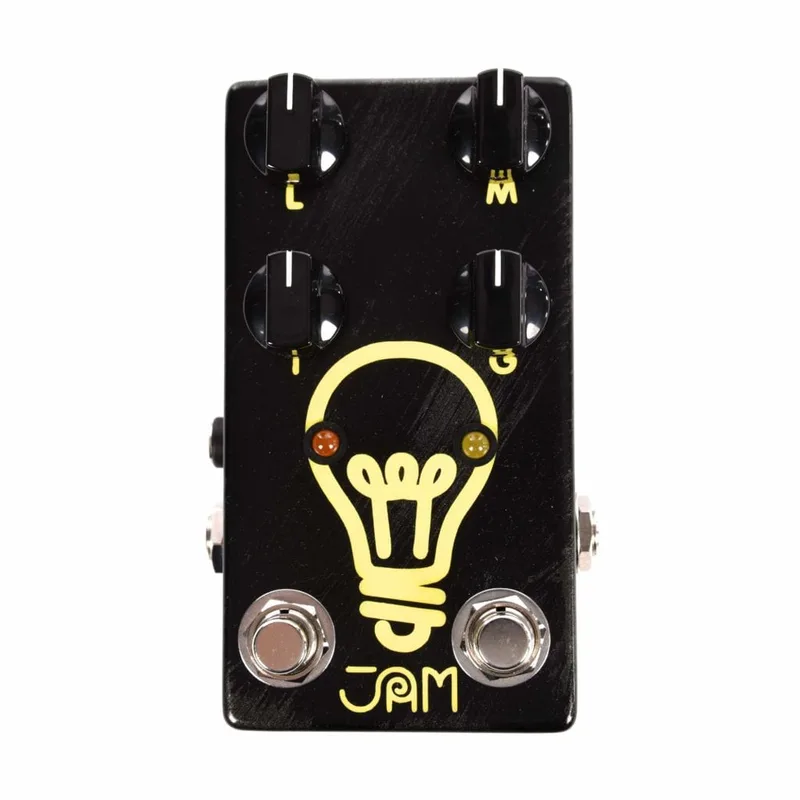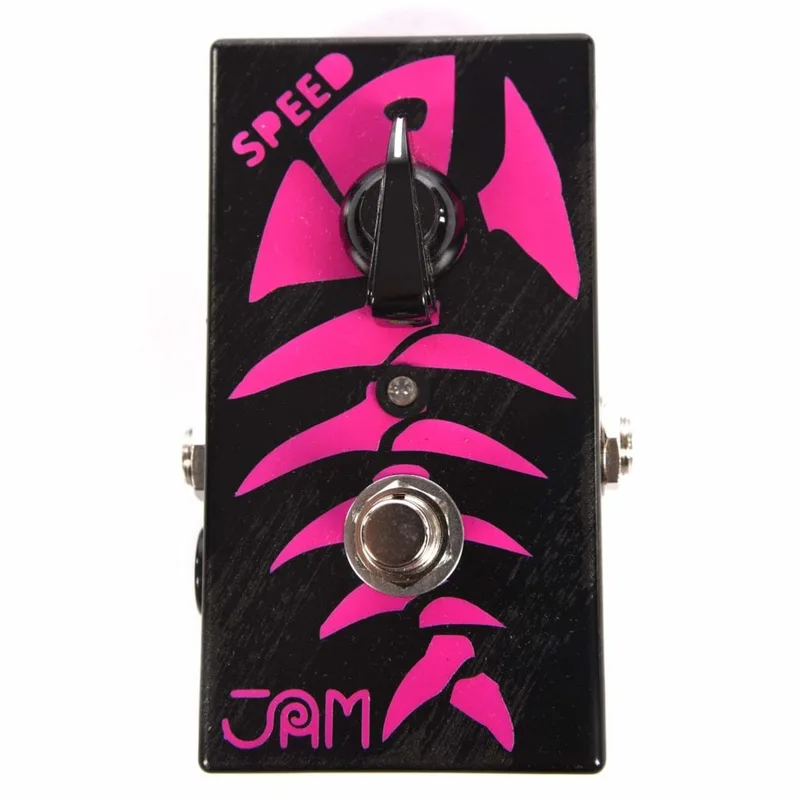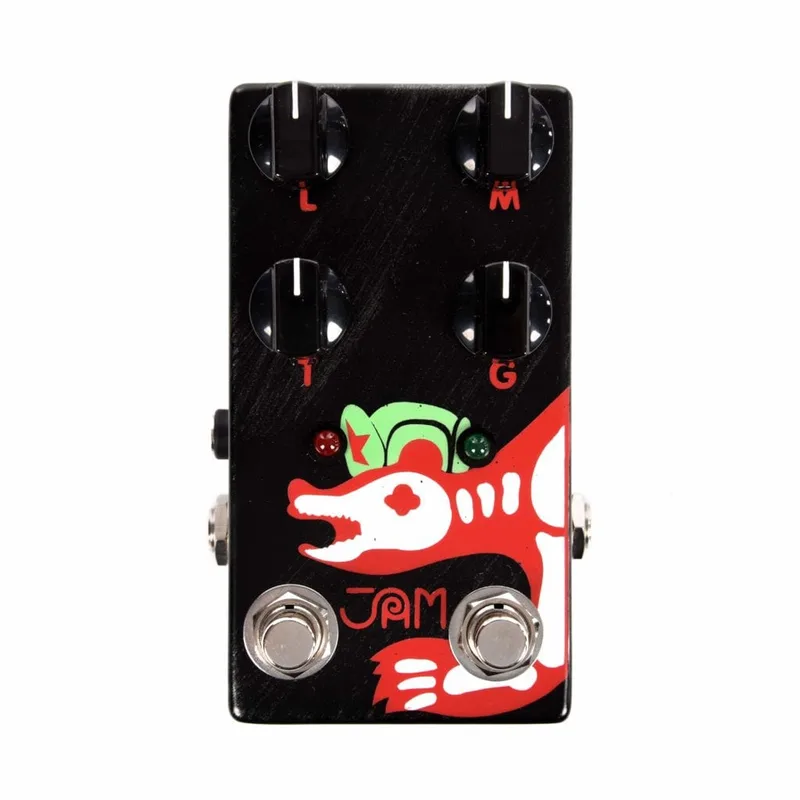


The Red Muck Bass is a bass fuzz/distortion pedal from Jam Pedals, the Greek maker whose line also includes bass versions of the Rattler, the LucyDreamer and the Ripple. JAM describes it as "a full-bodied fuzz-distortion that brings Triangle and Red Army/Civil War Muff-inspired weight to bass without sacrificing definition"1. In other words, it is a Big Muff-style fuzz voiced for bass, with a clean blend so your low end and attack survive the saturation.
The circuit draws on the '71 Triangle and later Red Army/Civil War Muff designs, with what JAM calls a smoother response, stronger mids, fat lows and an expanded Tone range1. The maker says its smoother top end, pronounced midrange and naturally fat low end cover "everything from vintage wool to controlled, high-impact mayhem"2.
A Muff-style fuzz-distortion for bass
For a bass player, the appeal of a Muff-style fuzz is weight, but vintage Big Muffs are famous for swallowing the fundamental when you push them. The Red Muck Bass addresses that in two ways: a clean-blend Mix control and a midrange voiced to keep the instrument present. JAM says the Mix control "sets the ratio between dry bass and fuzz-distortion, preserving attack and low-end definition"1, so you can dial in as much or as little of your dry signal as the fuzz needs.
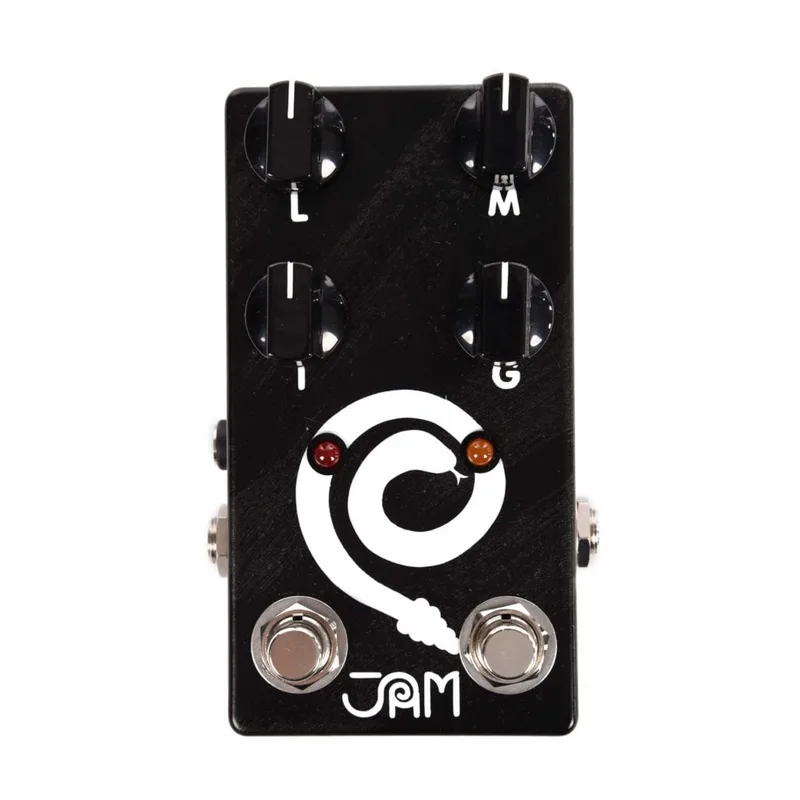
The pedal sits in JAM's bass range alongside the Rattler Bass (a Rat-based distortion) and other bass versions of the company's guitar pedals. Where those cover overdrive and distortion territory, the Red Muck Bass is the company's fuzz entry for bass, built on the two most-cited vintage Muff circuits rather than a modern high-gain design1.
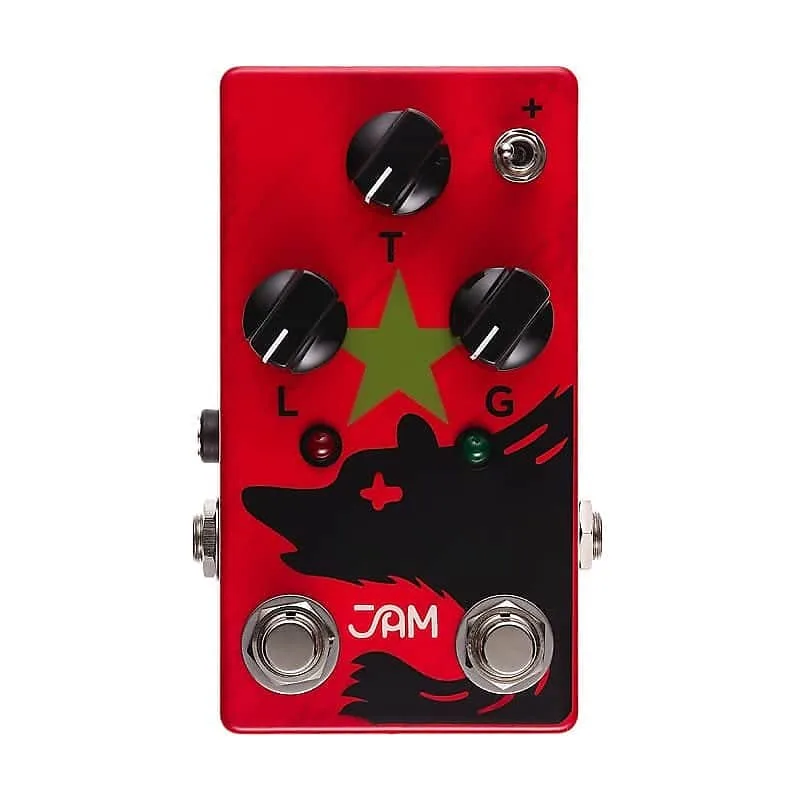
The wider Red Muck family gives useful context. The original Red Muck for guitar, now listed as discontinued by RockBoard, was described by that site as "a boutique fuzz/distortion pedal from JAM Pedals, inspired by the '71 'triangle' Big Muff and the later 'Red Army / Civil War' Muff circuits"6. The current Red Muck mk.2 for guitar keeps the same circuit roots7, and Delicious Audio groups the Red Muck MK2 among Muff-style fuzzes in its guide to fuzz types89.
The controls and two footswitches
The control set is four knobs and two footswitches:
| Control | What it does |
|---|---|
| Level | Sets output1 |
| Tone | Shapes the response1 |
| Gain | Controls fuzz intensity1 |
| Mix | Sets the ratio between dry bass and fuzz-distortion, preserving attack and low-end definition1 |
The right footswitch engages the main effect; the left engages the high-gain stage for instant additional saturation1. JAM describes this as the dedicated HIGH GAIN footswitch turning "one setting into two performance-ready gain stages"1. In practice that means you can set a rhythm level of fuzz and stomp the left switch for a louder, more saturated lead or section sound without touching a knob.
This is where the Bass version differs from the guitar Red Muck mk.2. On the mk.2, the left footswitch engages a separately tuned Boost section before the fuzz, with an internal trimmer setting its level7, and Delicious Audio notes the mk.2's boost also brings a two-way toggle for symmetrical or asymmetrical clipping8. The Bass version instead uses its second footswitch for a high-gain stage and puts its flexibility in the clean-blend Mix control, the control a bass player needs most1.
Power and connections
The Red Muck Bass runs on 9V DC, center-negative, drawing 12 mA1. That is a modest draw: for comparison, the guitar Red Muck mk.2 draws 60 mA7, so the Bass version is easier on a pedalboard power supply. Switching is true bypass1, so the pedal drops out of the signal path entirely when off. Dimensions including jacks and controls are 7.5 x 12 x 5.6 cm (2.9 x 4.7 x 2.2 in) and weight is 300 g (0.66 lb)1.
Circuit roots and artwork versions
JAM sells the Red Muck Bass in a standard version and in three Limited Artwork versions: the "Achenbach" Red Muck Bass, the "Relic" Red Muck Bass and the "Brown" Red Muck Bass3. The maker is explicit that these are the same pedal in different paint: "Same sound, different artwork"10. Each artwork pedal is a one-of-a-kind hand-painted piece, and the pedal you receive will differ in detail from the photos shown1112.
The artwork versions are priced at £294.00 against £219.00 for the standard version, prices listed by JAM Pedals with tax included101. The same hand-painted approach runs across JAM's artwork line for guitar, which includes the Feline, Lunar Muck, Noufaro and White Mountaintops Red Muck mk.2 versions12.
JAM Pedals also sells a Red Muck Bass B-Stock (Mislabeled): a small run produced with the Mix knob mislabeled as "S" instead of "M", sold at a discount13. The specifications are otherwise identical, including the same 12 mA current draw and true bypass switching13.
Players and related pedals
On the guitar side, the Red Muck's roster includes David Torn, Marc Ribot, Dweezil Zappa, Thurston Moore and Sean Ono Lennon12. Marc Ribot's own words on the pedal:
"The Red Muck is a standout fuzz: definitely going into my line-up"
Bass players comparing Muff-style fuzzes against other bass distortions can also look at JAM's Bass Rattler MKII, a Rat-based circuit, or the wider bass pedals range. The Red Muck Bass is the company's take on the vintage Muff sound, adapted with a clean blend and a two-stage footswitch layout for low-end instruments111.
Videos
JAM pedals
Rabea Massaad
Riffs, Beards & Gear
Questions
Is the JAM Red Muck Bass true bypass?
Yes. JAM Pedals lists true bypass switching in the Red Muck Bass specifications, and the same applies to the Achenbach, Relic and Brown artwork versions and the B-Stock units. When the pedal is off, your bass signal passes through without buffering or coloring.
Which Big Muff is the Red Muck Bass based on?
JAM Pedals says the circuit draws on the '71 Triangle Big Muff and the later Red Army/Civil War Muff designs. RockBoard describes the original Red Muck the same way, as a boutique fuzz/distortion inspired by those two vintage Muff circuits, and Delicious Audio calls the Red Muck line a Muff-style fuzz.
Do the Achenbach, Relic and Brown versions sound different?
No. JAM Pedals sells the Achenbach, Relic and Brown Red Muck Bass as custom artwork versions with the same sound and different artwork. Each is a one-of-a-kind hand-painted piece, so the pedal you receive will differ in detail from the photos shown, but the circuit is identical.
How much does the JAM Red Muck Bass weigh?
JAM Pedals lists the weight as 300 g, or 0.66 lb, for the standard Red Muck Bass and for every artwork version. Dimensions including jacks and controls are 7.5 x 12 x 5.6 cm, or 2.9 x 4.7 x 2.2 in.
Is the original Red Muck discontinued?
The original Red Muck V1 is listed as discontinued by RockBoard. JAM Pedals' current line includes the Red Muck mk.2 for guitar, which draws on the same '71 Triangle and Red Army/Civil War circuits, and the Red Muck Bass covered on this page.
What is mislabeled on the JAM Red Muck Bass B-Stock?
JAM Pedals produced a small run of Bass Red Mucks with the Mix knob mislabeled as S instead of M. These B-Stock units are sold at a discount; the circuit, controls and specifications are otherwise the same as the standard pedal.
Sources (13)
- Red Muck Bass, JAM Pedals
- “Relic” Red Muck Bass, JAM Pedals (jampedals.com)
- Red Muck Bass Limited Artwork, www.jampedals.com
- Tim Lefebvre, JAM Pedals
- Red Fang, JAM Pedals
- Red Muck V1 by Jam Pedals, RockBoard (www.rockboard.de), 2026
- Red Muck, JAM Pedals (jampedals.com)
- JAM Pedals Red Muck MK2 Fuzz, Delicious Audio, 2026-06-19
- The 6 Best Fuzz Types, In A Mix, Delicious Audio, 2022-09-18
- “Brown” Red Muck Bass, JAM Pedals (www.jampedals.com)
- “Achenbach” Red Muck Bass, JAM Pedals (jampedals.com)
- “Achenbach” Red Muck, JAM Pedals (jampedals.com)
- Red Muck Bass B-Stock (Mislabeled), JAM Pedals (www.jampedals.com)
 Tim Lefebvre