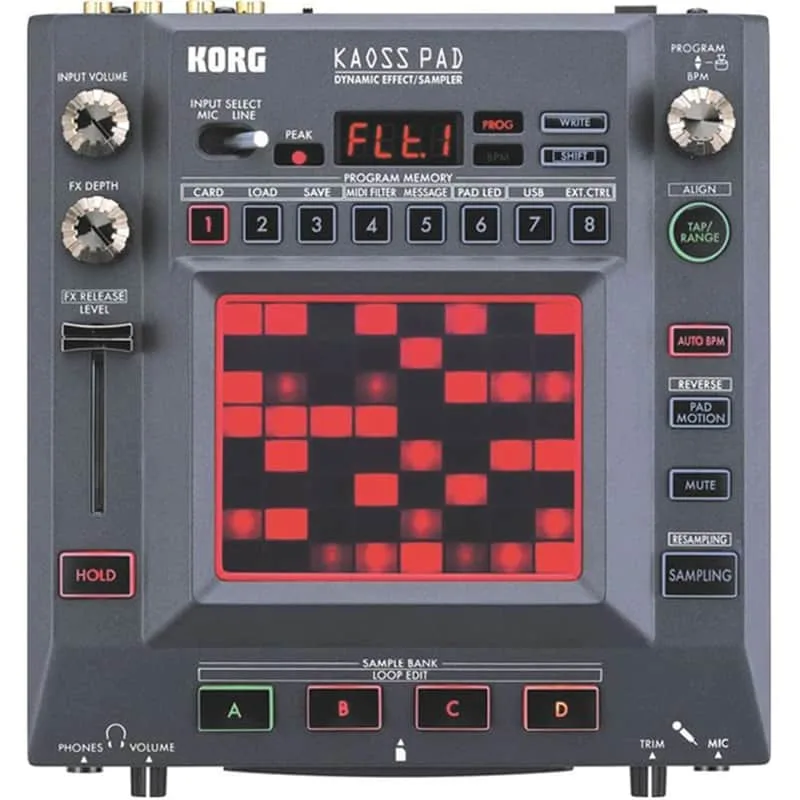


The Korg KAOSS Pad KP3 is a real-time effects processor and sampler built around a touchpad: you place your finger on the pad and move it around to change effect parameters in real time. Korg first introduced the KAOSS Pad concept in 1999, and the KP3 is the company's later revision of the line1. MusicPlayers.com's reviewer, Tony Grund, called it "a vast improvement in sonic quality over its predecessors," adding that "the reverbs now sound really good and are well suited to live performance"1.
The touchpad and how it works
The KAOSS Pad's defining control is the touchpad. The manual puts it simply: "The effect is applied when your finger touches the touch pad," with the effect shaped by rubbing or lightly tapping the pad2. Grund described the same idea from a player's angle: "place your finger on the touchpad, and move it around to change effect parameters in real time"1.
The pad does double duty as a display. "Not only is it a touchpad, but it's also an LED screen that never stops moving," showing touch trails and moving light as you play1.
Effects and memory
Grund described the KP3 as "basically a real-time effects unit," and its effect list is broad1:
- Filters and EQs
- Modulations, such as phaser and chorus
- LFOs
- Delays and reverbs
- Grain delays
- Loopers and sample editors
- Vocoders
Eight memory locations sit behind Program Memory buttons. "Because there are eight memory locations, there should be plenty of room to save effects for a set," Grund wrote1.
For players interested in the effect types themselves, the KP3's list overlaps several familiar categories covered elsewhere on the site, including filter, delay, reverb, phaser, chorus, looping and multi-effects pedals1.
Connections and computer editing
The KP3's jack layout reflects its DJ and mixer heritage1:
- RCA jacks as the primary In and Out
- 1/4" mic input, usable as a mono input from a mixer or an instrument
- Headphone jack for monitoring
A companion KP3 Editor can send samples from a computer to the unit, but Grund cautioned that audio transfer takes a long time and editing is not real time: "you're not really editing the KAOSS Pad in real time, so a data dump needs to be done every time something is changed"1.
The KP3's primary inputs and outputs are RCA jacks, which expect line level from a mixer rather than a guitar plugged straight in. The 1/4" mic input, usable as a mono input from a mixer or instrument, is the connection path for instrument level sources1.
The KAOSS Pad line today
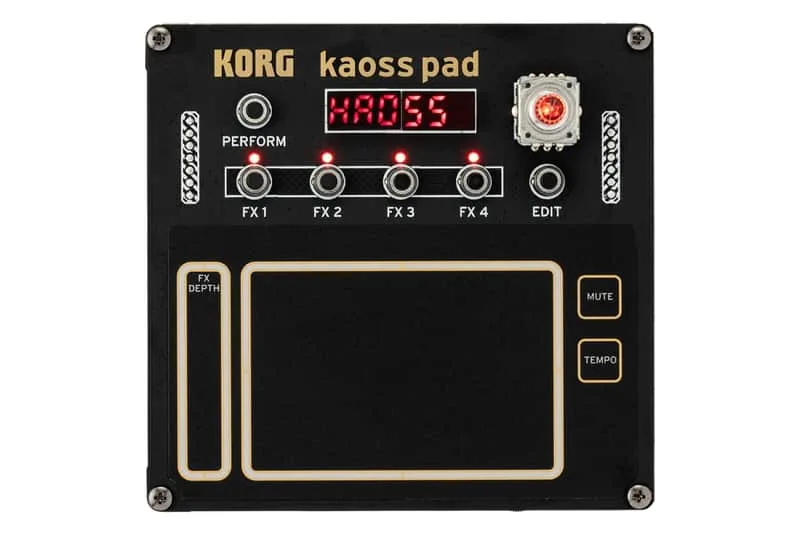
Korg has since carried the KAOSS touch interface into a smaller form: the Korg Nu:Tekt NTS-3 kaoss pad kit, a compact DIY effects unit kit that integrates "the iconic KAOSS XY pad touch interface and the distinctive KAOSS effects"3. Its built-in KAOSS effects "range from essential filters and compressors to immersive delays, reverbs and imaginative modulation effects," and the unit includes seven mastering effects45.
Videos
Denkitribe
Denkitribe
Off Shift Productions
Questions
Can you plug a guitar into the Korg KAOSS Pad KP3?
The KP3 uses RCA jacks as its primary inputs and outputs, so a guitar or instrument level source is not what its main jacks expect. It does have a 1/4 inch mic input that can be used as a mono input from a mixer or an instrument, which is the practical way to bring a guitar or other instrument level signal into the unit.
What kinds of effects does the KP3 have?
MusicPlayers.com's reviewer lists the effects as filters, EQs, modulations such as phaser and chorus, LFOs, delays, reverbs, grain delays, loopers, sample editors, and vocoders. The unit is described as basically a real-time effects unit, with the touchpad controlling effect parameters as you move a finger across it.
How many memory locations does the KP3 have?
The KP3 has eight memory locations, reached through Program Memory buttons. The reviewer noted that with eight locations there should be plenty of room to save effects for a set.
Does the KP3 have a headphone jack?
Yes. Alongside RCA jacks as its primary inputs and outputs and a 1/4 inch mic input, the KP3 includes a headphone jack for monitoring.
How does the KP3 differ from earlier KAOSS Pads?
Korg first introduced the KAOSS Pad in 1999, and the KP3 is described as Korg's latest revision of the line. The reviewer called it a vast improvement in sonic quality over its predecessors, noting that the reverbs now sound really good and are well suited to live performance.
Sources (5)
- Korg KAOSS Pad KP3, MusicPlayers.com, 2007-01-07
- KAOSS PAD KPV Owner's Manual, Korg, 2026-03
- NTS-3 kaoss pad kit, KORG
- Specifications, KORG (USA)
- NTS-3 kaoss pad kit, KORG (USA)