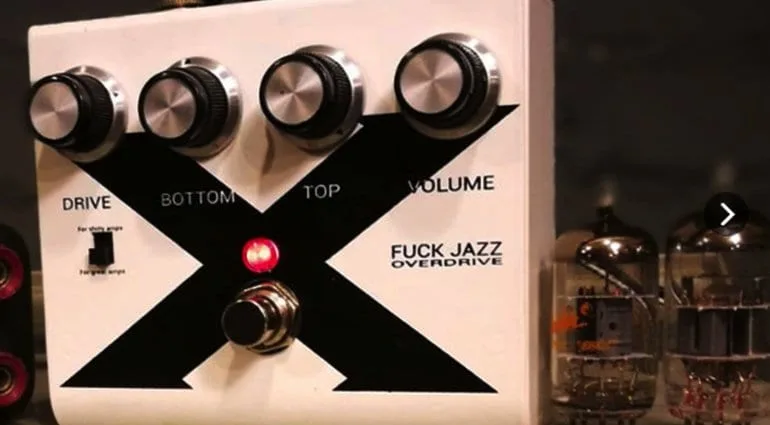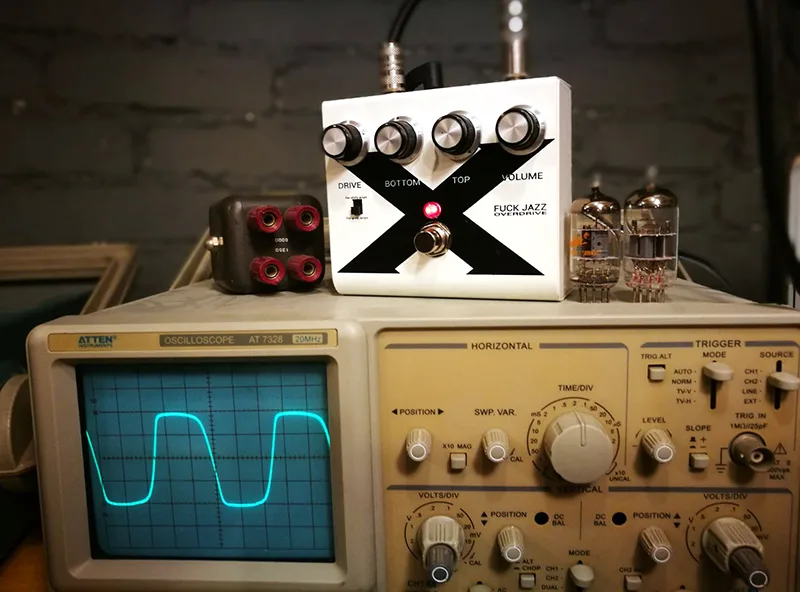


The Laa-Custom Phil X Fuck Jazz Overdrive, usually shortened to FJOD, is a single-channel overdrive pedal built by Laa-Custom, the company spearheaded by designer and builder Carlo Sorasio. It was designed in collaboration with guitarist Phil X, and Sorasio invited reviewers to an extremely limited showing of the pedal at NAMM 20181. The pedal sells for approximately $269 against an MSRP of $294.931.
What it does
As an overdrive, the FJOD sits in the family of pedals that push an amp into a hotter, more saturated version of its own voice, a category covered on the site's Overdrive Pedals page alongside neighbors like Distortion Pedals and Fuzz Pedals. What sets the FJOD apart from a straightforward gain box is its circuit: Laa-Custom developed it around a custom designed output transformer and a class A driver, a combination the company has coined True Coil Technology1.
The control layout is deliberately simple. Four retro-looking, old school-style knobs on the face are labeled Drive, Bottom, Top, and Volume, covering gain, low end, high end, and output level. A single Carling-style footswitch in the center toggles the effect on and off, with a red indicator lamp right above it1.
Build, power and practical details
The pedal is housed in a solid metal enclosure and is just a hair over four inches wide, which MusicPlayers.com's reviewer Bruce Sokolovic described as about the maximum width he likes to see for a single-channel overdrive. The 1/4-inch input and output jacks are placed on the rear of the pedal rather than the sides1.
Power comes from a standard DC input, with the specs supporting both 9V and 12V operation. There is no battery compartment, which the reviewer called a No Go for players who want to throw a lone pedal in a gig bag with a cable and nothing else1.
The FJOD is listed as a "Class A Buffered Bypass" pedal, so it buffers the signal even when the effect is off. There is no true bypass option, and with no battery compartment it always needs external power.
Support and documentation are worth knowing about before buying into a smaller builder. The FJOD ships with a simple PDF manual that fully explains the specs, the features and controls, and information about the circuit and transformer. Product support is limited to email only, and the reviewer found it took a couple of days for a response, though Laa-Custom's social media presence proved a better method of communicating with the company1.
What reviewers said
MusicPlayers.com reviewed the pedal in April 2018 after seeing it at NAMM. On the sound, the reviewer was unambiguous1:
"Well, we can say the PJOD pedal has a great,, and we mean GREAT, sound."
In use, he found it gave a Marshall JCM 800 the perfect push to make it a formidable, modern rock cannon sound, which is the role most players will ask of a pedal like this: an amp that already has a voice, pushed further1.
Videos
Bruce's video dungeon
rockinchippy
joonmoguitar
Questions
What is the Laa-Custom Phil X Fuck Jazz Overdrive?
It is a single-channel, all-analog overdrive pedal built by Laa-Custom, the company led by designer and builder Carlo Sorasio, and designed in collaboration with guitarist Phil X. It was shown at NAMM 2018 and carries the name Fuck Jazz Overdrive, shortened to FJOD in the press. It uses a custom output transformer and class A driver circuit the maker calls True Coil Technology.
How is the FJOD powered?
The pedal supports both 9V and 12V operation through its power input. There is no battery compartment, so it cannot run on a battery, which MusicPlayers.com's reviewer flagged as a drawback for players who like to throw a single pedal in a gig bag. It is listed as a Class A Buffered Bypass pedal.
What did reviewers say about the FJOD?
MusicPlayers.com's Bruce Sokolovic reviewed it in April 2018 and praised the sound, saying the pedal gave a Marshall JCM 800 the perfect push to make it a formidable, modern rock cannon sound. He also noted the solid metal enclosure, the rear-mounted jacks, and the lack of a battery compartment.
Sources (1)
- Laa-Custom Phil X Fuck Jazz Overdrive Pedal, MusicPlayers.com, 2018-04-20