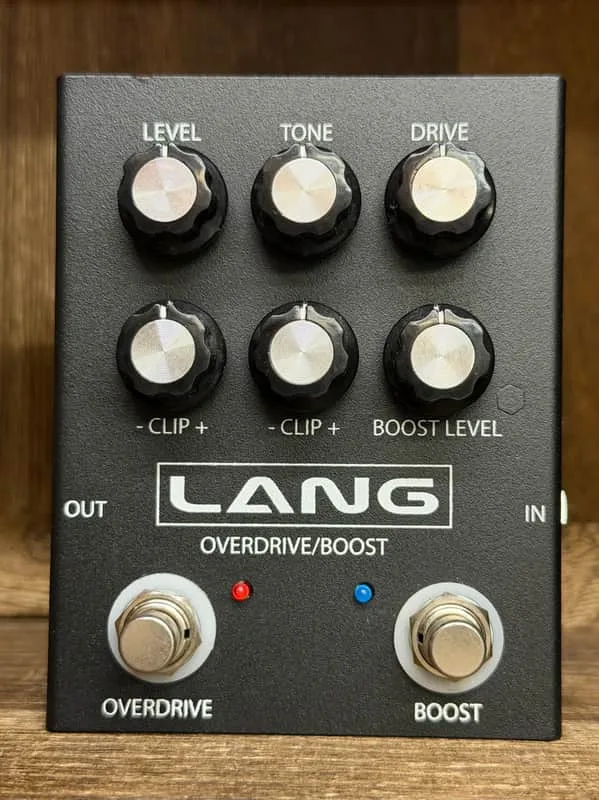
The Lang Amps Overdrive/Boost is the debut stompbox by Lang Amps, a Las Vegas-based amp builder. It is an overdrive/boost pedal that can act as a boost, overdrive, and even distortion at high gain settings, covering ground players usually spread across separate boost, overdrive and distortion pedals1.
What sets it apart is its approach to clipping. The pedal sports an original circuit based on a novel approach to clipping: the saturation can be adjusted for symmetrical or asymmetrical clipping at any level, from the voltage power rails to the signal's zero crossing point1.
Controls
Six knobs cover the pedal's functions. Four of them, Level, Tone, Drive and Boost, do what is expected in any overdrive with an extra boost, while the two "- CLIP +" knobs are the pedal's distinguishing feature1.
| Control | What it does |
|---|---|
| Level | Expected overdrive output control1 |
| Tone | Expected overdrive tone control1 |
| Drive | Expected overdrive gain control1 |
| Boost | Sets the boost level, linked to the Boost footswitch1 |
| "- CLIP +" (two knobs) | Control the character of the two clipping stages continuously, from clipping at the power rails to the zero crossing for that half of the signal1 |
The two CLIP knobs allow adjusting of saturation's clipping, dynamics, and even and odd harmonics separately from the drive and gain controls. In practice, that means a player can dial in the harmonic character of the saturation without re-balancing the amount of gain, something conventional overdrives with fixed clipping stages cannot do1.
The boost footswitch
Alongside the main switching, the pedal carries a separate Boost footswitch linked to the Boost knob. Delicious Audio's Paolo De Gregorio notes it is extremely useful in live situations to push the guitar louder without touching the main drive settings1.
Symmetrical and asymmetrical clipping
Clipping shapes the top and bottom halves of the guitar's waveform as it is saturated. Symmetrical clipping treats both halves the same way; asymmetrical clipping treats them differently, which shifts the balance of even and odd harmonics in the resulting tone. On this pedal that choice is not fixed by the circuit: the clipping is continuously adjustable from symmetrical to asymmetrical at any level, from the voltage power rails down to the signal's zero crossing point, via the two CLIP knobs1.
Questions
What does the CLIP knob do on the Lang Amps Overdrive/Boost?
The pedal has two "- CLIP +" knobs, one for each of its two clipping stages. Each controls the character of that stage continuously, adjustable from clipping at the power rails to the zero crossing for that half of the signal. This lets you adjust the clipping, dynamics, and even and odd harmonics of the saturation separately from the drive and gain controls.
Can the Lang Amps Overdrive/Boost act as a distortion?
Yes. According to Delicious Audio's product page, the pedal is able to act as a boost, overdrive, and even distortion at high gain settings, so it covers ground normally spread across several pedals on a board.
Does the Lang Amps Overdrive/Boost have a separate boost footswitch?
It does. The pedal carries a separate Boost footswitch linked to the Boost knob, which sets the boost level. Delicious Audio notes this is extremely useful in live situations to push the guitar louder without changing the main drive settings.
What is symmetrical versus asymmetrical clipping?
Symmetrical clipping cuts the top and bottom halves of the waveform the same way, while asymmetrical clipping treats them differently, which changes the balance of even and odd harmonics in the saturation. On this pedal the clipping is continuously adjustable from symmetrical to asymmetrical at any level, from the voltage power rails to the signal's zero crossing point.
Sources (1)
- Lang Amps Overdrive/Boost, Delicious Audio, 2023-07-21