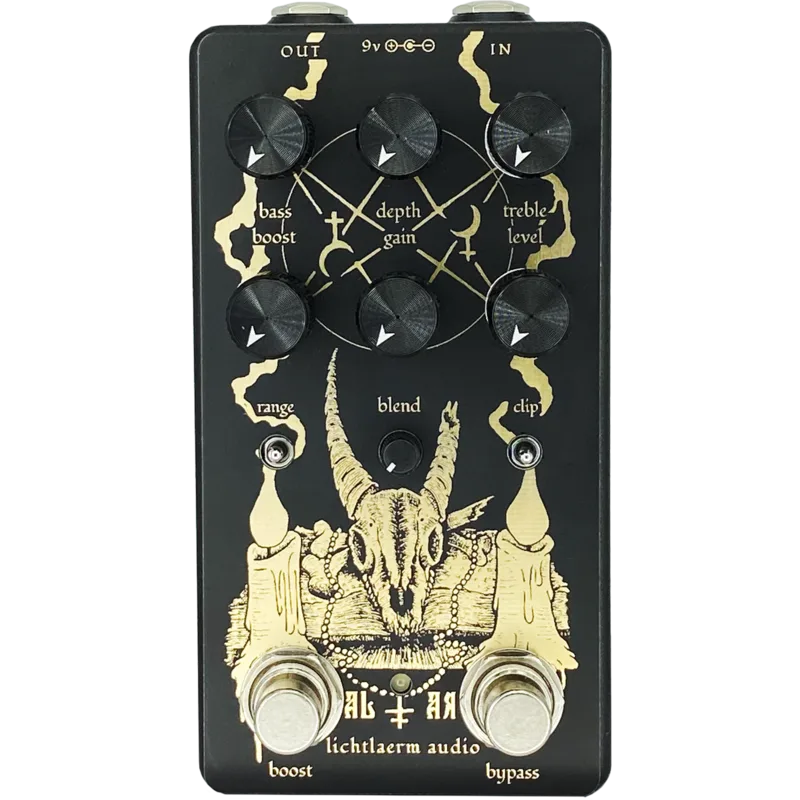


The Lichtlaerm Audio Altar is a "Dual Gain Monolith" pedal that combines fuzz, distortion and a clean boost in one box, built to order by Lichtlaerm Audio. At its core is a fuzz circuit the maker describes as "a loosely summoned spirit of the Black Russian Big Muff", stretched and reworked, with a morphing clipping control that moves between fuzz, overdrive and distortion styles, and a boost stage that works on its own. Lichtlaerm positions it for everything from "soaring Gilmourian sustain to molten doom-soaked riffage, sludge, stoner, and noise rock madness"1.
The circuit and what it does
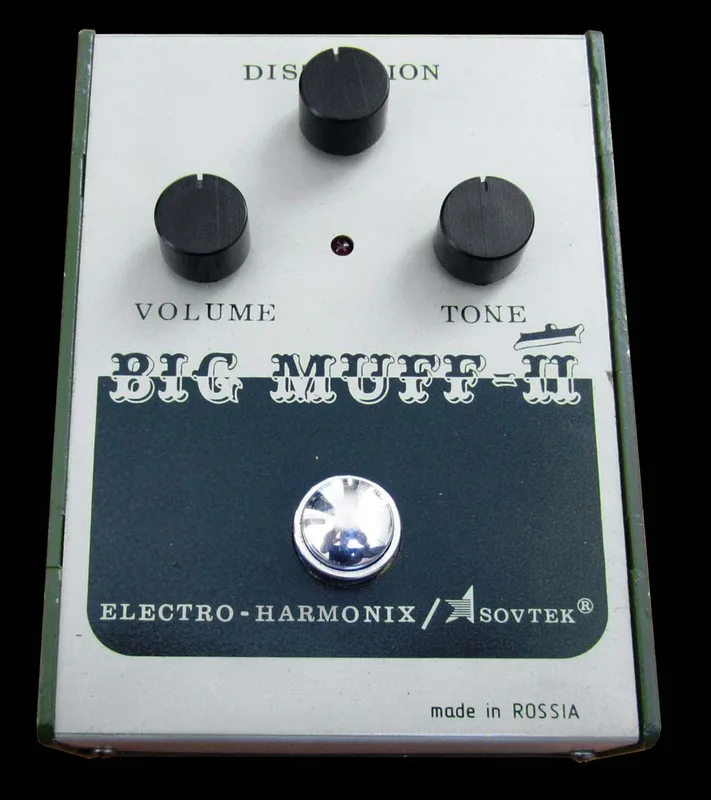
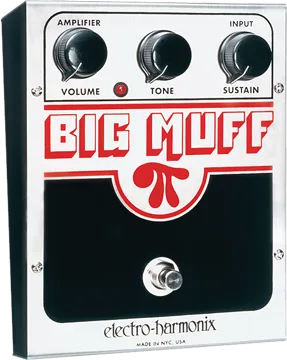
The fuzz side takes its starting point from the Black Russian Big Muff, the Soviet-era version of Electro-Harmonix's fuzz, but Lichtlaerm says it has been "stretched, mangled, and reborn" rather than copied outright1. Two controls shape the character more than anything else:
- Depth sets the input saturation, which the maker says dials in the saturation character "from tight, amp-like drive to blown-out, speaker-destroying fuzz filth", altering compression and fuzziness along the way1.
- COMP is a proprietary morphing control that blends between clipping styles, shifting, in Lichtlaerm's words, "from raw dynamic distortion to dry Muff-style aggression to smooth Germanium-like overdrive"1.
The result is a pedal meant to mix fuzz, overdrive and distortion seamlessly rather than sit in one lane1.
The controls
The Altar carries a large control set, listed here from the maker's page and Guitar Pedal X's review12:
| Control | What it does |
|---|---|
| Gain | Amount of gain on the fuzz/distortion side |
| Level | Output level |
| Bass, Mids, High | 3-band active EQ, ±18dB of cut/boost each, replacing the Blend knob of earlier versions1 |
| Depth | Input saturation: from tight, amp-like drive to blown-out fuzz1 |
| Comp | Morphing clipping control across fuzz, overdrive and distortion styles1 |
| Grind | Warps the boost's EQ curve from near-flat to a fully cranked HM-2-style scoop1 |
| Boost | +36dB of boost on the boost side |
| Boost footswitch | Engages the boost independently |
| Bypass footswitch | Bypasses the pedal |
| DOOM (internal) | Alters the circuit's corner frequencies, shifting from mid-forward Sovtek crunch to a low-end hammer through the clipping stage1 |
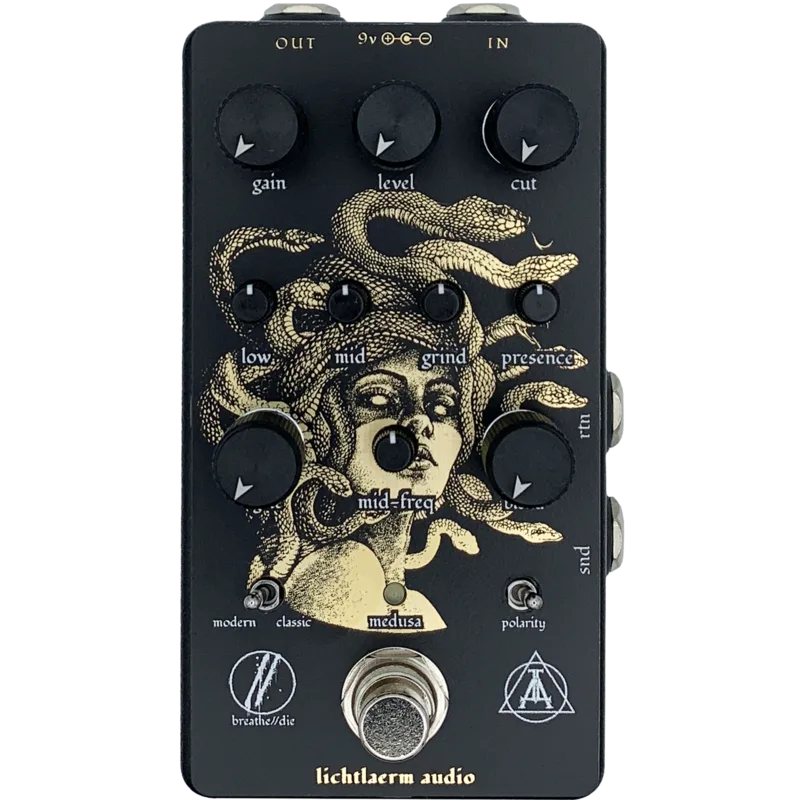
The Grind control is worth a second look: it warps the boost's EQ curve from near-flat to a fully cranked HM-2-style scoop. Lichtlaerm also builds an HM-2-inspired pedal of its own, the Lichtlaerm Audio Medusa, for players who want that circuit on its own1.
The boost
The boost stage is not just a volume push tacked onto the fuzz. Lichtlaerm describes it as "a standalone leviathan: up to +36dB of clean push with a secret agenda", saying it "subtly excites upper harmonics"1. Because it has its own footswitch, it can be used entirely on its own as a boost pedal, or stacked under the fuzz side for solos and riffs that need to jump forward.
Power and practicalities
The Altar runs from a 9V center-negative supply at 13mA, and Lichtlaerm notes that the pedal boosts that to 36V internally, giving the circuit more headroom than the supply alone would suggest1. The 13mA draw is modest, but as with any center-negative pedal it needs a proper DC supply rather than a battery or an AC adapter.
All Lichtlaerm pedals are made to order, and the maker states production may take 14 to 20 days1. The listed price of €199.00 includes EU VAT and excludes shipping1; Guitar Pedal X listed the pedal at €199 / $219 in November 20252.
Guitar, bass and the maker's lineup
Earlier versions of the Altar served both guitar and bass alike, but Lichtlaerm says the new evolution is more focused, with "the guitar version lead[ing] the charge" and tighter control as the aim1. Bass players may want to weigh that against the earlier, dual-instrument versions.
The Altar sits in the Lichtlaerm Audio lineup as a compact pedal built to seamlessly mix fuzz, overdrive and distortion, covering everything from soaring Gilmourian sustain to molten doom-soaked riffage, sludge, stoner and noise rock madness1.
What reviewers said
Guitar Pedal X reviewed the Altar and came away impressed, concluding that "while the overall Doom Fuzz category probably has a new champion now in the Altar"2.
"while the overall Doom Fuzz category probably has a new champion now in the Altar."
Videos
ambienttrash
Let's Play All
We As A Company
Questions
What circuit is the Lichtlaerm Audio Altar fuzz based on?
Lichtlaerm Audio describes the fuzz circuit as a loosely summoned spirit of the Black Russian Big Muff, stretched and reworked rather than a straight copy. The COMP knob then shifts the clipping character across fuzz, overdrive and distortion styles, so the Big Muff lineage is a starting point rather than the whole story.
What does the DOOM switch do?
The DOOM switch is an internal switch that alters the corner frequencies of the circuit. Lichtlaerm says flipping it shifts the gain stages from mid-forward Sovtek crunch to a low-end hammer through the clipping stage, which is where the pedal's doom and sludge character comes from.
How much current does the Altar draw?
The Altar draws 13mA from a 9V center-negative power supply, according to Lichtlaerm Audio. The pedal boosts that supply internally to run at 36V, which is why the current draw stays low even though the internal headroom is high.
What polarity does the Altar use?
The Altar runs on a 9V DC center-negative power supply, the same polarity standard as most modern pedals, so it works with a standard isolated supply.
Can the boost be used on its own?
Yes. Lichtlaerm describes the boost circuit as a standalone leviathan, offering up to +36dB of clean push that the maker says subtly excites upper harmonics. It has its own footswitch, so it can be used independently of the fuzz and distortion side.
Is the Altar made for bass as well as guitar?
Earlier versions of the Altar served both guitar and bass alike, according to Lichtlaerm Audio. The current evolution is more focused, with the guitar version leading the charge, so bass players looking at the newest iteration should treat it as a guitar-focused design.
How long does it take to get an Altar?
Lichtlaerm Audio builds all of its pedals to order, and the maker states that production may take 14 to 20 days before a pedal ships.
Sources (2)
- Lichtlaerm Audio Altar, Lichtlaerm Audio
- Guitar Pedal X, Guitar Pedal X, 2025-11-27