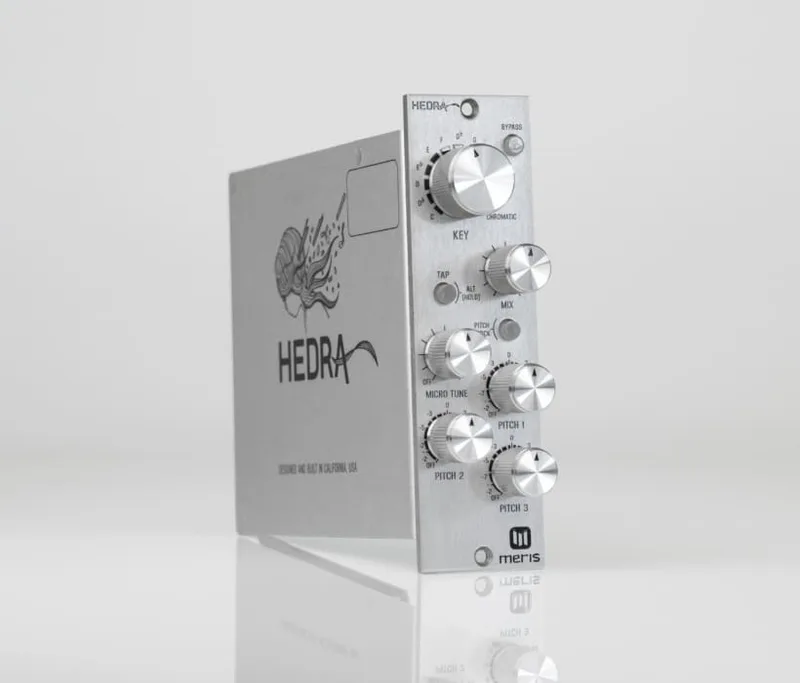


The Meris Hedra is a 3-voice studio pitch shifter with hard tuning, built as a compact pedal and also offered as a 500 series studio rack unit12. Three pitch-shifted voices, each with its own pitch interval and time offset, combine with your original signal to create harmonized, rhythmic layers. Meris describes the result plainly: "3 voices, in rhythm, combine with your original voice to create angelic harmonies"2. Each voice can be delayed and fed back, which opens everything from subtle detune to what the maker calls extreme warping1.
The design draws on a specific lineage. Guitar.com reported at launch that Hedra is "a three-voice rhythmic pitch shifter inspired by studio rack units from the 90s"3, and gearnews.com framed it as bringing 1990s studio rack rhythmic pitch shifting into a guitar pedal3. It sits in the broader family of octave and pitch pedals, but its rhythmic, delay-integrated approach sets it apart from a straightforward octave or harmony pedal.
The controls and alt functions
The front panel keeps a small set of knobs, with a second layer of functions hidden behind them. Alt functions are only accessible while the Hold button is held down2, and Delicious Audio noted that "there's a lot more than meets the eye, thanks to alternate functionality triggered by holding either footswitch"5.
| Control | Main function | Alt function (with Hold) |
|---|---|---|
| Mix | Balances dry and wet signals1 | Controls delay feedback1 |
| Micro Tune | Slightly detunes all three pitch-shifted voices1 | Selects pitch correction (none, loose, strict) between Min and Mid, or amount of glide between Mid and Max1 |
| Pitch 1 | Sets the interval for the first pitch-shifted voice1 | Sets a fraction of the main tempo for the first voice1 |
| Mode | Selects the delay configuration2 | See delay modes below |
| Pitch Feedback | When lit, places the pitch shifters in the delay's feedback loop1 | Runs the delay at half speed1 |
The Micro Tune alt function is where the "hard tuning" part of the design lives: you can choose no correction, loose correction or strict correction, or dial in glide between pitch targets1. In Alt mode, the Key knob gives access to scales: major, minor, Eastern and minor pentatonic, as gearnews.com described6. That scale locking is what makes the voices track musically rather than drifting chromatically.
Delay modes: Dual, Series and Pitch Feedback
Hedra is not just a pitch shifter; it has a delay engine with four configurations, each routing feedback differently26.
| Mode | What it does |
|---|---|
| Dual | Splits the delay into two short delays with a stereo output26 |
| Dual + Series | The same two short delays, with cross-feedback between them26 |
| Series | One long series delay with standard feedback26 |
| Pitch Feedback | One long series delay with the pitch shifters routed into the feedback loop26 |
Pitch Feedback mode, engaged when neither Dual nor Series is active, is the mode that gives Hedra its most distinctive character: each repeat comes back shifted, so the delays climb or cascade through the pitch intervals you have set6. The feedback routing also changes with the mode. In Series delay modes, Pitch 3 sets the feedback loop; in Dual delay modes, Pitch 1 and Pitch 3 both contribute to feedback, accessed through the Mix alt function2.
Total delay time depends on the configuration: the two Series modes share 520 msec, and the two Dual modes share 260 msec2.
Power, MIDI and stereo connections
Hedra is a stereo pedal, with stereo inputs and outputs confirmed by both the maker and Pedal of the Day's review27. Pedal of the Day also listed expression pedal control, MIDI I/O, external tap tempo and switchable input/output headroom levels among its connections7.
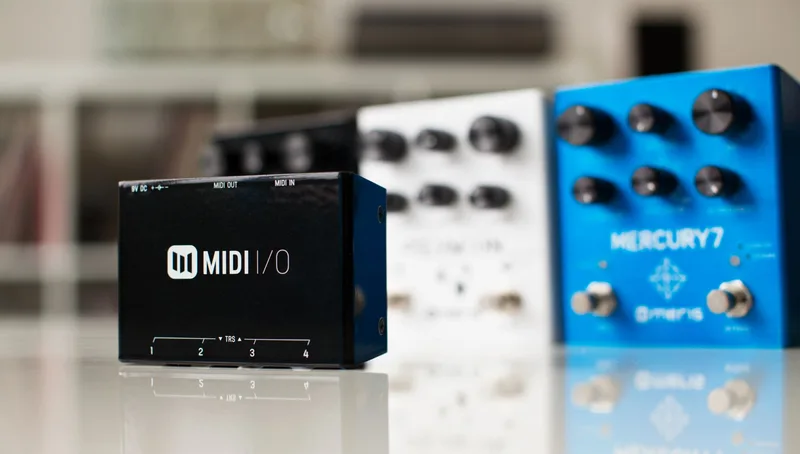
The EXP jack is multi-function: with compatible hardware (not included), it supports MIDI, a preset switch, an expression pedal or a tap switch2. External tap tempo runs over TRS5, and presets are available via an external 4-preset switch or MIDI2. Players building a controlled rig may find the MIDI pedals and expression pedal overviews useful for the hardware that connects here.
MIDI over the EXP jack requires a compatible MIDI to TRS conversion box, which Meris does not include with the pedal2. Plan for that extra piece if MIDI control is part of your setup.
Where it came from and what reviewers said
Meris announced the Hedra in May 2019 at $299, with gearnews.com also listing a UK price of GBP 319 RRP6 and MusicRadar reporting the same $299/£319 pricing with availability later that month8. By July 2019, Premier Guitar reported it was "available now in the USA and shipping to Distributors world-wide"4. The pedal carries Meris's raw brushed aluminum enclosure with clear coat1, and the maker lists a typical signal to noise ratio of -116 dB1. Its DSP design is credited to Angelo Mazzocco, DSP Engineer/VP at Meris2.
The name has a geometric origin: Delicious Audio explains that the device is "named Hedra after the suffix of Polyhedra (meaning multiple planes/sides)"5. In Delicious Audio's Best Pedals of 2019 aggregate chart, the Hedra finished with 8 points9.
Pedal of the Day reviewed it in June 2019 and found it demanding but rewarding7:
"This magnificent beast is tricky to tame, but can be skewed and swerved with a little bit of finesse to make it a useful, exploratory and all-around fun effect to try and wrangle."7
Pedal of the Day, June 20197
That verdict lines up with what the design promises: a pedal with deep, layered controls that rewards players willing to explore its alt functions and feedback routing51.
Videos
Premier Guitar
Meris
Meris
Questions
Is the Meris Hedra true bypass?
Yes, and it is selectable. The Hedra offers relay-based true bypass or analog buffered bypass, so you can choose whether the pedal is fully out of the signal chain when off or keeps a buffer in line to preserve your tone over long cable runs.
How do you use MIDI with the Meris Hedra?
MIDI runs in and out over TRS through the pedal's EXP jack. You need a compatible MIDI to TRS conversion box, which is not included. The same multi-function jack can also be used with an expression pedal, a preset switch or a tap switch, and presets are available through an external 4-preset switch or MIDI.
How long is the delay time on the Meris Hedra?
The total available delay time depends on the mode. The two Series delay modes share 520 msec of total time, while the two Dual delay modes share 260 msec. Pitch Feedback mode, a long series delay with the pitch shifters in the feedback loop, uses the Series timing.
Where does the name Hedra come from?
The name comes from the suffix of Polyhedra, a word meaning multiple planes or sides. It fits the pedal's design: three pitch-shifted voices, each on its own plane of pitch and timing, combine with your original voice to form the complete sound.
Sources (9)
- Hedra - Meris, Meris
- Hedra - Meris, Meris
- Create a cacophony of voices with Meris’ Hedra, Guitar.com, 2019-05-15
- Meris Unveils the Hedra, Premier Guitar, 2019-07-31
- Meris Hedra Stereo Rhythmical Pitch-Shifter, Delicious Audio, 2024-09-13
- Meris Hedra: 1990s studio rack rhythmic pitch shifting, gearnews.com, 2019-05-15
- Meris Hedra Rhythmic Pitch Shifter Delay, Pedal of the Day, 2019-06-12
- Meris's Hedra is an ethereal rhythmic pitch shifting pedal for guitars, synths and more, MusicRadar, 2019-05-16
- Best Guitar Pedals Of 2019, Delicious Audio, 2020-02-07