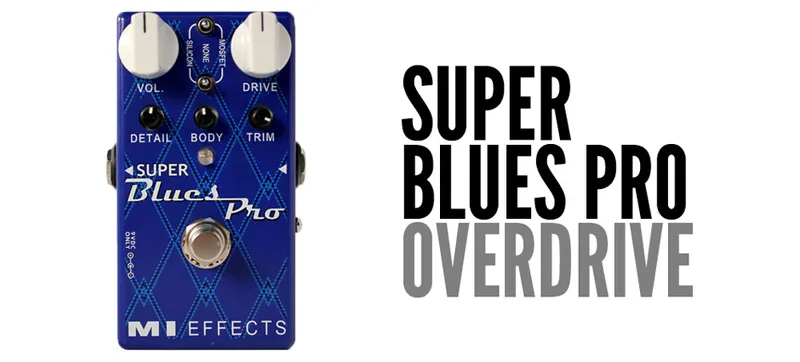


The MI Audio Super Blues Pro is a low to mid-gain overdrive pedal built on a modified Tube Screamer design, and it is an upgraded version of the company's earlier Blues Pro. Premier Guitar described it at launch as a pedal "designed to deliver classic Tube Screamer sound with upgraded features," including control over the bass response, top end and gain and clipping structure1. Where a stock TS-type pedal fixes its voicing, the Super Blues Pro puts those variables on the face of the pedal2.
MI Audio says the range of clipping tones available includes the classic TS sounds of the original Blues Pro, a range of compressed fuzz sounds, a smooth mid-rich overdrive in the vein of Dumble amplifier tones, or an open chiming top-end boost3. The pedal shipped from 8 June 2012, made by MI Effects in Australia1.
A Tube Screamer-style overdrive with fuzz options
The lineage runs from the mid-focused TS sound, which MI Audio calls a classic found on a lot of blues and rock recordings, to the Blues Pro, which took that design a step further. One of the main features of the Blues Pro is a bass and low-mid boost that MI Audio says helps get rid of the typical mid-hump of a TS-type pedal3. The original was an overdrive, in the designer's words, "crammed with many different sounds, accessible via three knobs"1.
The Super Blues Pro keeps that character but extends it. MI Audio describes the pedal as covering a low-gain boost, a harmonic blues solo tone or super-compressed fuzz, all dialled and switched in from the same box2. Premier Guitar's announcement put it the same way: the Super Blues Pro delivers the original mid-focused TS sound found on a lot of classic blues and rock recordings, "and so much more with control over the bass response, top-end and gain/clipping structure"1.
The pedal appeared on That Pedal Show's gear list for its episode on understanding guitar overdrive pedals, covering gain, clipping, headroom and EQ4.
The controls
The Super Blues Pro carries five knobs and two clipping toggles1. Each control shapes a different part of the overdrive:
| Control | What it does |
|---|---|
| VOLUME | Sets the output level1 |
| GAIN | Works with TRIM for fine control of the blend between clean and overdrive signal2 |
| TRIM | A secondary gain in a separate part of the circuit from GAIN; adds bite and sizzle to the attack. At 2 o'clock it gives the classic Blues Pro position2 |
| BODY | Adds more bass and lower-mids to the overdrive2 |
| DETAIL | The flexibility of a multi-band EQ in a single control, from a more open overdrive sound at its most full to a more mid-rich tone as it is dialled back2 |
DETAIL is essentially like the original tone control on the Blues Pro3. In fuzz territory, the BODY control also affects the amount of compression and decay of strummed notes, which MI Audio says allows for a choking, blooming fuzz2.
Clipping switches: Silicon, MOSFET or none
The two toggle switches control the pair of soft-clipping diodes in the circuit, and each switch offers a choice of SILICON, MOSFET or NONE2. Because each toggle controls the clipping of one half of the waveform, the two can be set the same for symmetrical clipping or differently for asymmetrical combinations1. MI Audio's designer describes this as the ability to choose the clipping device for each side of the waveform individually5.
What each setting does, in MI Audio's own description2:
- SILICON: A compressed and throaty overdrive like the original Blues Pro.
- MOSFET: A more open overdrive with a brighter attack, which Premier Guitar's announcement characterized as a more open, tube-like, uncompressed drive1.
- NONE: No clipping diode on that half of the waveform, suited to a low-gain boost to drive the front end of an amp2.
Combining NONE on one switch with SILICON or MOSFET on the other gives an overdrive/fuzz tone that can be gated and super-squished1. MI Audio also notes that selecting either SILICON and NONE, or MOSFET and NONE, gives two different fuzz tones that clean up with the guitar's volume knob2.
Power: 9V in, 18V inside
The pedal runs from a 9V battery or a 9V DC power supply only, through a 2.1mm jack with negative center, drawing 10mA2. Inside, voltage multiplying circuitry boosts that 9V input to an 18V supply for the circuit3. Premier Guitar's launch announcement listed the same feature1.
MI Audio says the added headroom gives more clarity in the top end and attack, and really adds sparkle when using the pedal as a low-gain boost for an amplifier3.
The power input is 9V DC only. Feeding the pedal a higher voltage at the jack is not what the 18V figure refers to; the 18V supply is generated internally from the 9V input32.
Where it came from and what reviewers said
The Super Blues Pro was designed by Michael Ibrahim, director of MI Audio and the company's pedal designer1. MI Effects announced the pedal as ready to hit the streets on 8 June 20121.
The pedal was hand made in Sydney, Australia with a 5 year warranty, in a blue powder coated enclosure with a durable multi-layered silkscreen21. 2" x 4.3" (55.9mm x 109.2mm)2, while Premier Guitar's announcement lists 2.6" x 4.6" (92mm x 117mm)1.
The store page listed the pedal at AU$220.00 and showed it sold out2. MI Audio's product page describes the Super Blues Pro as newly announced and not yet in customers' hands, with the designer looking forward to getting it into the hands of Blues Pro fans3.
"I wanted to create an overdrive, crammed with many different sounds, accessible via three knobs."
Videos
MI Audio
Prymaxe
Brett Kingman
Questions
Is the MI Audio Super Blues Pro true bypass?
Yes. MI Audio specifies a heavy duty 3PDT footswitch with true bypass, so the pedal's circuit is fully out of the signal path when it is switched off. Premier Guitar's announcement of the pedal also listed true bypass switching among its features.
How do you get the original Blues Pro sound from the Super Blues Pro?
Set the TRIM control to 2 o'clock. MI Audio says this is the classic Blues Pro position, and the standard Blues Pro sounds are achieved with the TRIM set there. The DETAIL control is essentially like the original tone control on the Blues Pro, so it works the same way when recalling those tones.
Can the Super Blues Pro run on a battery?
Yes. The pedal takes a 9V battery or a 9V DC power supply only, through a 2.1mm jack with negative centre polarity. Current draw is 10mA. Internally, voltage multiplying circuitry boosts that 9V input to an 18V supply for the circuit.
Who designed the Super Blues Pro?
Michael Ibrahim, director of MI Audio and the company's pedal designer. He described the original Blues Pro as an overdrive crammed with many different sounds, accessible via three knobs, and the Super Blues Pro as the extension of that idea.
Sources (5)
- MI Effects Shipping Super Blues Pro Overdrive, Premier Guitar, 2012-12-05
- Store | MI Audio, MI Audio, 2020-04-11
- Super Blues Pro, MI Audio
- Understand Guitar Overdrive Pedals Gain, Clipping, Headroom, EQ & All That, That Pedal Show, 2020-06-26
- NEW SUPER BLUES PRO!, MI Audio, 2012-08-14