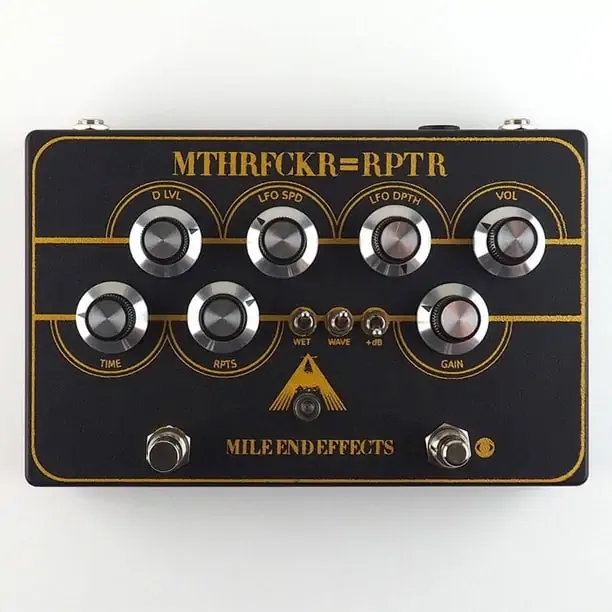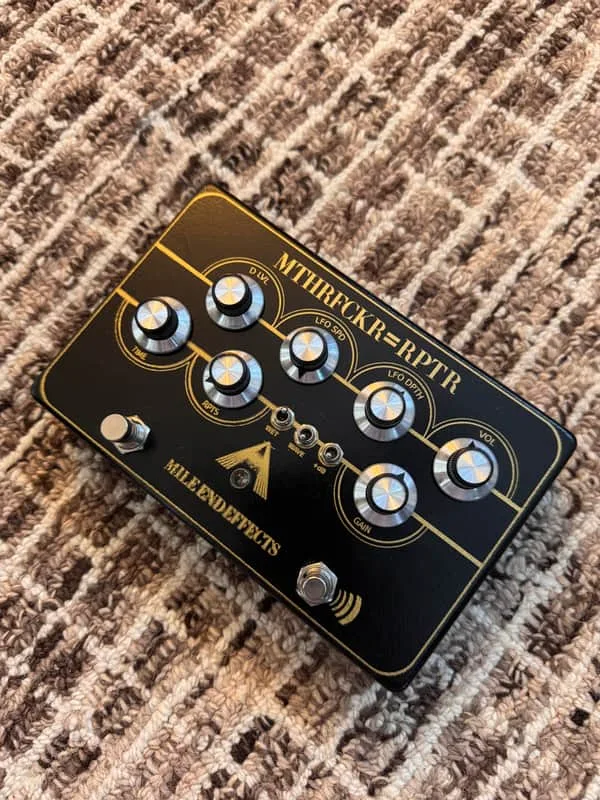


The Mile End Effects MTHRFCKR-RPTR is a digital delay built around the sound of cassette tape falling apart. Premier Guitar's reviewer described it as a pedal that "embraces distortion to an almost perverse degree," probing not just fuzzy overdrive but mangled modulations, all rooted in Mile End founder Justin Cober's fascination with cassette tape degradation1. It sits in the delay family, but it also carries a preamp gain section, which puts it in conversation with preamp pedals and overdrive pedals as much as with other echoes.
Tape inspiration and designer
Mile End founder Justin Cober designed the pedal around his fascination with cassette tape degradation1. Premier Guitar framed the lineage this way: builders of Echoplex- or Space Echo-inspired pedals usually try to replicate the irregularities of the tape medium, but the MTHRFCKR-RPTR puts the mangled possibilities front and center instead1. Where most tape-inspired delay pedals chase a faithful echo, this one leans into what happens when the tape chews the signal.
Controls and how it plays
Two features set the pedal apart for a player working the front panel:
- Wet switch: removes the dry signal entirely, so the pedal can feed only echoes downstream1
- Soft-relay footswitch: for driving the pedal into self-oscillation1
The preamp gain section is a core part of the design. Premier Guitar's reviewer found it "produces harmonically balanced and very organic" overdrive sounds, and noted that it really enhances the delay and modulation textures1. That makes the gain stage a texture control for the echoes as much as a drive in its own right, closer in spirit to a fuzz or distortion voicing than a clean boost.
What reviewers said
Premier Guitar's reviewer summed the pedal up as "a very practical digital delay with a heavy and authentic analog flavor and an extraordinarily fun and creative control interface"1. The same review noted that though the echoes are digitally generated, the sound should please any old-school analog delay fan1.
Videos
Premier Guitar
Mile End Effects
Mile End Effects
News
Questions
Is the Mile End Effects MTHRFCKR-RPTR analog or digital?
The MTHRFCKR-RPTR is a digital delay. Premier Guitar's reviewer noted that although the echoes are digitally generated, they should please any old-school analog delay fan, and described the pedal overall as a very practical digital delay with a heavy and authentic analog flavor.
Who designed the MTHRFCKR-RPTR?
The pedal comes from Mile End founder Justin Cober, whose fascination with cassette tape degradation shaped the design. Premier Guitar's review ties the pedal's character directly to that interest in how tape breaks down and mangles a signal.
What does the wet switch do on the MTHRFCKR-RPTR?
The wet switch removes the dry signal entirely, leaving only the delayed signal. That makes it possible to run the MTHRFCKR-RPTR as the only effect in a chain, or to place it in a parallel setup where the dry signal is handled elsewhere.
Can the MTHRFCKR-RPTR self-oscillate?
Yes. The pedal has a soft-relay footswitch for driving it into self-oscillation, letting a player push the repeats into runaway territory with a stomp rather than by turning knobs.
What size enclosure does the MTHRFCKR-RPTR use?
The MTHRFCKR-RPTR is housed in a 7.4" x 4.7" Hammond 1590D enclosure, a large-format box that leaves room for its control interface.
Sources (1)
- One Bad Mother&$%#in’ Delay, Premier Guitar, 2021-03-29