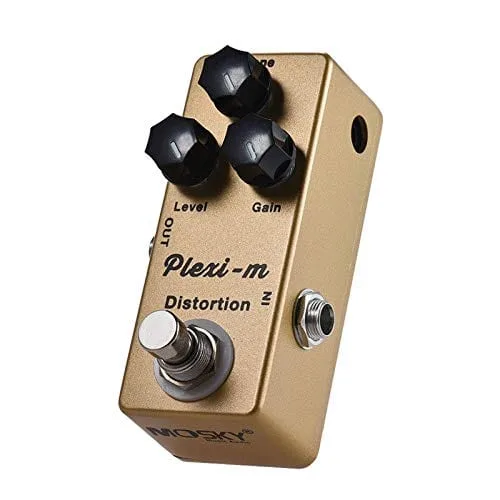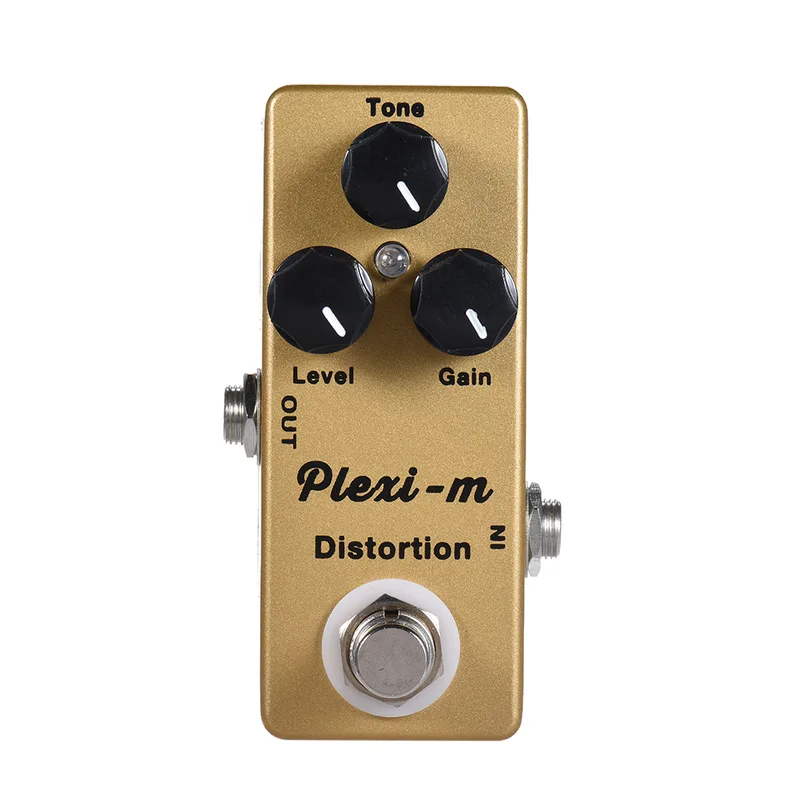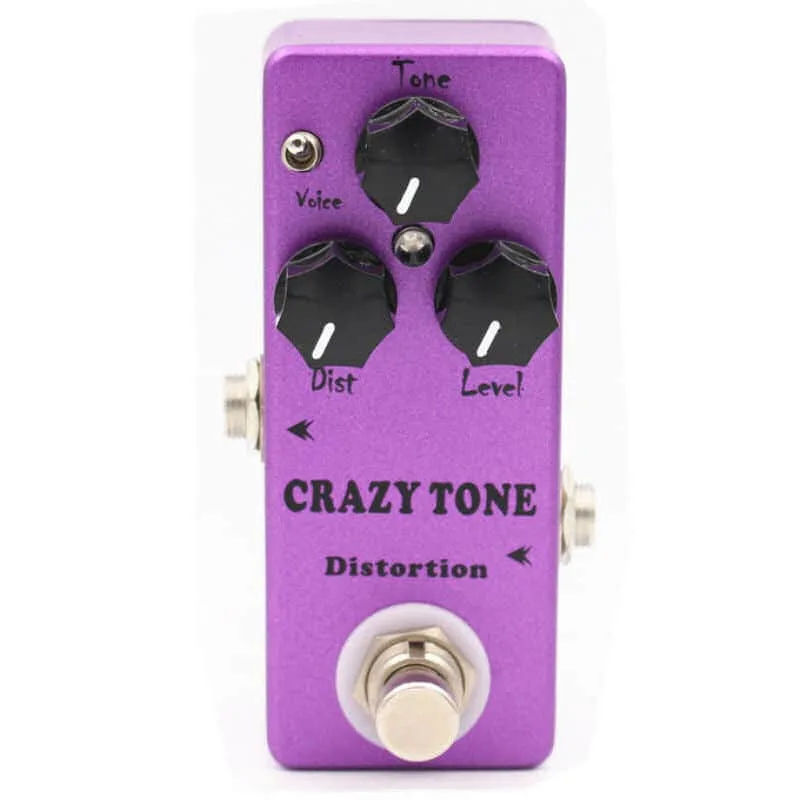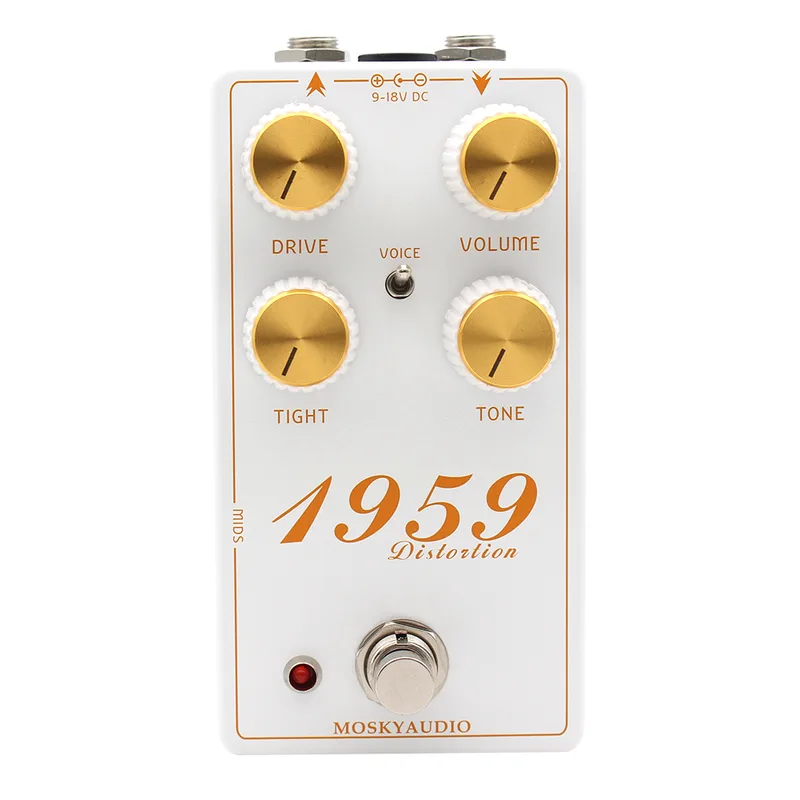

The Mosky 1959 Distortion is a compact distortion pedal from Mosky built around what the maker calls classic British tube amp character. It puts three gain settings and a Tight knob in one small box, aiming at the sounds of the Marshall Bluesbreaker, Super Lead Plexi and JCM800 amps, and it can also run as a booster1. It sits in Mosky's wider line of amp-flavored drives, alongside pedals like the MOSKY PLEXI-M DISTORTION and the Mosky PLEXI Distortion.
The Tight knob and three gain modes
The pedal's core control is the Tight knob. Mosky describes it in broad tonal terms: "The Tight knob transforms your sound, offering everything from iron-rich distortions to the granular textures of Japanese rock"1.
Around that knob sit three gain settings, each aimed at a different amp1:
| Mode | What Mosky says it does |
|---|---|
| Low Gain | Emulates the JTM45/Bluesbreaker for a rich, bluesy sound1 |
| High Gain | Mimics the Super Lead/Plexi, ideal for punchy rock tones1 |
| #34 Mode | A tribute to Slash's modified JCM800, offering a wide dynamic range1 |
Mosky sums up the concept as "Iconic Marshall Tones in a Box: Capture the legendary sounds of the Marshall Bluesbreaker, Super Lead Plexi, and JCM800 amps"1.
Power and bypass
The 1959 Distortion is compatible with 9 to 18V power supplies. Mosky notes that the wider voltage range gives greater headroom and versatility, and says the pedal can double as a booster or EQ1. The pedal is true bypass, which the maker describes as keeping the signal unaltered when the effect is off1.
The pedal's circuit is based on the RAVENSTONE 1959 DISTORTION, according to Mosky's product page1.
Distortion or booster
Mosky lists dual functionality as a standalone distortion or booster1. In practice that means the pedal can be run at lower gain settings as a clean-ish boost into an amp, or pushed as a full distortion on its own. The maker ties this to the 9 to 18V power range, which it says supports greater headroom when used as a booster or EQ1. Players looking at that role may also want to compare dedicated boost pedals or the MOSKY CRAZY TONE Distortion from the same maker.
Videos
Barnstormer001
Questions
Is the Mosky 1959 Distortion true bypass?
Yes. Mosky's product page lists the 1959 Distortion as true bypass, which the maker describes as keeping the signal unaltered when the pedal is switched off. That means your guitar's dry tone passes through unchanged until you engage the effect.
What voltage does the Mosky 1959 Distortion run on?
The pedal is compatible with 9 to 18V power supplies. Mosky notes that running at higher voltage within that range gives greater headroom and versatility, and says the pedal can double as a booster or EQ in that role.
What is the #34 mode on the Mosky 1959?
The #34 Mode is one of the pedal's three gain settings. Mosky describes it as a tribute to Slash's modified JCM800, offering a wide dynamic range. It sits alongside the Low Gain and High Gain settings on the pedal.
Can the Mosky 1959 be used as a booster?
Yes. Mosky lists dual functionality as a standalone distortion or booster. The maker also points out that the pedal's 9 to 18V power compatibility supports its use as a booster or EQ, with greater headroom at higher voltages.
Which Marshall amps does the Mosky 1959 aim to capture?
Mosky describes the pedal as capturing the sounds of the Marshall Bluesbreaker, Super Lead Plexi and JCM800 amps. The three gain settings map onto those amps: the Low Gain setting emulates the JTM45/Bluesbreaker, the High Gain setting mimics the Super Lead/Plexi, and the #34 Mode is a tribute to Slash's modified JCM800.
Sources (1)
- 1959 DISTORTION_Hand-Built Effect Pedals_Products_mosky pedal, moskyaudio.com