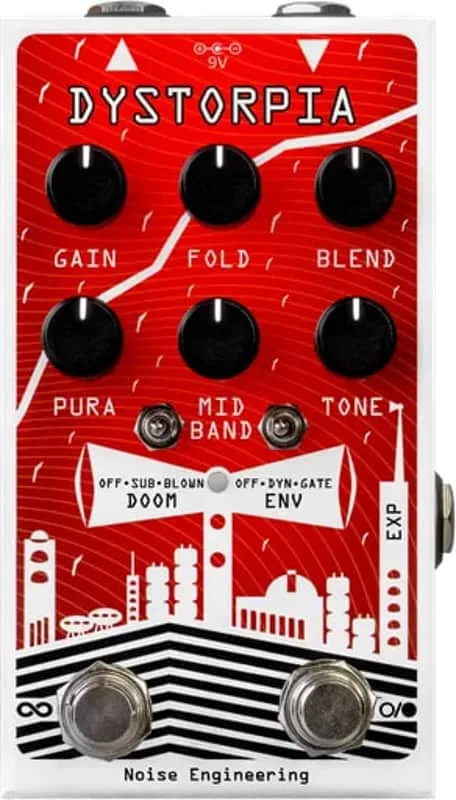


The Noise Engineering Dystorpia is a digital fuzz-distortion stompbox, and the first guitar-based product from Noise Engineering, a company that until the Dystorpia specialized in Eurorack synthesizer modules1. Rather than the transistor or op-amp clipping that most fuzz and distortion pedals use, the Dystorpia generates its gain from two digital distortion circuits: a wavefolding stage and a multi-band rectifier2. Wavefolding bends the waveform back on itself instead of slicing off its peaks, which produces harmonically strange, aggressive tones that reviewers found far removed from typical guitar distortion3.
Delicious Audio describes the result as "a versatile and original fuzzstortion circuit that does, among other things, wavefolding"2. For a player, that means a pedal aimed at textures and noise rather than warm vintage fuzz: Guitar Pedal X called it "a really different somewhat discordant and noisy distortion - nothing like the more typical clipping types of distortion tone"4.
How the circuit works
The Dystorpia blends two distortion generators. The Fold side is a wavefolder, which Delicious Audio says "produces a nasty and gnarly distortion"2. The Pura side is a multi-band rectifier that adds a harmonic fuzz; guitar.com's reviewer notes it also produces an up-octave21. Because neither stage clips the signal the way a conventional fuzz does, the character of the gain is different: folding and rectifying reshape the waveform into new forms rather than flattening its peaks.
A three-way toggle on the left selects between an ordinary signal path, a Gate that silences unwanted noise, and what the maker calls a Dynamic Circuit, which shapes the output to match the dynamics of the input, "therefore delivering a truly uncompressed and touch-sensitive distortion or fuzz"2. Guitar.com describes the Dynamic mode as one that "clamps down more gently when you're playing quietly"1.
The controls
| Control | What it does |
|---|---|
| Fold | Sets the wavefolding side, producing a nasty and gnarly distortion2 |
| Pura | Sets the multi-band rectifier, adding a harmonic fuzz and an up-octave21 |
| Gain | Sets the amount of saturation2 |
| Tone | Sets the overall EQ2 |
| Mid Band | Sets the mid focus, allowing for cutting or more hollow tones2 |
The two footswitches are an Engage switch for bypass and a Freeze switch that holds the sound indefinitely as a drone3. There is also an expression pedal input linked to the tone circuit, so the overall EQ can be swept with the foot1.
What it sounds like
Guitar.com's reviewer Richard Purvis characterized the core tone as "fine-grained and buzzy rather than loose and gurgly, with a sensible gain range and a taut smoothness that makes it ideal for big lead lines"1. That places it away from the sagging, spitting character of vintage-style fuzz and closer to a tight, textured distortion. Guitar Pedal X called the pedal as a whole "raw and spiky sounding," and pretty far removed from most guitar distortions3.
Two practical points from the review stand out. First, the octave from the Pura side "tracks tidily on the upper frets and creates some great lo-fi textures on chords"1. Second, running Fold and Pura together is a lot: Purvis wrote that he "found the combination to be almost always overwhelming"1, which suggests treating the two stages as alternatives to blend in carefully rather than both at full tilt.
"Highly musical and addictive drone feature"
The enclosure itself is substantial: guitar.com describes it as "an extremely heavy chunk of metal"1.
What reviewers said
Guitar.com's September 2024 review praised the drone feature, the octave tracking and the effective noise gate1. The reviewer found the octave "tracks tidily on the upper frets and creates some great lo-fi textures on chords," while noting the Fold and Pura combination is "almost always overwhelming"1. Guitar Pedal X included it in its roundup of the best new distortion pedals of 2024, highlighting it as a genuinely different, discordant and noisy take on distortion4. The consistent thread across reviews is that the Dystorpia is not trying to be a conventional fuzz: it is a noise and texture instrument with a modular pedigree, best suited to players who want sounds a clipping circuit cannot make.
Videos
Noise Engineering
Noise Engineering
Harp Lady
Questions
Is the Noise Engineering Dystorpia analog or digital?
It is a digital pedal. Noise Engineering comes from the Eurorack synthesizer module world, and the Dystorpia brings that digital approach to a guitar stompbox. Its sound is generated by wavefolding and multi-band wave rectification rather than the analog clipping used in most fuzz and distortion pedals.
Does the Dystorpia have an expression pedal input?
Yes. The Dystorpia has an expression pedal input linked to the tone circuit, so you can sweep the overall EQ with your foot while playing. This is one of several features carried over from Noise Engineering's modular synthesizer background.
What does the Freeze footswitch on the Dystorpia do?
The Freeze footswitch holds the sound indefinitely, producing a sustained drone from whatever you are playing at the moment you press it. Guitar.com's reviewer called it a highly musical and addictive drone feature, and it is one of the pedal's most distinctive tricks.
Does the Dystorpia have a noise gate?
Yes. A three-way toggle on the left of the pedal offers a Gate setting that silences unwanted noise, alongside a Dynamic Circuit setting that shapes the output to match the dynamics of your input. The reviewer at guitar.com found the gate works effectively.
How much does the Dystorpia cost?
The Dystorpia was priced at $399 in the USA when it launched in 2024. In the UK it was listed at around £360 at launch, with later reviews quoting £347 to £379, so UK pricing has varied between retailers and over time.
Sources (4)
- Noise Engineering Dystorpia Review, guitar.com, 2024-09-25
- Noise Engineering Dystorpia Distortion, Delicious Audio, 2025-08-19
- Guitar Pedal X, Guitar Pedal X, 2024-09-06
- Guitar Pedal X, Guitar Pedal X, 2024-12-17