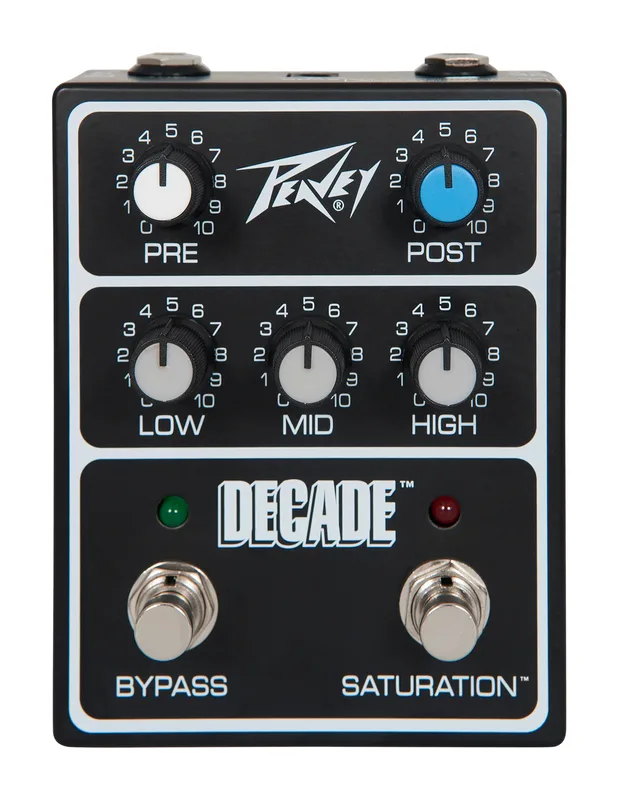


The Peavey Decade Preamp is a preamp pedal from Peavey Electronics that puts the front end of the company's circa-1980 Decade combo amp on a pedalboard. Peavey describes the sound as "crunchy and wiry, emphasized midrange with lots of harmonic richness, well-balanced tone at low gain"1. It is a single-input, single-output pedal with Pre and Post gain controls, a switchable Saturation circuit, and a 3-band EQ, in the same control layout as the original amplifier12.
The Decade itself was a 10W solid-state practice combo3, and the pedal is a faithful recreation of that original circuit1. Its claim to fame is Josh Homme: Peavey calls the pedal a re-creation of Josh Homme's 1980s Decade combo amp1, the amp behind his Queens of the Stone Age tones. Original Decade amps shot up in price after Homme shared that it was his studio secret weapon4.
A crunchy, mid-forward solid-state preamp
The Decade Preamp is an amp-in-a-box pedal: instead of modeling or approximating a circuit, it miniaturizes the preamp section of a specific vintage Peavey amplifier. Peavey says the pedal delivers the Decade's character without the hassle of dealing with an old '80s practice amp4, and the maker's own description of the tone centers on a crunchy, wiry midrange with harmonic richness that stays balanced at low gain settings1.
One thing the pedal deliberately does not do: it has no onboard cabinet or speaker emulation1. It is a preamp, not a complete direct rig, so players who want to go straight to a front-of-house console or an interface without an amp will want to pair it with a speaker simulation pedal.
The controls: Pre Gain, Post Gain, Saturation and 3-band EQ
The control layout is identical to the original amplifier's2, which keeps it simple: two gain knobs, a three-band EQ, and one switch.
| Control | What it does |
|---|---|
| Pre Gain | Sets the gain of the input circuitry1 |
| Post Gain | Sets the sensitivity of the power amp input stage, acting as the master volume1 |
| Saturation | Switchable function that increases gain and harmonic content even at low output levels1 |
| Low EQ | Continuously variable bass control1 |
| Mid EQ | Variable midrange control that interacts with the Low and High bands1 |
| High EQ | Variable treble control1 |
Pre Gain and Post Gain work like the input and master volumes on the original amp: Pre Gain drives the input circuitry into its crunch, and Post Gain sets how hard the downstream stage is hit1. The EQ bands are interactive rather than isolated, with the Mid control specifically described as interacting with the Low and High bands1.
The Saturation switch
Saturation is the circuit the original Decade was known for. Premier Guitar reported that the pedal's switchable Saturation is built off the Peavey Saturation patent, and allows tube-like sustain and overload2. With Saturation off, the pedal runs in its Normal mode; switched on, it adds gain and harmonics even when Post Gain is turned down, so the extra character is available at quiet output levels1. Peavey says that at maximum Saturation the pedal reaches fuzz-like levels of gain and harmonics1, which puts its ceiling well past ordinary crunch territory and into fuzz pedal range.
The output level matches the input signal level1, so the pedal can sit in a chain without large level jumps when it is engaged.
Power: 9V in, 24V inside
The power arrangement is the main place the pedal departs from a straight parts copy of the amp circuit. The input is a standard 9V DC supply through a barrel connector with a negative tip, and a standard 9V battery works too1. Inside, a high-efficiency inverter boosts that 9V to 24V1.
That internal 24V rail is what gives the pedal the dynamic response and headroom of the vintage amp, according to gearnews5. For a player, it means the pedal runs from the same 9V power supply as the rest of a pedalboard, with no special high-voltage adapter, while the circuit itself sees the higher rail the original amp's design expects.
The pedal runs on a standard 9V center-negative supply or a 9V battery, but the circuit inside runs at 24V via an internal inverter1. No external 24V supply is needed or used.
Connections and bypass
The pedal keeps connectivity minimal: one instrument input labeled "IN" and one line-level output labeled "OUTPUT"12. The output is capable of driving PA systems, instrument amps or pedalboards, with a 1 kΩ output impedance1. Bypass is a hard bypass with anti-click circuitry1, so the dry signal path is not buffered when the pedal is off.
The enclosure is a rugged die-cast box built with what Peavey describes as premium components, and the pedal has been tested and approved for worldwide EMC and FCC compliance by an independent laboratory1. Guitar.com's review notes it is made in Taiwan3.
Where it came from: the Decade and Josh Homme
The original Peavey Decade was a 10W practice combo from around 198013. It stayed a sleeper until Josh Homme revealed it as his studio secret weapon for Queens of the Stone Age tones, after which original Decade amps shot up in price4. Homme has since collaborated with Peavey on the Decade Too, his signature amp, breathing new life into the Decade name6.
"Original Peavey Decade amps have shot up in price ever since Josh Homme shared his secret weapon in the studio."
What it costs
Guitar.com listed the Peavey Decade Preamp at $199 USD in March 20263. gearnews had reported a lower street price of $176.00 USD in December 20257, so street prices have moved around the $199 list figure. Peavey's own product page lists the pedal at £152.00 GBP13.
Videos
Peavey Electronics
Eirik Stordrange
TheGuitarGeek
Questions
Does the Peavey Decade Preamp pedal have cab simulation?
No. Peavey states the Decade Preamp pedal does not have any onboard cabinet or speaker emulation. Its line-level output can drive a PA, an instrument amp or a pedalboard, but players going direct to a PA or interface will need a separate speaker simulation pedal to get the sound of a cab.
What does the Saturation switch do on the Peavey Decade pedal?
Saturation is a switchable function that increases gain and harmonic content even at low output levels. Peavey describes it as built off the Peavey Saturation patent, allowing tube-like sustain and overload. At maximum Saturation the pedal reaches fuzz-like levels of gain and harmonics.
Can I plug the Peavey Decade Preamp straight into a PA?
Yes, electrically. The output is a line-level output capable of driving PA systems, instrument amps or pedalboards, with a 1 kΩ output impedance. But since there is no onboard cabinet or speaker emulation, a direct PA feed will sound like a raw preamp rather than a miked amp unless you add a speaker simulation.
Is the Peavey Decade pedal based on Josh Homme's amp?
Yes. Peavey calls it a re-creation of Josh Homme's 1980s Decade combo amp. Homme's Peavey Decade was his secret weapon for Queens of the Stone Age tones, and he has collaborated with Peavey on the Decade Too signature amp. Original Decade amps rose in price after he revealed he used one.
Where is the Peavey Decade Preamp made?
Guitar.com's review states the pedal is made in Taiwan. It is built by Peavey Electronics with what the maker describes as premium components inside a rugged die-cast enclosure, and it belongs to the Peavey Legacy Preamp Series of miniaturized classic Peavey amp circuits.
Sources (7)
- Decade™ Preamp Effects Pedal, Peavey
- Peavey Debuts Decade PreAmp Pedal, Premier Guitar, 2025-04-28
- Acorn Amplifiers Solid State Preamplifier review, Guitar.com, 2026-03-17
- QOTSA secret studio weapon in a pedal? Acorn Amps Solid State, gearnews.com, 2022-04-05
- Peavey Preamp Pedals: Bandit, Rock Master, Decade, Session, and VTM, gearnews.com, 2025-01-25
- "If you're seeking a polished, smooth, modern distortion, this is most definitely not the stomp box for you": Peavey Decade preamp pedal review, MusicRadar, 2025-07-29
- The 5 Best Effects Pedals of 2025: From Perfect Beginner Tool to Premium Boutique Effect, gearnews.com, 2025-12-15