

The Pettyjohn Electronics FILTER is an EQ pedal from Pettyjohn Electronics, a pedalboard-sized equalizer designed by Stephen, the company's founder, who had been thinking about making an EQ well before the pedal existed1. It belongs to the company's line of guitar effects pedals, sold through the maker's own shop21.
Pettyjohn Electronics is the maker of the FILTER, offering it through its own shop alongside its other pedals21. The idea for an EQ from the company goes back to its founder: the designer Stephen had been considering making an EQ long before the pedal appeared3.
What the FILTER does to your sound
Each of the three bands offers up to 12 dB of boost or cut, which is a wide range for a pedal: enough to reshape a guitar's voice entirely, not just nudge it. The bands are laid out to cover the range of a guitar, and a LEVEL control lets you set the pedal for unity gain or use it as a boost with any EQ curve engaged2.
The maker says the FILTER's high headroom gives a low-noise, low-distortion performance, again with the transparency and musicality of an analog console EQ in mind3. How a band behaves depends on where it sits:
- Low band: voiced for "very powerful low-end without feeling muddy, even at high boost levels," according to Delicious Audio2.
- Mid band: the inductor-driven bell, described in more detail below.
- High band: Delicious Audio found it "highly useful for dialing in the perfect amount of sweet articulation or smoothing harsh overtones"2.
Controls and frequencies
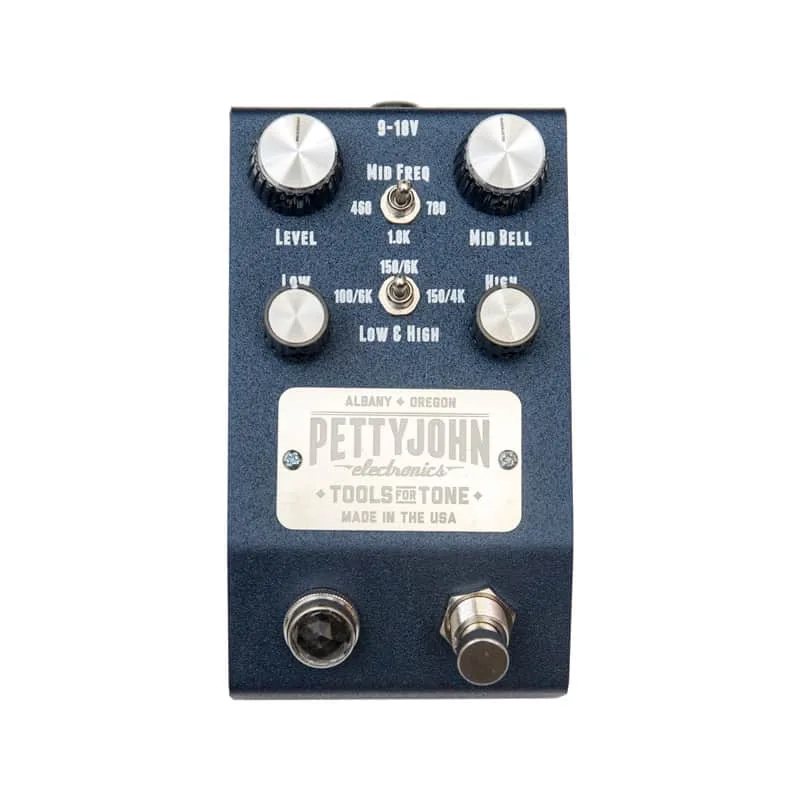
The pedal keeps its controls compact: three band knobs for boost and cut, mini toggles to select each band's filter shape or center frequency, and a LEVEL control12. Semi-parametric here means you choose the frequency from fixed options rather than sweeping it continuously.
| Band | Toggle options | Filter type |
|---|---|---|
| Low | 150 Hz or 100 Hz | Bell at 150 Hz, or low shelf at 100 Hz3 |
| Mid | 460 Hz, 780 Hz or 1.8 kHz | Inductor-driven bell3 |
| High | 4 kHz or 6 kHz | Bell3 |
The low shelf at 100 Hz is the one non-bell option, useful for a broad lift or cut of the bottom end rather than a focused hump. The mid choices span the range where a guitar's body and bite live, and the high choices sit where articulation and harshness are decided.
The inductor-driven mid bell
The mids are the circuit's centerpiece. A premium inductor drives the bell filter, and Pettyjohn says the Mids section "is based on some of the most sought after console EQ's ever made"3. That topology is a deliberate nod to vintage studio EQs, which used inductors rather than the op-amp gyrator circuits common in cheaper designs.
Delicious Audio's Paolo De Gregorio reported on what that choice buys in practice2:
"the use of a real inductor results in a rich, dimensional sound that makes the 'mids' come alive with extra harmonics"2
Wah-like tones
The FILTER is an EQ, not an envelope filter or wah, so it will not sweep automatically as you play. But the mid bell can be pushed toward similar territory. Delicious Audio found that "vocal, wah type tones are even available when the mid bell is pushed to the extreme and can be perfect for getting a solo" tone2. Set the mid toggle to 780 Hz or 1.8 kHz, boost hard, and the pronounced resonance starts to behave like a fixed wah position rather than a flat EQ adjustment.
Where it came from
The FILTER comes out of a long-held idea: Stephen, the founder of Pettyjohn Electronics, had been thinking about making an EQ well before the pedal was built3. The pedal is sold by the maker through its own shop2.
The designer behind it is Stephen, Pettyjohn's founder, who had been considering an EQ design for some time before the pedal existed3. Pettyjohn Electronics makes and sells the FILTER through its own shop21.
Pettyjohn Electronics sells the FILTER through its own shop21. The pedal was designed by Stephen, the company's founder, whose interest in building an EQ predates the product3.
How it fits with other Pettyjohn EQ pedals
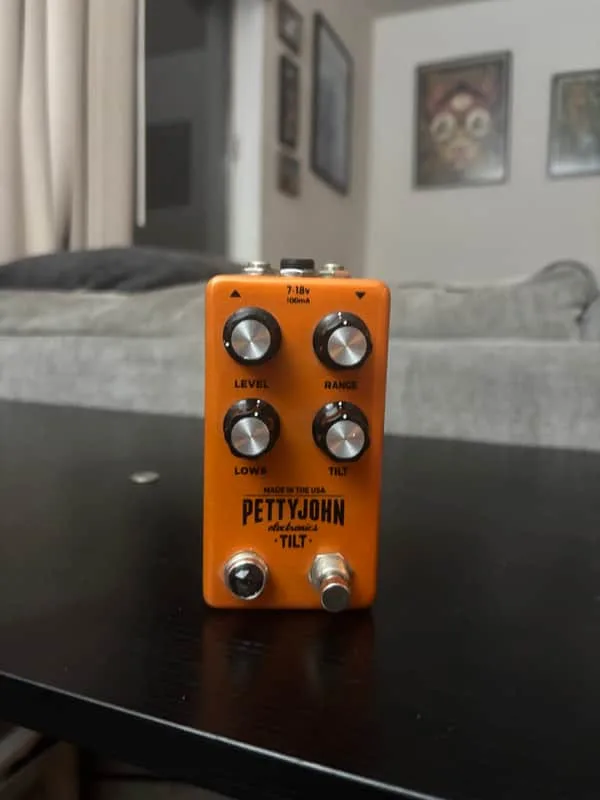
The FILTER is not the company's only take on tone shaping. Pettyjohn has also released the Tilt, a different approach from the FILTER's three fixed bands. Players comparing the two can read more on the Pettyjohn Tilt page1.
Videos
Pettyjohn Electronics
Shawn Tubbs
Linda Taylor
Questions
What frequencies does the Pettyjohn Electronics FILTER control?
The Low band works as a bell at 150 Hz or a low shelf at 100 Hz. The Mid band is an inductor-driven bell selectable at 460 Hz, 780 Hz or 1.8 kHz. The High band is a bell at 4 kHz or 6 kHz. Together the three bands cover the range of a guitar, with 20 Hz to 20 kHz of dynamic range.
Does the FILTER use a real inductor in the mids?
Yes. The mids use a premium inductor-driven bell filter, a topology Pettyjohn says is based on some of the most sought after console EQs ever made. Delicious Audio reported that the real inductor gives the mids a rich, dimensional sound with extra harmonics.
Can the FILTER make wah-like tones?
Not as an envelope filter would, but pushing the mid bell to its extremes gets close. Delicious Audio found that vocal, wah-type tones are available when the mid bell is pushed to the extreme, which they described as useful for solo tones. It is still an EQ, not a triggered filter.
What size is the Pettyjohn Foundry Series footprint?
The Foundry Series is Pettyjohn Electronics' single-pedal format, and the FILTER is the sixth pedal released in it. The maker describes the FILTER as a three-band semi-parametric EQ in that humble single-pedal footprint, sized for a normal pedalboard rather than a rack or large-format unit.
Sources (3)
- Pettyjohn Electronics Unleashes the Filter, Premier Guitar, 2017-11-23
- Pettyjohn Electronics Filter EQ, Delicious Audio, 2017-11-23
- FILTER: The Best EQ Pedal, Pettyjohn Electronics, 2019-02-19