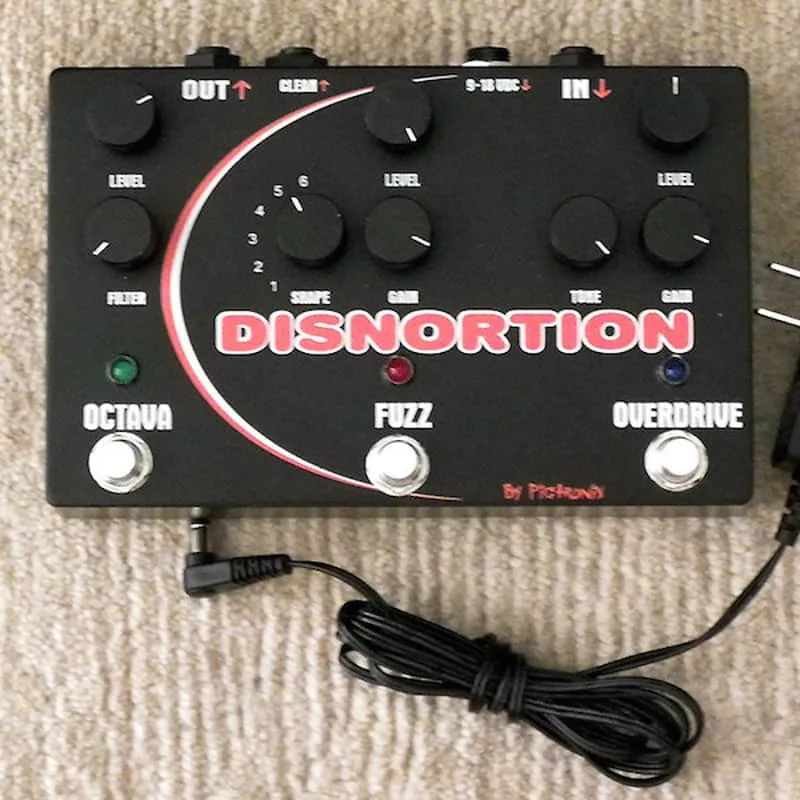


The Pigtronix Disnortion is an analog overdrive, fuzz and octave-up pedal in one enclosure, made by the US effects firm Pigtronix1. It is a large, three-footswitch pedal23, with each of its three effects on its own switch so you can use them alone or stacked. Pete Thorn, demoing it, described it as "a vintage stle overdrive a fuzz and an octave effect all in the same pedal"4.
The original pedal was in production from 2005 to 20153, and gearnews reports that the original Disnortion pedals ceased being made in 20155. The design did not disappear: Pigtronix later released the Disnortion Micro's larger sibling, the Disnortion Micro, a compact version carrying over the same analog fuzz and overdrive circuits6.
Octave, fuzz and overdrive working in parallel
The Disnortion's defining idea is that its three effects are independent and can run at the same time. MusicRadar's Trevor Curwen notes that "the original had three independent effects"2. Analog Man's product page for the OFO Disnortion, the version it sold, describes the routing in detail: parallel fuzz and overdrive, with the octave circuit wired in series before them8. That means the octave-up feeds the dirt circuits rather than sitting alongside them.
Each circuit has its own character:
- Overdrive: a touch-sensitive circuit using a proprietary 5-stage gain architecture that Pigtronix says retains the natural tone of the instrument while gradually breaking up as you play louder8. Thorn called the overdrive side "a real warm fat vintage style overdrive"4.
- Fuzz: Pigtronix's own take on diode clipping, which the maker describes as providing plenty of compression and controllable feedback while preserving dynamics8.
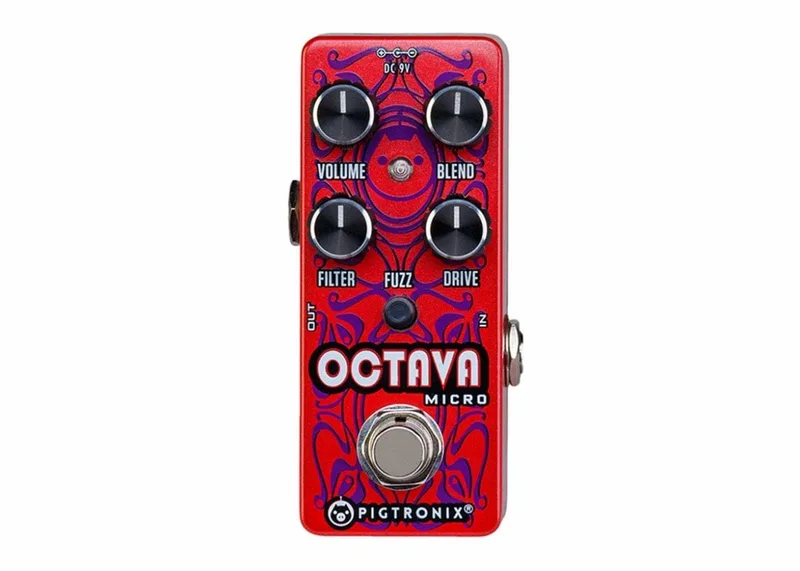
- Octave: a frequency-doubling octave-up8, the circuit Pigtronix later expanded into the standalone Octava Micro.
The whole pedal is described by its maker as extremely low noise, with controls tuned to give the widest musical range from each circuit8. In his demo, Pete Thorn found the pedal flexible enough that it worked with almost any guitar and amp combination he tried4.
The controls
Each of the three sections has its own small control set, which is what the three footswitches and large enclosure allow.
| Section | Controls | What they do |
|---|---|---|
| Overdrive | Level, Gain, Tone | Set the drive section's volume, saturation and brightness4 |
| Fuzz | Gain, Level, Shape | Shape "radically alters the frequency of the fuzz"4 |
| Octave | Level, Filter | Filter rolls off highs on the octave signal4 |
The fuzz's shape control is the one Thorn spent the most time on in his demo: at its lowest setting versus higher settings it radically changes the fuzz tone, getting thin and then super fat4.
The Disnortion Micro simplifies this. It has knobs for Gain and Output volume2, with a single gain knob controlling the saturation of both the fuzz and overdrive circuits simultaneously93. In place of the shape control it uses a rotary tone control filter switch providing 6 musical EQ curves through a complex passive network3. The Micro also adds Series/Parallel switching3, where the original's fuzz and overdrive worked only in parallel2. Its six filter positions include No Filter and Low Pass (Bass)3.
The original Disnortion runs on 18V7. The Micro operates on standard 9V power and uses an internal converter to achieve the same 18-volt headroom2, so the two pedals need different supplies.
What reviewers said
MusicRadar's review of the Disnortion Micro describes Parallel mode as a blend of fuzz and overdrive, more overdrive in nature, ranging from clean boost to gritty just-breaking-up sounds to natural distortion with a crisp fuzzy edge and individual string clarity2. Among its listed pluses is its compact size2.
Pete Thorn's demo video covers the full pedal:
Pigtronix's launch material for the Micro leaned on the original's reputation, saying it "is loved for its limitless headroom, making it compatible with any instrument, from th"e weakest '60s pawnshop single coils to the most belligerent humbuckers, as well as 5-string active basses and modern synth rigs3.
A related pedal, the Aria Disnortion, is an analog overdrive with a 3-band active EQ (Bass, Mid, Treble) that Premier Guitar's reviewer found "very flexible"1011. Their buying advice on the Aria: buy it if you want a flexible fuzz covering many tones including bass fuzz, skip it if you want a low-gain transparent overdrive11. Pigtronix claimed the Aria would "make you write new songs"10.
In his demo video, Pete Thorn found the Disnortion flexible, reporting that it worked with almost any guitar and amp combination he put it with4.
Who uses it
Pigtronix's 2017 press material says the original Disnortion "remains in constant use with world-class bands such as Queens of the Stone Age, Aerosmith, Living Colour, and Muse."3 On the bass side, Bass Gear Magazine notes the Disnortion "had been used for years by bass players, including Tony Levin"12, which lines up with the maker's headroom claims for 5-string active basses3. The Micro's sound design is credited to David Koltai3.
The Disnortion Micro and later Pigtronix fuzzes
The Disnortion Micro is a micro-sized pedal2, a micro version of the classic Disnortion3. Delicious Audio dates it back to 201413, while Pigtronix announced it in 2017 and described it as available at retailers worldwide3. Its CMOS overdrive responds to playing dynamics using a unique 6-stage gain architecture6, and it packs the 18V headroom of the original analog fuzz and overdrive circuits into the small box3.
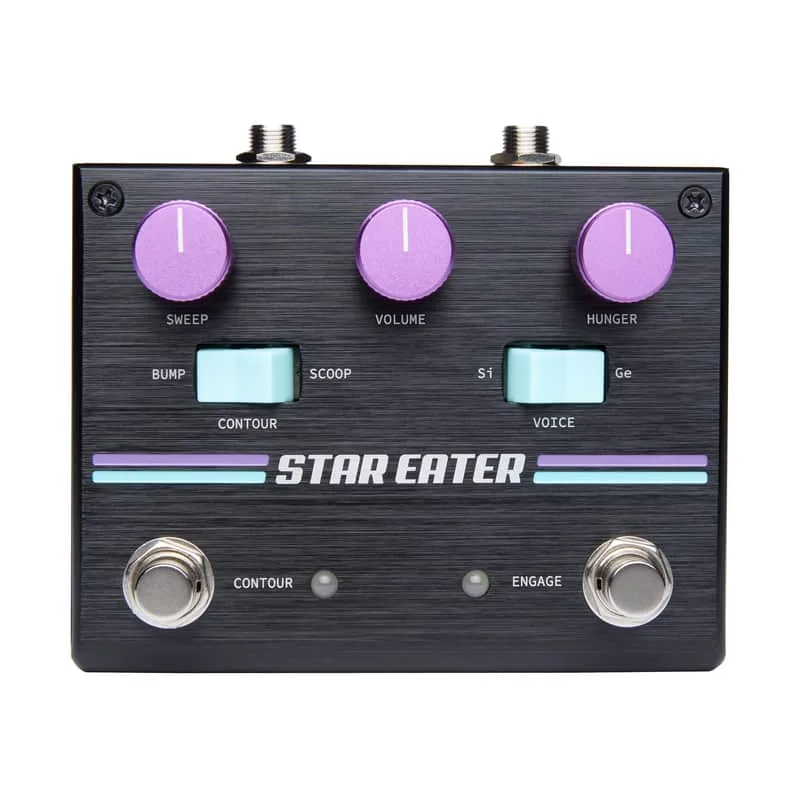
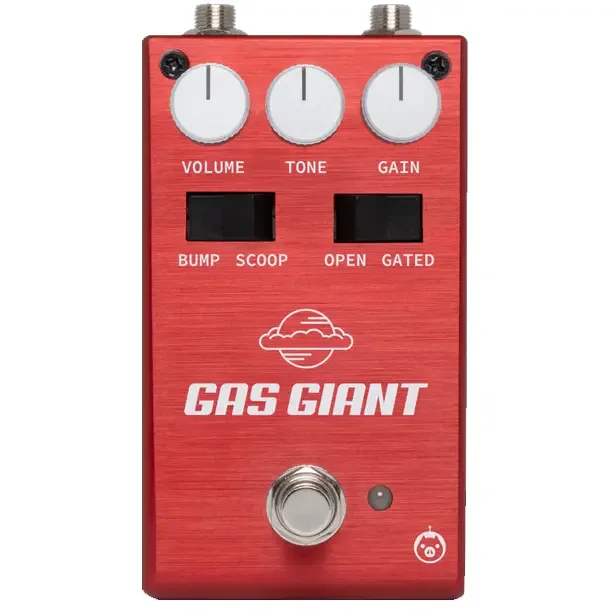
Pigtronix has since continued in fuzz with pedals like the Star Eater and the Gas Giant, but the Disnortion remains the design that put the company's parallel-routing idea on pedalboards.
Videos
ProGuitarShopDemos
Pigtronix
Questions
What power supply does the Pigtronix Disnortion need?
The original Disnortion runs on 18V. The Disnortion Micro operates on standard 9V power and uses an internal voltage converter to reach the same 18V headroom as the original, so a normal 9V center-negative supply is all the Micro needs.
Is the Pigtronix Disnortion analog or digital?
It is analog. Reviewers and Pigtronix's own descriptions describe the Disnortion as three flavors of analog distortion in one box, and the Disnortion Micro carries over the original analog fuzz and overdrive circuits from the large-format pedal.
Is the Pigtronix Disnortion still made?
No. The original three-footswitch Disnortion was in production from 2005 to 2015 and then ceased. Pigtronix continues as a maker, and the design lives on in the Disnortion Micro, which the company announced in 2017 and described as available at retailers worldwide.
Can the three effects in the Disnortion run at the same time?
Yes. The original pedal has three independent effects, an octaver, fuzz and overdrive, each with its own footswitch, so they can be combined. The fuzz and overdrive work in parallel, and the Micro adds a switch for running them in series instead.
Does the Disnortion work with bass?
Yes. Pigtronix's launch material for the Micro says the original was loved for its limitless headroom, making it compatible with any instrument, including 5-string active basses and modern synth rigs. Bass players, including Tony Levin, used the Disnortion for years.
What is the Pigtronix Disnortion Micro?
A micro-sized version of the Disnortion that keeps the original analog fuzz and overdrive circuits and their 18V headroom in a compact enclosure. It has a single gain knob controlling both circuits, a six-position tone filter switch, and series or parallel routing. Delicious Audio dates it back to 2014.
Sources (13)
- Pigtronix launches Bob Weir's Real Deal, MusicRadar, 2018-07-26
- Pigtronix Disnortion Micro review, MusicRadar, 2017-08-27
- Pigtronix Announces the Disnortion Micro, Premier Guitar, 2017-01-30
- Pigtronix Disnortion demo by Pete Thorn, youtube.com, 2010-11-15
- Pigtronix Disnortion Micro: Squeal dirt box, squeal!, gearnews.com, 2017-02-02
- Pigtronix Release the Disnortion Micro, Guitar Interactive Magazine, 2017-04-10
- Pigtronix releases Disnortion Micro guitar effects pedal, MusicRadar, 2017-04-10
- PIGTRONIX EP-, Analog Man (analogman.com), 2015
- Pigtronix Disnortion Micro, Delicious Audio, 2023-05-09
- Pigtronix Philosopher's Tone & Aria Disnortion Reviews, Delicious Audio, 2010-06-28
- Pigtronix Aria Disnortion Pedal Review, Premier Guitar, 2010-10-27
- Quick Look, Bass Gear Magazine, 2019-05-13
- Pigtronix Octava Micro, Delicious Audio, 2018-03-08
 Brad Whitford