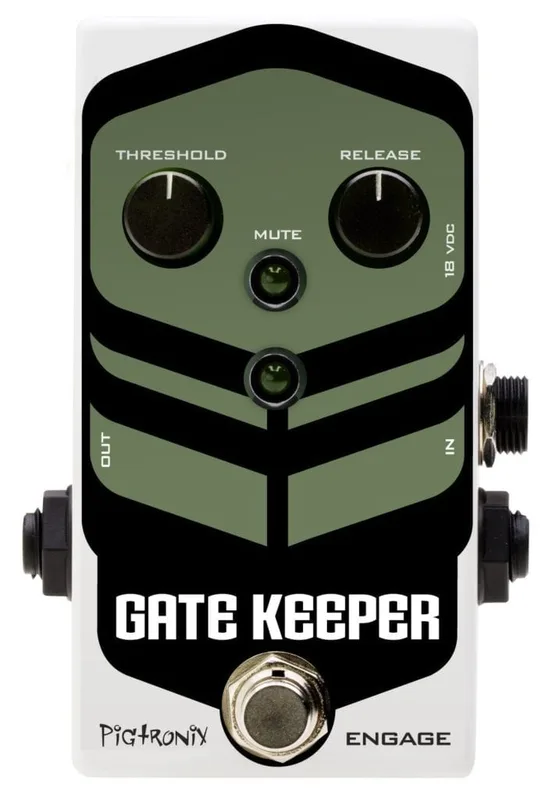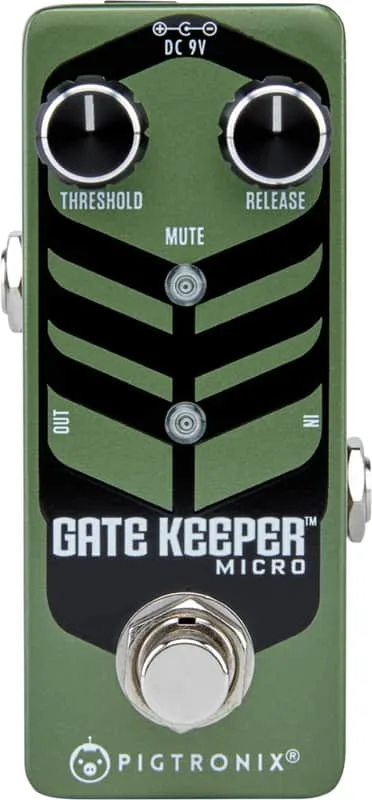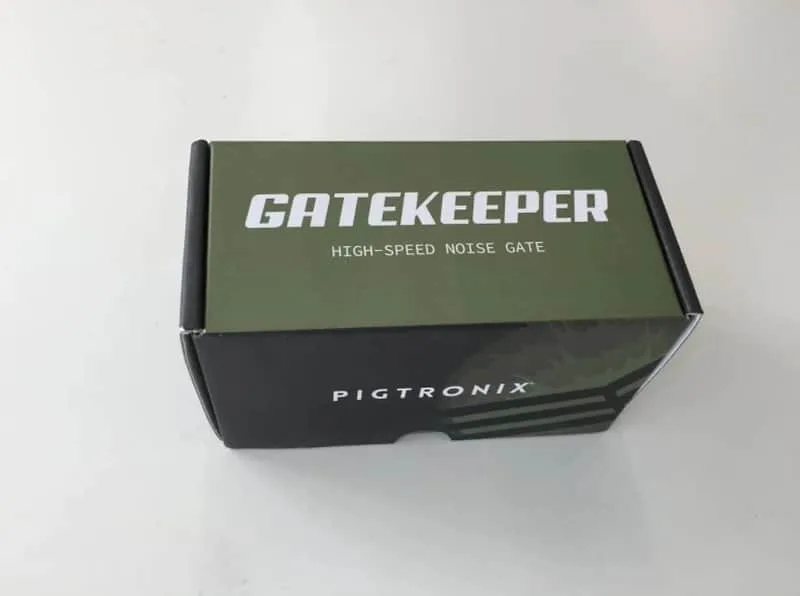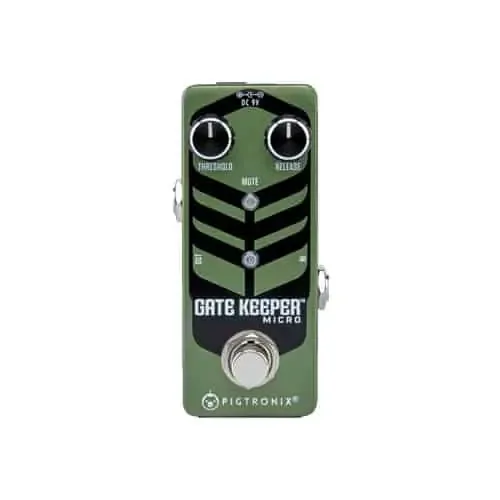
The Pigtronix Gatekeeper Mini is a compact noise gate pedal from Pigtronix, designed for high-gain rigs where hum, hiss and buzz creep in whenever you stop playing. Delicious Audio described it as "a lightning fast, studio-quality noise gate that locks out unwanted noise from any rig," mercilessly cutting unwanted sounds "at the very instant you stop playing"1.
It works like any other noise gate: you set a Threshold level, and any signal below it is silenced. Pigtronix built it on ultra high-speed J-FET circuitry to eliminate hum, hiss, buzz and other intrusive non-musical sounds, and the pedal provides 100% attenuation with what the maker calls unprecedented response time1. It is a mini pedal, sized for tight pedalboards, and it arrived in 2021 as one of four mini-pedals Pigtronix released that year, three of them unveiled during the virtual NAMM show1.
Where the Gatekeeper Mini comes from
The Gatekeeper Mini is a shrunken version of the full-size Pigtronix Gatekeeper, which Pigtronix unveiled in July 2013. The original was announced as a studio-quality noise gate with threshold and release time knobs, J-FET circuitry, true bypass switching, an army green color scheme and a MAP price of $1492. Premier Guitar's launch coverage called it "another piece of word-class analog engineering from Pigtronix"2, and Delicious Audio noted its above-average headroom and wide-range threshold control3.
Pigtronix then shrank the design in stages. In 2017 the company released micro editions of several effects, including a small version of the big Gatekeeper with its J-FET circuit4. In February 2020, MusicRadar reported Pigtronix announcing three new mini pedals, among them the Gatekeeper Micro, promising a "lightning-fast, studio-quality" noise gate with threshold and release time knobs5. The Gatekeeper Mini followed in 20211.
The Threshold and Release controls
The Gatekeeper Mini has two knobs, and they divide the work the way most two-knob gates do1:
| Control | What it does |
|---|---|
| Threshold | Sets the signal level below which the gate cuts out your signal1 |
| Release | Sets how long the gate takes to close after the signal drops1 |
Guitar World's noise gate buying guide explains the same arrangement on the Gatekeeper Micro: the threshold knob determines how much signal is needed for the gate to open, while the release knob controls how quickly it closes6. GuitarPlayer's guide describes the same split on the Pigtronix Gatekeeper 2, with Threshold determining how much signal opens the gate and the release knob determining how long before it closes7.
In practice, a low Threshold setting lets quiet playing through while still muting rig noise; a higher setting clamps down harder, which suits heavily overdriven or distorted signals that sit well above the noise floor. The Release control keeps sustained notes from being chopped off abruptly, since a fast close suits staccato playing and a slower one lets chords ring out before the gate shuts1.
How it sounds in a high-gain rig
Guitar World's 2026 buyer's guide, which named the Gatekeeper Micro its best compact noise gate, found it "great for keeping things tight and controlled, less so for just general hum reduction, which makes it well-suited" to players who use more gain, while noting it takes time to dial in6. That matches the Mini's own positioning: it is built for high-gain rigs, cutting hum and white noise the instant you stop playing1.
"The Pigtronix Gatekeeper is a lightning fast, studio-quality noise gate that locks out unwanted noise from any rig."
Questions
What circuitry does the Pigtronix Gatekeeper Mini use?
The Gatekeeper Mini uses ultra high-speed J-FET circuitry to eliminate hum, hiss, buzz and other non-musical noise. It is a smaller version of the full-size Pigtronix Gatekeeper, which is built on the same J-FET circuit and described in the launch press coverage as analog engineering from Pigtronix.
Is the Pigtronix Gatekeeper Mini analog?
The original Gatekeeper was described at launch as analog engineering from Pigtronix, and Guitar World describes the Gatekeeper Micro's gating as old-school analogue. The Mini shares the same J-FET circuit family, so it follows the same analog gating approach rather than digital modeling.
What is the difference between the Gatekeeper Micro and the Gatekeeper Mini?
They are different generations of Pigtronix's compact noise gate. The Gatekeeper Micro was announced in February 2020 as one of three mini pedals, while the Gatekeeper Mini arrived in 2021 among four mini-pedals Pigtronix released that year. Both carry Threshold and Release controls and J-FET-based gating.
Does the Gatekeeper Mini have a release control?
Yes. The Gatekeeper Mini has Threshold and Release knobs. The Threshold sets the signal level below which the gate cuts your signal, and the Release sets how long the gate takes to close after you stop playing.
When did Pigtronix release the Gatekeeper Mini?
Pigtronix released the Gatekeeper Mini in 2021. It was one of four mini-pedals the company released that year, three of which were unveiled during the virtual NAMM show, as reported by Delicious Audio in February 2021.
Sources (7)
- Pigtronix Gatekeeper Mini Noise Gate, Delicious Audio, 2021-02-18
- Pigtronix Unveils Gatekeeper Noise Gate, Premier Guitar, 2013-07-09
- Pigtronix Gatekeeper Noise Gate, Delicious Audio, 2013-08-06
- Pigtronix Micro Editions: Three little piggie pedals in time for Christmas, gearnews.com, 2017-12-04
- Pigtronix unveils 3 new mini guitar effects pedals, MusicRadar, 2017-11-27
- Best noise gate pedals 2026: clean up your signal, Guitar World, 2021-03-19
- Best noise gate pedals: control your tone, GuitarPlayer (www.guitarplayer.com), 2024-09-24