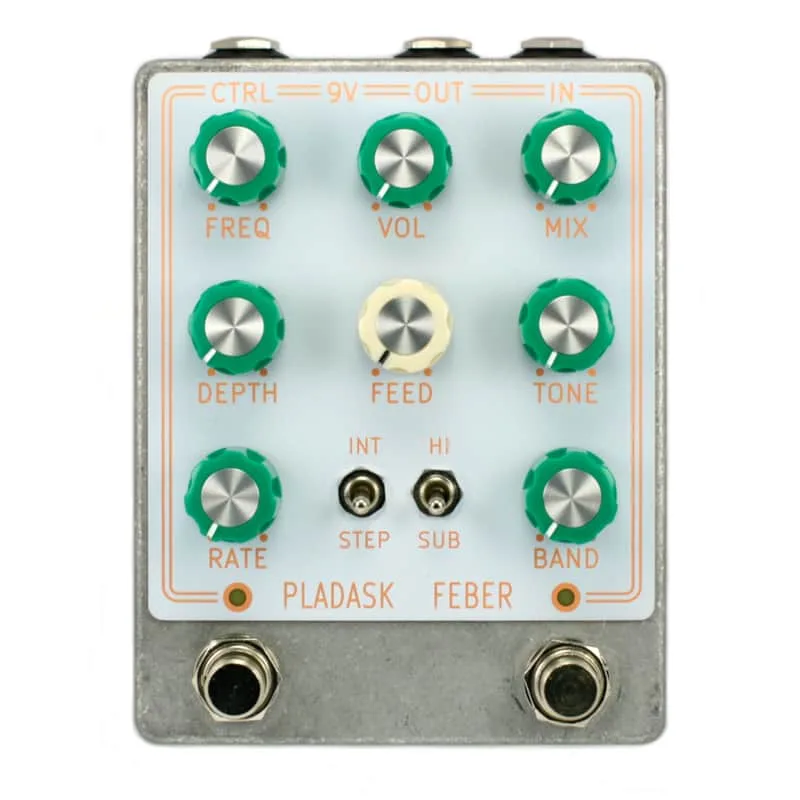


The Pladask Elektrisk Feber is a compact pedal that the maker classifies as a Ring/Amplitude/Phase Modulator, exploring the intersection of single sideband modulation, ring modulation, phasing and tremolo1. Where a standard ring modulator multiplies your signal against one internal oscillator, the Feber builds a small system around that idea: a pair of ring modulators, a Hilbert transform approximation, feedback, and a random value sample/hold generator1. The result is a pedal that can deliver classic ring mod, tremolo and phaser effects, but also step filters and textures that evolve and swell when you work the momentary footswitch2.
It is a digital design, built on the Spin FV1 signal processor2, and it is aimed squarely at players who like to experiment. Pedal of the Day called it "one of the most intriguing yet, with new auditory inflections waiting around every curve and corner"3.
How it works: ring modulators, a Hilbert transform and sample/hold
Ring modulation produces its bell-like, inharmonic timbre through linear frequency shifting, producing upper and lower sidebands: the modulator multiplies the input by a carrier, and the maker notes that this linear frequency shifting is what gives ring modulation its characteristic sound3. The Feber runs two ring modulators rather than one, and feeds them through a Hilbert transform approximation, alongside feedback and a random value sample/hold generator, which is what lets it explore single sideband modulation, ring modulation, phasing and tremolo in one circuit1.
The rest of the circuit shapes what those modulators do:
- Feedback loops the output back across the modulator and a low pass filter, set by the FEEB knob, and at high settings the pedal can self-oscillate2.
- Sample/hold is a random value generator that grabs values and holds them, so the ring modulator frequency jumps around in steps rather than sweeping smoothly. The DEPTH knob sets how much of this randomness is applied: at minimum the frequency is completely dictated by the FREQ knob, at maximum it is completely random, when the function is active4.
- Frequency ranges come from the HI/SUB knob. HI gives 20 to 1600 Hz for classic ring mod clang. The unlabeled middle position gives 0.3 to 30 Hz, which is tremolo and phasing territory. SUB gives 0 to 5 Hz, and at 0 Hz the modulation waveform freezes in its tracks2.
That last point is worth sitting with for a moment: at SUB and 0 Hz you get a static, fixed transformation of your sound rather than a moving one, which is a different tool entirely from a conventional ring modulator.
Controls and footswitches
| Control | What it does |
|---|---|
| FREQ | Sets the ring modulation frequency when the sample/hold function is inactive2 |
| HI/SUB | Sets the frequency range: HI 20 to 1600 Hz, middle 0.3 to 30 Hz, SUB 0 to 5 Hz2 |
| DEPTH | Sets the depth of the sample/hold function, from fully FREQ-dictated to fully random4 |
| FEEB | Sets feedback across the modulator and low pass filter; self-oscillation possible at high settings2 |
| MIX | Dry/wet balance from 100% dry to 100% processed2 |
| VOL | Master volume; unity gain at 12 o'clock, max gain +16dB2 |
The two footswitches both have a momentary trick. The left one activates or bypasses the sample/hold function, and holding it longer than 500 ms momentarily flips the function instead of latching it, so you can inject a burst of random stepped modulation on demand4. The right footswitch is the bypass switch, with the same 500 ms rule: hold it and the effect state changes only while you hold4. Delicious Audio highlighted exactly this in practice, noting the pedal produces "a variety of textural sounds" that evolve and swell via the momentary footswitch2.
Inside the pedal are two miniature switches and one trimpot. The Z/100 switch reduces the input impedance from 1MΩ to 10kΩ14. The -9dB switch adds a -9dB input pad (damping), which the maker notes is useful for line level signals2. The unlabeled trimpot is associated with the expression input and the maker says it should not be adjusted2.
Power and connections
The Feber does not support battery operation, so it depends entirely on an external power supply4. That is worth knowing when planning a pedalboard around it: there is no battery fallback if a supply output fails, and the pedal needs a dedicated power connection at all times.
For external control, the pedal has an expression input: an unlabeled internal trimpot is associated with the expression input, and the maker states that it should not be adjusted24. Anyone opening the pedal up to tweak its internal settings should leave that trimpot alone and stick to the two miniature switches, Z/100 and -9dB, which are the user-facing internal options4.
What reviewers said
Pedal of the Day reviewed the Feber in June 2022 and framed it as "a feature rich tool for exploring amplitude- and phase-based modulation at both high and low frequencies," describing the combination of single sideband modulation, ring modulation and the sample/hold generator as an intersection worth exploring3. Their takeaway on the experience of playing it:
"This pedal has a lot of sensitive controls, which interact with each other to create a near-endless field of exploration"3
Pedal of the Day3
They also noted that their demo video runs just under 12 minutes, a sign of how much ground the controls cover3. Delicious Audio's write-up took a similar view, calling it a creative pedal whose variety of textural sounds is discovered by experimenting with the controls, from classic ring mod, tremolo and phaser sounds to step filters and unique, evolving textures2.
Videos
Ponderer Sounds
Tri Pedal Reviews
sp3ct3rs d3mos
Questions
Is the Pladask Feber analog or digital?
Digital. The pedal utilizes the Spin FV1 signal processor, the same reverb and effects chip found in many compact digital pedals. Its circuit combines a ring modulator pair, a Hilbert transform approximation, feedback and a random value sample/hold generator, all running through that processor.
Does the Feber run on a battery?
No. The maker states plainly that the pedal does not support battery operation. It needs a 9V DC center negative supply with a standard 2.1mm plug, drawing 100mA, so plan on a pedalboard power supply rather than a battery.
Is the Pladask Feber true bypass?
Yes. The Feber uses relay based true bypass, switched by the right footswitch. Holding that switch longer than 500 ms only momentarily changes its status, so a quick press toggles the effect and a long hold gives you a momentary blast of it.
Can I use a Strymon power supply with the Feber?
No. Pladask Elektrisk states that the Feber does not support Strymon brand power supplies. Use a standard 9V DC center negative supply with a 2.1mm plug capable of supplying its 100mA current draw.
Can the Feber self-oscillate?
Yes. The FEEB knob sets the amount of feedback across the modulator and the low pass filter, and the maker notes that self-oscillation is possible at high feedback settings. This is where the pedal moves from modulation into generating its own sound.
Can I control the Feber with an expression pedal or CV?
Yes. The CTRL socket accepts an expression pedal or a control voltage source of 0 to 3.3V to control the FREQ parameter. Connecting anything to the CTRL socket renders the FREQ knob inactive, and the input is protected against voltages from -12 to 15.3V.
Sources (4)
- FEBER | PLADASK ELEKTRISK, Pladask Elektrisk, 2020-11-15
- Pladask Elektrisk Feber Ring Modulator, Delicious Audio, 2024-06-11
- Pladask Elektrisk Feber Amplitude/Phase Modulator, Pedal of the Day, 2022-06-11
- Feber_Manual_ENG.pdf, Pladask Elektrisk, 2023