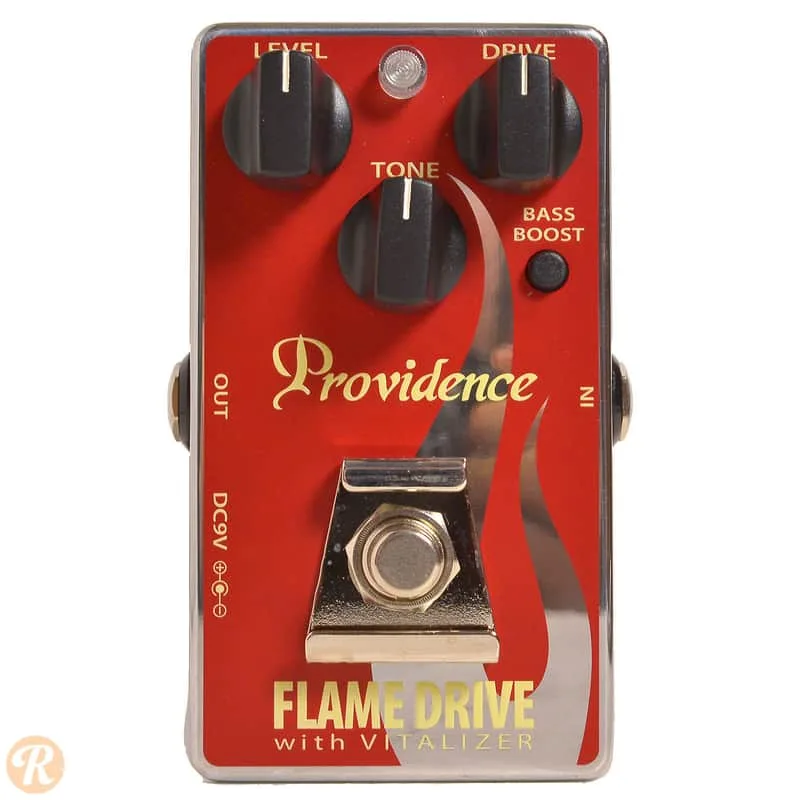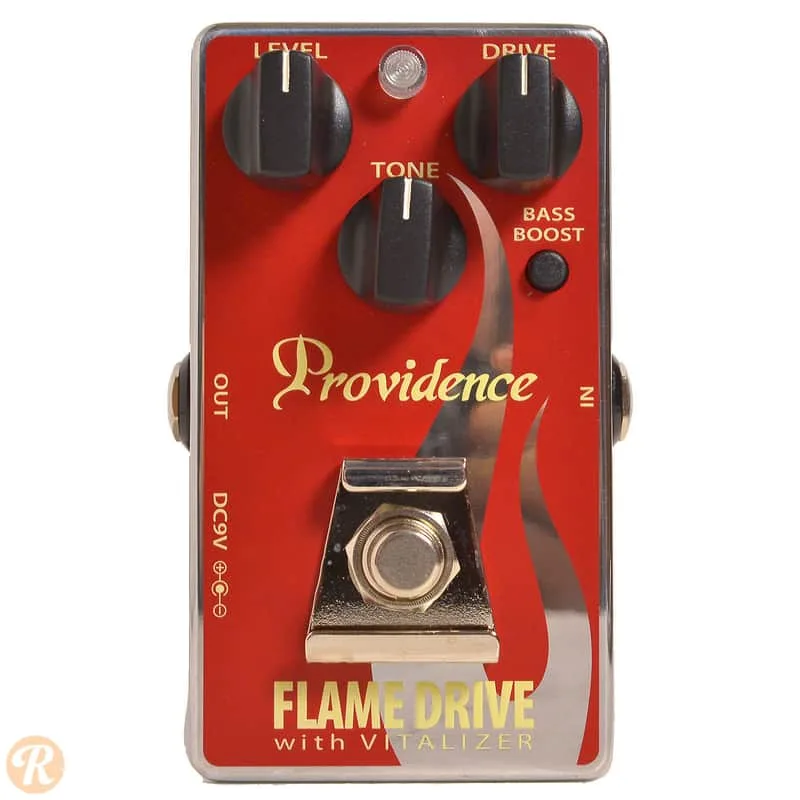


The Providence FDR-1 Flame Drive is an overdrive pedal that stretches into distortion territory. Announced by Godlyke, Inc. in April 2012, it was described in the launch press release as "an extremely versatile pedal" that "can deliver anything from sweet, silky overdrive to edgy, overtone-rich distortion"1. It launched as the first model in Providence's new "F" Series of pedals, replacing the earlier "Free the Tone" line, at a $399 street price12.
What sets it apart in the launch description is its responsiveness: "It features a fast attack response that easily tracks the most detailed picking nuances, creating an eminently musical, amp-like distortion that is never flat or muddy sounding"1.
An overdrive-to-distortion pedal with a fast attack
The Flame Drive sits between a classic overdrive and a full distortion. Providence's launch material positions it as covering the whole span, from low-gain silky sounds to edgy, overtone-rich clipping, with the fast attack response doing the work of keeping the playing dynamics audible at either end1.
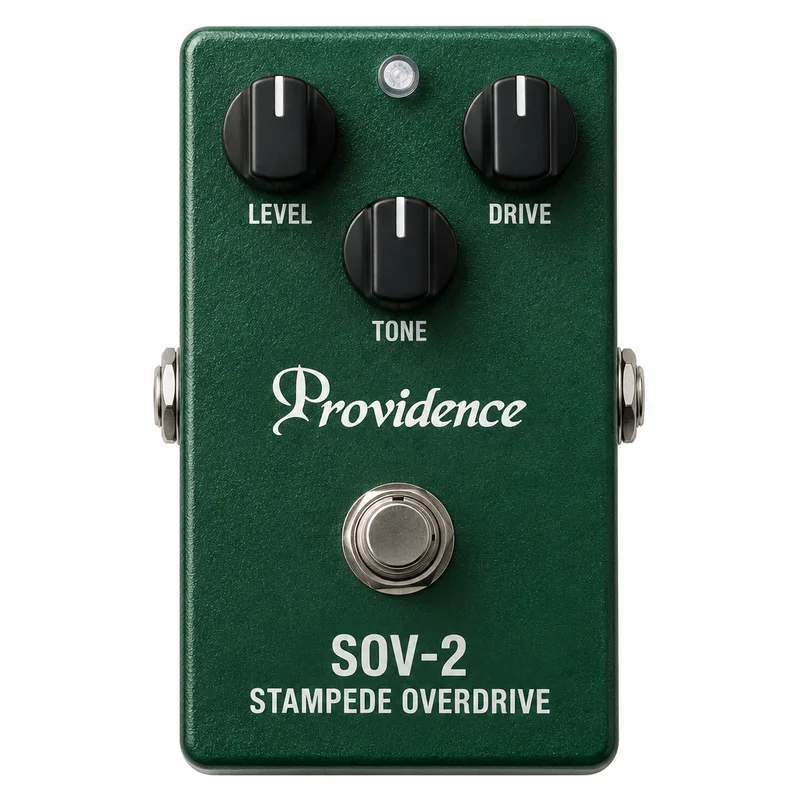
MusicRadar's 2012 roundup of Providence pedals reviewed the Flame Drive FDR-1F version and placed it in the company's lineup by comparison: "the ornately decorated Flame Drive FDR-1F is reminiscent of the SOV-2 Overdrive but with more gain and low end power (it has a bass boost switch) on offer"4. The same review summed up its character: "It's a very musical pedal, ideal for emotive soloing"4.
MusicRadar's later review of the FDR-1F was positive overall, with the price the only real criticism: "A superb overdrive, but only the truly tone obsessed will justify the extra outlay over the S Series for the extra sonic"5.
Controls
| Control | What it does |
|---|---|
| Drive | Sets the gain, from silky overdrive up to edgy distortion13 |
| Tone | Shapes the treble content13 |
| Level | Sets the output volume13 |
| Bass Boost switch | Adds low-end punch13 |
The control set is deliberately simple: three knobs plus one switch. The Bass Boost switch is the one departure from a standard overdrive layout, and it is what MusicRadar pointed to when describing the FDR-1F as having more low-end power than the SOV-24.
Power and connections
The Flame Drive runs on either a 9V battery or an AC adapter through its DC 9V input jack, drawing approximately 8 mA at DC 9V3. Connections are straightforward: a 1/4-inch input jack, a 1/4-inch output jack and the DC 9V power jack3.
The FDR-1F version reviewed by MusicRadar adds DCG, double-contact-grounding on the jacks, which the review describes as being "for improved connection and reliability"5.
The Vitalizer circuit
The Flame Drive features Providence's "Vitalizer" noiseless switching circuit1. Guitar World's launch coverage described what it consists of: "a low-impedance output buffer in combination with a filtering circuit"2.
MusicRadar explained what it means on a pedalboard: "it features the company's Vitalizer circuit that prevents signal degradation when chaining many pedals together," and noted that the circuit stays active even when the pedal is switched off4. For a player running long signal chains, that makes the Flame Drive behave partly like a buffer pedal that never stops working, rather than a pedal that drops out of the path entirely when bypassed.
The first pedal in Providence's F Series
The FDR-1 Flame Drive was the first model in Providence's "F" Series of pedals, which replaced the company's "Free the Tone" line2. No Treble's launch coverage confirmed it as "the first in their new 'F' series of pedals," shipping at a $399 street price3.
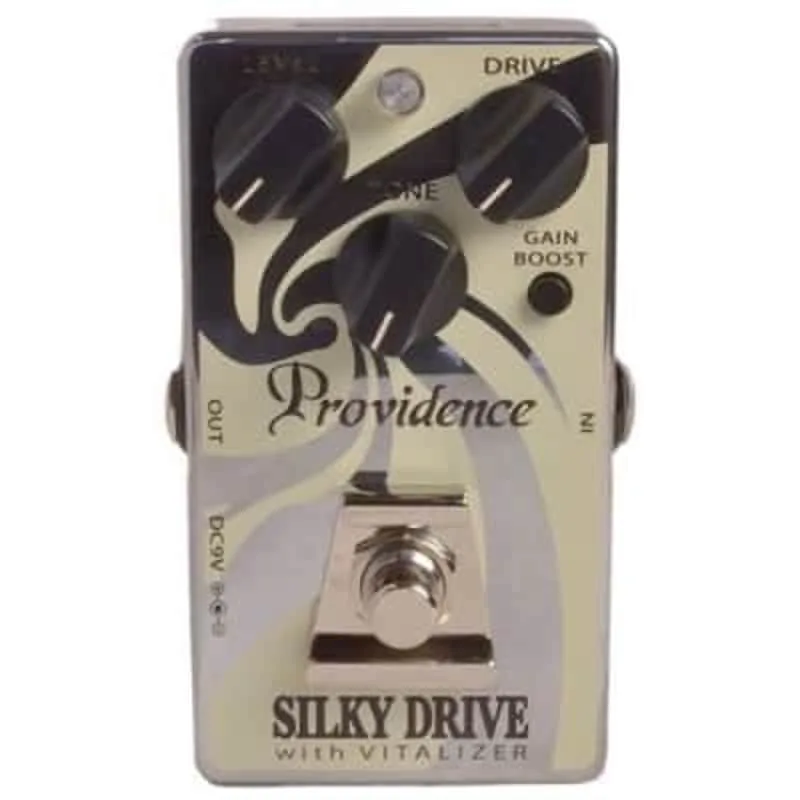
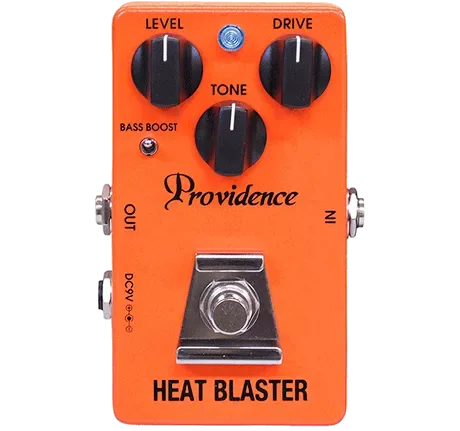
The FDR-1F reviewed by MusicRadar is a later version of the same pedal, carrying the F Series naming into the model designation itself45. Players comparing Providence drives today will meet both names: the FDR-1 from the 2012 US launch, and the FDR-1F in the company's subsequent lineup, alongside pedals like the Providence Silky Drive SLD-1F and the Providence Heat Blaster HBL-4.
Videos
ProvidenceSoundMovie
ProvidenceSoundMovie
Questions
Does the Providence FDR-1 Flame Drive take a 9V battery?
Yes. The Flame Drive runs on either a 9V battery or an AC adapter through its DC 9V input jack, drawing about 8 mA at 9V DC. Its stated weight of roughly 250 grams is measured without a battery installed.
What does the Bass Boost switch do on the Flame Drive?
The Bass Boost switch adds low-end punch on top of the standard Drive, Tone and Level controls. MusicRadar's review of the FDR-1F found the pedal reminiscent of the Providence SOV-2 Overdrive but with more gain and low-end power, and the switch is part of that extra bottom end.
What is the Vitalizer switching circuit?
Vitalizer is Providence's noiseless switching circuit, made up of a low-impedance output buffer combined with a filtering circuit. MusicRadar notes it prevents signal degradation when you chain many pedals together, and that it stays active even when the pedal itself is switched off.
How much current does the Flame Drive draw?
The FDR-1 Flame Drive draws approximately 8 mA at DC 9V, according to the launch specifications published by No Treble in May 2012. That is a light draw by pedalboard standards and easy on most power supplies.
Who distributes the Providence FDR-1 Flame Drive in the US?
Godlyke, Inc. announced and released the Providence FDR-1 Flame Drive in the United States in April 2012, describing it as the first model in Providence's new F Series of pedals, which replaced the earlier Free the Tone line.
Sources (5)
- Godlyke Introduces the Providence FDR-1 Flame Drive, Premier Guitar, 2012-04-26
- Godlyke Introduces Providence FDR-1 Flame Drive Distortion Pedal, Guitar World, 2012-05-03
- Godlyke Debuts Providence FDR-1 Flame Drive Pedal, No Treble, 2012-05-09
- 4 overdrive and distortion pedals from Providence, MusicRadar, 2012-06-21
- Providence FDR-1F Flame Drive review, MusicRadar, 2011-04-27