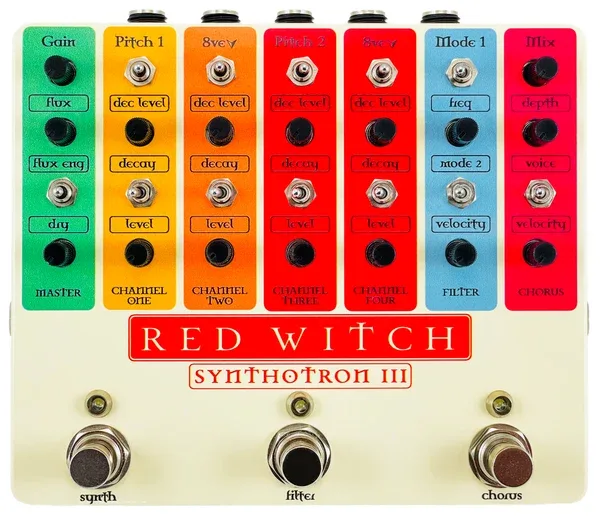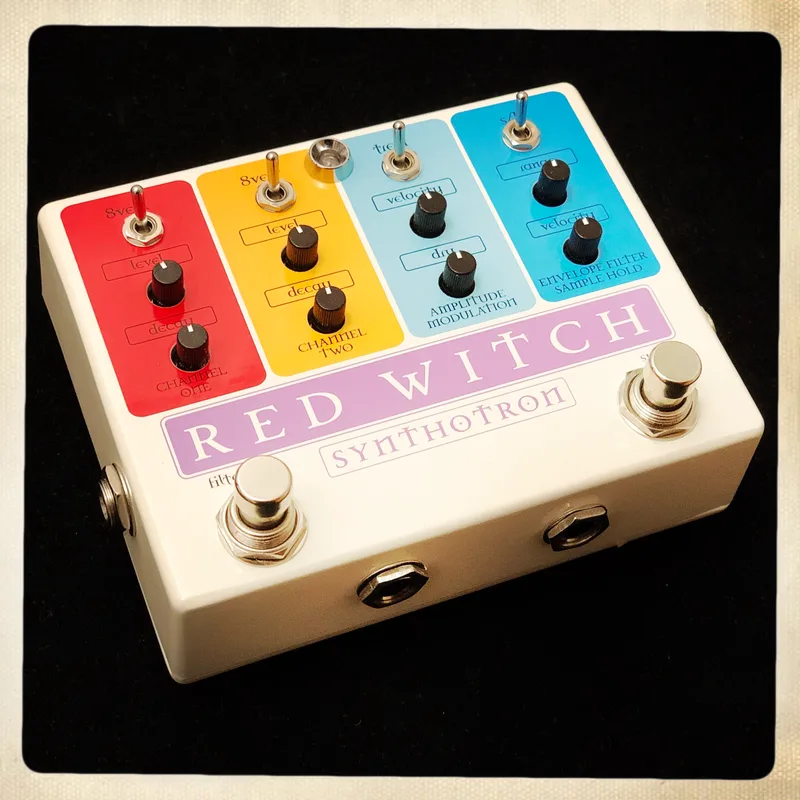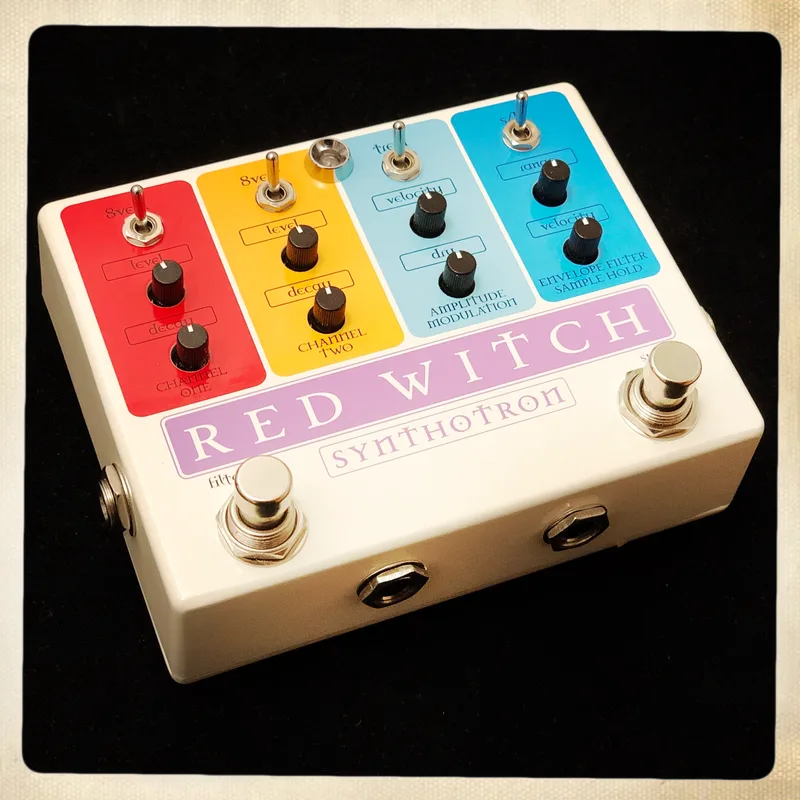


The Red Witch Synthotron II is an analog guitar synth pedal that combines two analog synthesizer voices with a filter section in one box. Announced in October 2019 as the successor to the original Synthotron, it was billed by Red Witch as "Better, stronger, and faster than its predecessor, the Synthotron II is the six-million-dollar man of analog guitar synths"1. There are no digital reproductions or emulations inside: the maker described it as having "all the delicate filth of a generation of analog 70's synths"1. It is a monophonic tracker, following one note at a time, which is the trade-off that comes with an all-analog design2.
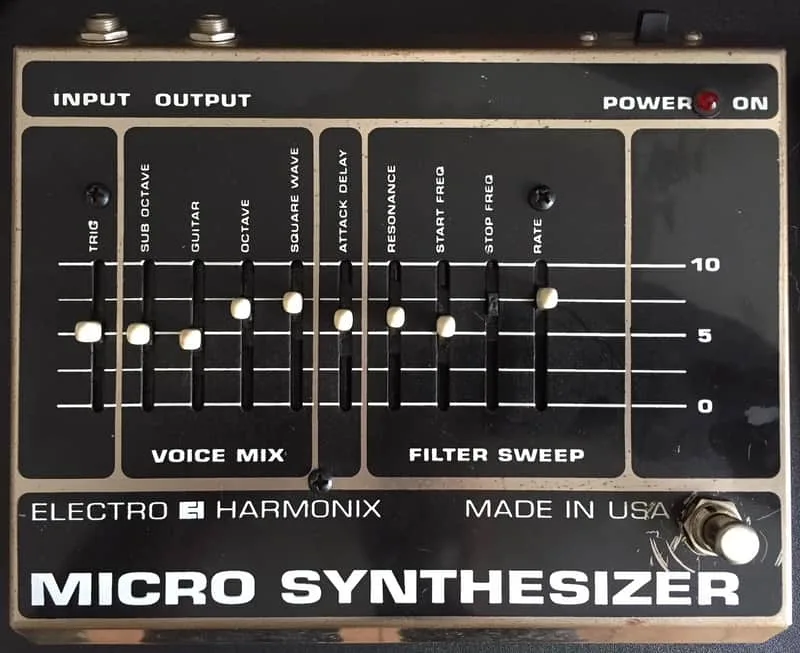
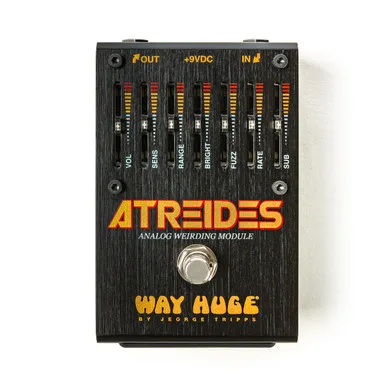
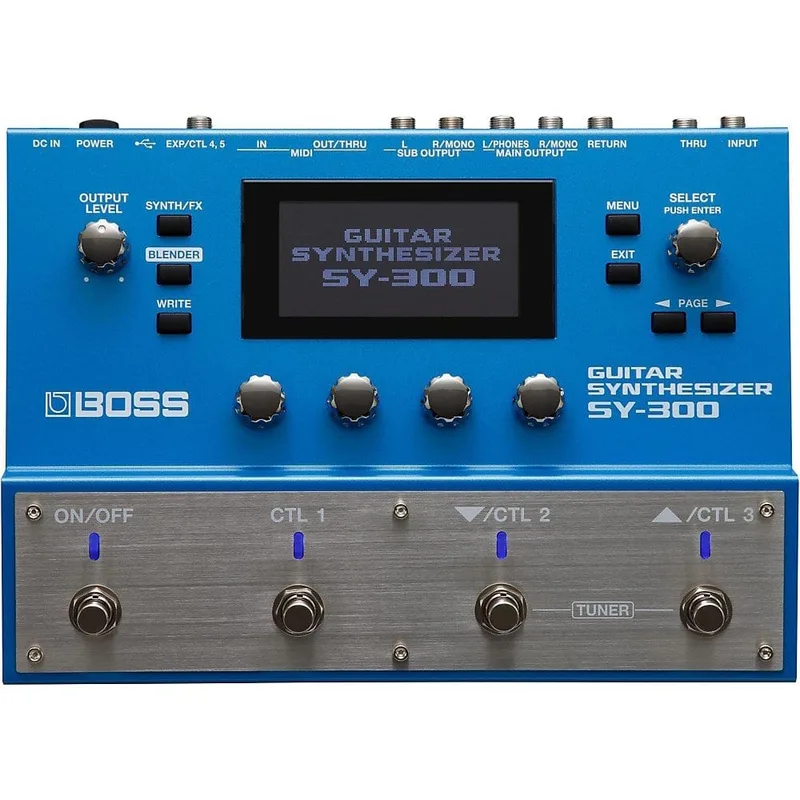
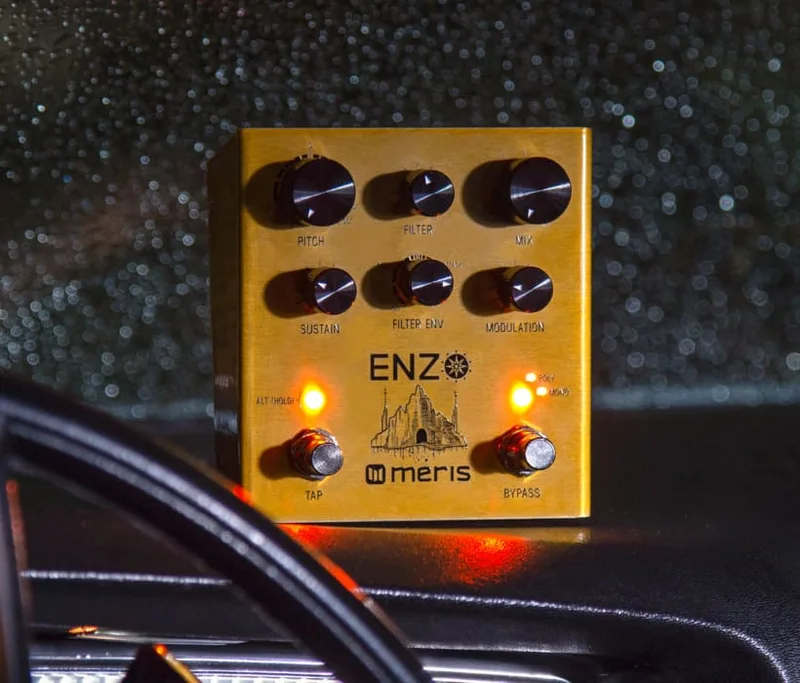
The pedal is laid out as two halves. The synth side holds two oscillators, each with its own set of controls, and the filter side offers an envelope filter and a sample hold mode. Each half has its own footswitch, and the two can run separately or stacked together34. For players browsing synth pedals, it sits in the analog corner of the category, alongside pedals like the Electro-Harmonix Micro Synthesizer and the Way Huge Atreides Analog Weirding Module, rather than with digital polyphonic options such as the Boss SY-300 or Meris Enzo.
The 300mA current draw rules out battery operation and makes a shared daisy-chain supply a poor match. Plan on a dedicated 9V output that can deliver the full draw1.
What it does: dual analog synths and a filter
The Synthotron II is built around dual analog synthesizers, the same core feature Red Witch carries across the Synthotron line1. The synth side generates two oscillator voices that follow your playing, and the filter side processes the sound with either an envelope filter, which responds to how hard you pick, or a sample hold mode, selected with a toggle switch2. A further switch on the synth side toggles the pitch relationship between up two octaves and down one octave4.
The two sections are independent. You can run the synth alone, the filter alone, or both together, and the filter section also includes a Dry knob for blending in your instrument's original dry signal, which adds clarity when the synth voices get thick2. Pedal of the Day characterized the filter section as "filled with gooey, dripping funk, great for sending your bass or guitar back a couple of decades to the Land of Soul and Power"2.
The original Synthotron, designed back in 2012, was described on the Red Witch website as the company's most polarising pedal4. The Synthotron II kept the concept and revised the presentation, with Pedal of the Day calling it "an analog synth filter sample hold mixture that takes everything about the first model and launches it" forward2.
The controls
The control layout is organized into three color-coded groups. The green and yellow boxes hold the controls for the first and second oscillators, and the red box sets the controls for the filter section2. On the original Synthotron the oscillator controls sat in red and orange boxes, so the color change is one of the visible differences between versions6.
| Control group | Controls | What they do |
|---|---|---|
| Green box (oscillator 1) | Pitch, volume, decay | Sets the pitch of the oscillator note, its volume level in the mix, and a short or long decay time2 |
| Yellow box (oscillator 2) | Pitch, volume, decay | Same three controls for the second oscillator2 |
| Red box (filter section) | Filter controls, mode toggle, Dry knob | Sets the filter sound, toggles between Envelope Filter and Sample Hold modes, and blends in dry signal for clarity2 |
Each oscillator's decay control chooses between a short or long decay time, so the two voices can be set to speak differently, one quick and percussive, the other hanging back with a longer tail2. The octave switch on the synth side moves the pitch relationship between up two octaves and down one octave4.
Two footswitches, one for the synth and one for the envelope side, turn the sections on and off independently4. Pedal of the Day's take on stacking them: "Click both of the individual effects' footswitches on at the same time, and hold on to your hats, 'cause it's about to get loud"2.
Where it came from
The Synthotron line began with the original Synthotron in 2012, a synth and filter pedal that Pedal of the Day reviewed in 2016 and called "another exciting, unique and innovative piece of gear"46. The Synthotron II followed in 2019, announced on 2 October with the pedal available the same day, shipping from Red Witch's US warehouse1. The first 150 units were hand assembled, numbered and signed by creator Ben Fulton1.
The launch price was $199.99 USD, offered for a very limited time on those first units1. MusicRadar reported the same $199.99 price at launch, with UK and EU pricing of £165 and approximately €1807.
The line goes back further than the Synthotron II. The original Synthotron was designed in 2012, and according to the Red Witch website it was the maker's most "polarising" pedal8. The Synthotron II followed as an analog guitar synth pedal2, available for a limited time at $199.99 USD, with the first 150 units hand assembled, numbered and signed by creator Ben Fulton2. There is also the Synthotron III, which Red Witch ships in 100% recycled packaging9.
What reviewers said
Published reactions to the Synthotron line split two ways. Pedal of the Day, which reviewed both the original and the Synthotron II, was enthusiastic on both passes. Of the original, the reviewer called it "a new and powerful Synth/Filter pedal"2, and of the Synthotron II wrote that the pedal improved on what the site itself called "an instant classic"2.
The other side of the reaction came from Red Witch itself. Ben Fulton, writing in the announcement of the Synthotron III, said:
"Synthotron I and II were unique, but also quite polarising - the inherent challenges with analog tracking meant that people seemed to either adore it or be utterly mystified by it."10
That matches the maker's own earlier description of the original as its most polarising pedal4. For a player deciding whether an analog synth pedal fits their rig, the honest summary from the coverage is that the Synthotron II rewards single-note playing and experimentation, and that analog tracking is the thing to weigh against the polyphonic digital alternatives.
The launch also carried one of the more memorable descriptions in pedal press. The Synthotron II was:
"Described by a certain famous top hatted rock star as 'the love child of an Atari game console and a 70's pornographic film'"1
Guitar Interactive Magazine repeated the same description in its coverage of the launch9.
Synthotron II and Synthotron III compared
| Original Synthotron | Synthotron II | |
|---|---|---|
| Designed | 20128 | Follow-on analog guitar synth pedal2 |
| Price | Not stated | $199.99 USD at launch, limited time2 |
| Production | Not stated | First 150 units hand assembled, numbered and signed by Ben Fulton2 |
| Status | Described by Red Witch as its most "polarising" pedal8 | Available now, shipping same day from the US warehouse2 |
The Synthotron III also exists in the line, and Red Witch ships all of its pedals in 100% recycled packaging9.
Videos
Red Witch Pedals
Pedal of the Day
Questions
Is the Red Witch Synthotron II true bypass?
Yes. The Synthotron II uses true bypass switching, so with both effects disengaged the instrument's signal passes through without the pedal's circuitry in the path. Each of the two effects also has its own footswitch, so you can leave one section on and the other off.
Can the synth and filter sections be used at the same time?
Yes. The pedal has two individual footswitches, one for the synth and one for the filter, and both can be clicked on at the same time for combined sounds. The sections can also be used separately, which makes it easy to dial in each one on its own before stacking them.
Is the Synthotron II polyphonic?
No. The Synthotron II is an all-analog device and it is monophonic, tracking one note at a time. That is typical of analog guitar synths, and it is part of why the Synthotron line was described by Red Witch's Ben Fulton as polarising: the inherent challenges with analog tracking meant players either took to it or did not.
What power supply does the Synthotron II need?
It uses any standard DC 9 volt pedal power supply, but the current draw is 300mA, described as wallwart only. That is far more than a typical analog overdrive, so a dedicated supply rather than a shared daisy chain is the practical choice, and battery power is not part of the design.
What is the difference between the Synthotron II and Synthotron III?
The Synthotron III, launched in November 2023, is an expanded all-analog pedal with synth, filter and chorus sections, priced at £599 with production limited to 100 units through the end of 2023, each hand-signed and numbered by Ben Fulton. The Synthotron II keeps to the synth and filter sections and launched at $199.99 in 2019.
Is the Red Witch Synthotron II still in production?
The Synthotron II page on the Red Witch website lists the pedal as sold out as of late October 2026, so it is not currently available from the maker. The line continues with the Synthotron III and the Synthotron CV, which also pairs dual analog synthesizers with a filter.
Sources (10)
- Red Witch Unveils the Synthotron II, Premier Guitar, 2019-10-02
- Red Witch Pedals Synthotron II Synthesizer Filter Sample Hold, Pedal of the Day, 2019-11-02
- Red Witch reckons its Synthotron II is the "the most surreal, crazy analog pedal you've ever encountered", Guitar World, 2019-09-27
- Red Witch Synthotron II: A revamped analogue guitar synthesiser pedal, gearnews.com, 2019-09-29
- Synthotron II, Red Witch Pedals
- Red Witch Pedals Synthotron Analog Synth, Pedal of the Day, 2016-05-10
- Red Witch unveils the Synthotron II analogue guitar synthesiser, MusicRadar, 2019-09-27
- Limited Edition Synthotron CV- Analog Guitar Synth with CV and PLL input, Red Witch Pedals
- New Pedal From Red Witch Ltd, Guitar Interactive Magazine, 2019-10-02
- Synthotron III From Red Witch, Premier Guitar, 2023-10-24