

What a filter pad pedal is
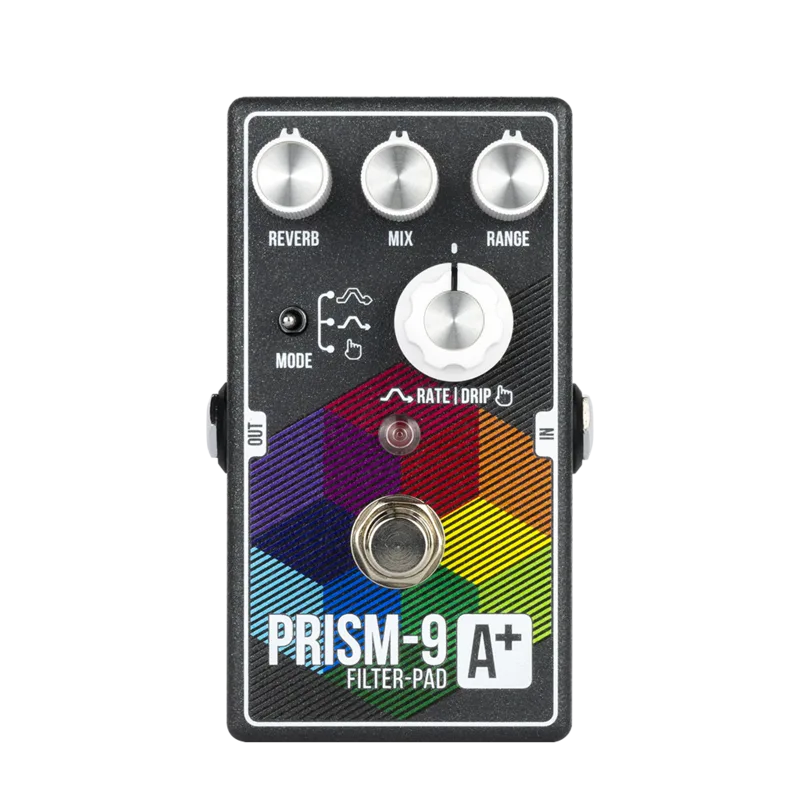
The Prism-9 was presented at launch as "a unique, complex, fully-featured effect that embraces analog synthesis techn"iques1. Where a conventional filter pedal sweeps a tone control over your signal, a filter pad pedal sustains and shapes the guitar into a bed of sound. The Prism-9's circuit combines a resonant low-pass filter, pitch shifting and a room reverb1, and the maker positions it as an original design meant to contribute to the world of existing modulation effects such as phaser, chorus and tremolo1.
Delicious Audio, covering the launch, noted that Shift Line pedals have some kind of cultish reputation in the US1, and summed up the pedal's intent:
The controls
The Prism-9 keeps its control set small, but each knob changes behavior depending on the mode you are in.
| Control | What it does |
|---|---|
| REVERB | Controls reverb amount and decay2 |
| RANGE | Determines the filter cutoff frequency2 |
| RATE / DRIPS | Behavior depends on mode: LFO rate in Auto and Auto Fat, resonance or LFO depth in Manual21 |
| MODE switch | Selects among the pedal's three modes: Manual, Auto, or Auto Fat2 |
The RATE knob is the one that repays close reading, because it does three different jobs:
- Auto and Auto Fat modes: the RATE knob controls LFO rate, creating what the maker calls a kind of chorus effect when turned clockwise1.
- Classic Manual mode: the trapezoid LFO is disengaged, and the knob controls the depth of the sine LFO, a mode the maker calls DRIPS. From 7 to 12 o'clock it sets regular mode depth from 0 to max; from 12 to 5 o'clock it runs fat mode, with depth going from max back to 01.
- Modern Manual mode: the LFO is disengaged, and the knob controls filter resonance, from mild operation up to self-oscillation, with maximum Q at 12 o'clock. From 12 to 5 o'clock you get fat mode with added octaves21.
Classic and Modern modes
The pedal has two switchable global modes, "classic" and "modern," which are comprised of the same elements but in different arrangements2. The differences are structural, not just tonal:
| Classic mode | Modern mode | |
|---|---|---|
| Filter placement | Before the reverb1 | After the reverb21 |
| Filter slope | Fixed at 24 dB/Oct1 | Auto Fat: 24 dB/Oct; Auto: 12 dB/Oct; Manual: 12 dB/Oct with the RATE knob controlling resonance21 |
| Octave sounds | More | Fewer21 |
| Max LFO speed in Auto modes | Lower | Higher21 |
Because the filter sits before the reverb in Classic mode, the reverb tail is not filtered; in Modern mode the filter comes after the reverb, so the reverb itself is swept by the filter. That ordering difference is the heart of the two modes' character12.
For bass players, the designer's view is that "The Modern mode seems to work better with bass guitar (although you might like the Classic one, too)"1.
Power and bypass
The Prism-9 runs on a 9V regulated supply2. Its current draw may reach 100mA, so a battery might only last for several hours and should be viewed strictly as an emergency option21. For best results, use a corresponding PSU1.
The bypass is active rather than true bypass: Shift Line says this prevents the click of the footswitch from getting into the reverb space21. In practice that means the pedal's circuitry stays in the signal path when bypassed, trading true-bypass purity for quiet switching and a reverb tail that decays naturally.
Videos
Chords Of Orion
ShurSoma
Questions
What is a filter pad pedal?
A filter pad pedal uses a resonant low-pass filter, modulation and reverb to sustain a guitar signal into ambient pads and backgrounds. Shift Line describes the Prism-9 as working great for creating ambient pads and backgrounds in slower styles of music. It is a different animal from a standard filter or wah pedal, closer to a small analog synth voice on a pedalboard.
What is the difference between Classic and Modern mode on the Prism-9?
In Classic mode the filter is fixed at 24 dB/Oct and sits before the reverb. In Modern mode the filter is placed after the reverb, and its slope varies by mode: 24 dB/Oct in Auto Fat and 12 dB/Oct in Auto and Manual. Modern mode also has fewer octave sounds and a higher maximum LFO speed in the Auto modes.
Does the Prism-9 work with bass guitar?
Yes. According to the designer, Modern mode seems to work better with bass guitar, although you might like the Classic one too. The differences in filter slope and placement between the two modes give bass players a real choice of character.
Can the Prism-9 run on a battery?
It can, but only as a stopgap. The pedal's current draw may reach 100mA, so a battery might only last for several hours and should be viewed strictly as an emergency option. For best results, use a corresponding 9V regulated power supply.
Does the Prism-9 have true bypass?
No. The bypass is active, which Shift Line says prevents the click of the footswitch from getting into the reverb space. This is a deliberate design choice rather than a cost saving.
Is the Shift Line Prism-9 discontinued?
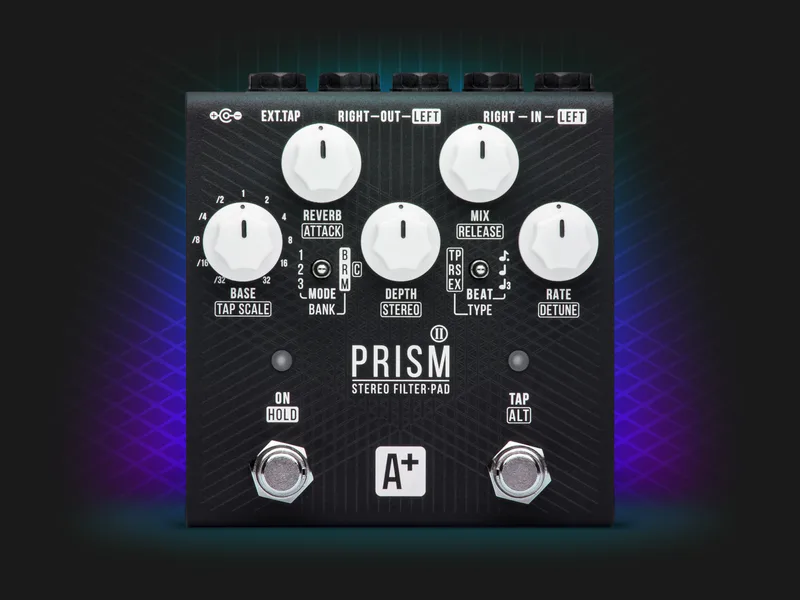
Yes. Shift Line's product page marks the Prism-9 as discontinued. The company later introduced the Prism II, a stereo version of the same filter pad concept, which carries the line forward.
Sources (2)
- Shift Line A+ Prism-9 Filter Pad, Delicious Audio, 2018-12-13
- A+ Prism-9, Shift-Line, 2026