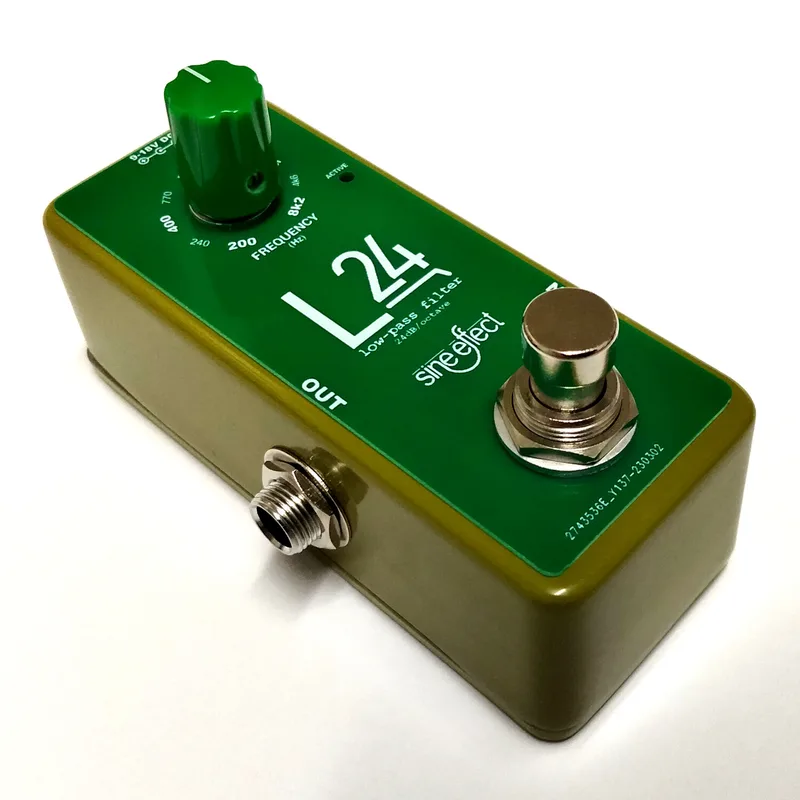
The Sine Effect Electronics L24 is a steep low-pass filter pedal: it lets everything below a chosen cutoff frequency through and rolls off everything above it at 24dB per octave, a fourth-order slope. The maker describes it as "the counterpart to the H24 HPF pedal", its high-pass sibling, and the two together cover the two directions a fixed filter can cut. Sine Effect builds its guitar and bass pedals by hand in Scotland, a practice the company says it has kept up since 20141.
What it does to your signal
A low-pass filter at this slope is a tone-shaping tool rather than an effect in the usual sense. With the cutoff set low, the L24 removes harmonics and fret noise above the note, which is useful for darkening a bright guitar, taming a harsh pickup, or getting a rounded, almost upright-bass-like voice on bass pedal boards. Set high, it only trims the very top of the spectrum. Because the slope is 24dB per octave, the transition is much sharper than the gentle roll-off of a guitar's tone control or most equalization pedals: content above the cutoff drops away quickly instead of fading gradually1.
The maker's specification for the filter is an adjustable frequency of 200Hz to 8.2kHz with a slope of 24dB/octave (4th-order), and the pedal is listed with a noise figure of <100dB1.
Controls and specifications
The maker's listing gives the following specifications for the L241:
| Specification | Value |
|---|---|
| Filter type | Low-pass, 24dB/octave (4th-order) |
| Cutoff range | 200Hz to 8.2kHz, adjustable |
| Bypass | True bypass |
| Input impedance | 1 mega-ohm |
| Output impedance | 100 ohm |
| Noise | <100dB |
| Supply voltage | 9 to 18V DC, center-negative |
| Current draw | ~10mA |
| Dimensions | ~48x100x50mm (including sockets and knobs) |
Power and practical use
The L24 runs on a 9 to 18V DC center-negative supply and draws about 10mA, which is light enough for any standard pedalboard supply1. The 1 mega-ohm input impedance is high enough that the pedal will not load down your guitar's pickups, and the 100 ohm output impedance means it can drive the rest of a chain without difficulty1.
The L24 and the H24 are separate pedals, not switchable modes of one unit. If a player wants both low-pass and high-pass filtering, the two can be used together, and both share the same 9 to 18V DC center-negative power requirement and true bypass switching12.
The L24 and the H24
The H24 is the L24's mirror image: a steep high-pass filter pedal that removes lows below the cutoff instead of highs above it, at the same 24dB/octave slope. Sine Effect lists the H24 with hand-matched components, true bypass switching, and the same 9 to 18V DC center-negative supply as the L2421. Where the L24 is the tool for shaving off top end, the H24 does the same job at the bottom of the spectrum, for instance tightening low-end mud before a drive pedal or narrowing a signal for a specific voice.
Availability and where it is made
Sine Effect Electronics has built its guitar and bass pedals by hand in Scotland since 2014, and the L24 is part of that range1. At the maker's listing dated 26 October 2026, the pedal was in stock with one unit ready to ship and a lead time the maker gives as "0 WEEKS! 1 READY TO SHIP." The listed price is £97.00 GBP1. All Sine Effect pedals come with a 2-year warranty1.
Questions
Is the Sine Effect L24 true bypass?
Yes. Sine Effect Electronics lists the L24 as true bypass, so when the pedal is off, your guitar's signal passes straight through without any filtering or buffering in the way. The pedal also has a 1 mega-ohm input impedance and a 100 ohm output impedance, which keeps it from loading down your pickups or struggling to drive what comes after it.
What power supply does the L24 need?
The L24 runs on a 9 to 18V DC centre-negative supply and draws about 10mA. That low draw means almost any standard pedal power supply or daisy chain can handle it, and the pedal can be run at higher supply voltages within that range if you want to try it.
What frequency range does the L24 cover?
The cutoff frequency is adjustable from 200Hz to 8.2kHz, with a slope of 24dB per octave, which is a fourth-order filter. That steep slope means content above the cutoff is removed quickly rather than gently, so you can dial in anything from a dark, bass-heavy tone to a narrow band of treble.
What is the difference between the L24 and the H24?
They are counterparts from the same maker: the L24 is a low-pass filter that removes highs above the cutoff, while the H24 is a high-pass filter that removes lows below it. Both filter at 24dB per octave, both are true bypass, and both run on 9 to 18V DC centre-negative power. The H24 is listed with hand-matched components.
Where is the Sine Effect L24 made?
Sine Effect Electronics builds its guitar and bass pedals by hand in Scotland, and the company says it has done so since 2014. The L24 is one of those pedals, and at the time of the maker's current listing it was in stock with one unit ready to ship.
Sources (2)
- L24 - low-pass filter (24dB/octave), Sine Effect Electronics
- H24 - high-pass filter (24dB/octave), Sine Effect Electronics