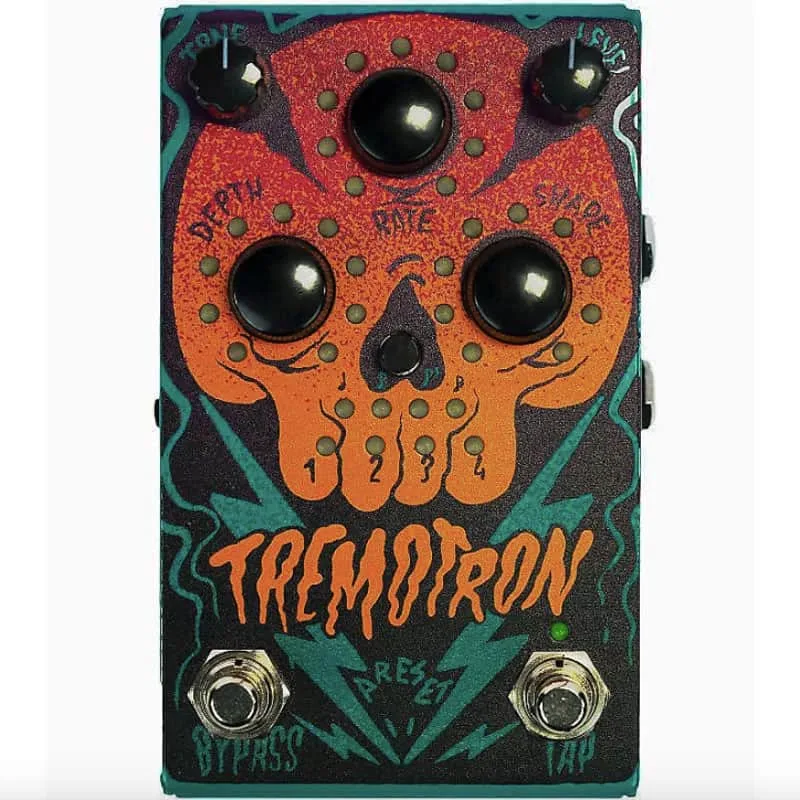


The Stone Deaf Tremotron is a tremolo pedal that puts two analog tremolo circuits in one box, made in the UK by Stone Deaf. Each of its two tremolos has its own Depth, Rate and Wave Shape controls, so you can run two modulations at once, set them at different speeds, or sync them in time with each other using the same syncopations1. Premier Guitar's reviewer described it as "bristling with features, including MIDI connectivity, brilliant digital and expression pedal control", all packed into a relatively compact enclosure2.
Under the hood it is a digitally controlled dual-analog VCA design: at its heart are two waveform generators driven by a voltage control amplifier and a secondary LFO tremolo circuit2. Guitar.com's review notes that, like all Stone Deaf pedals, it has a purely analog signal path, with digital control layered on top3. Premier Guitar's reviewer placed the voicing in context: "VCA tremolo is a little less contoured than, say, Fender optical or bias tremolo. But it's easy to regulate, especially with choppy, fast modulations"2.
What the Tremotron does
A tremolo raises and lowers the volume of your signal in a repeating cycle, and the Tremotron gives you two of those cycles at once. Because each side has its own controls, the two can run at different speeds for a compound, lopsided pulse, or lock together in time with matching syncopations1. Premier Guitar's reviewer found this breadth was the point: "What's cool about Stone Deaf's Tremotron is how many of these tremolo variations it can cover"2.
The wave shapes are where the two sides get their character. Guitar.com counted nine wave shapes plus six "half and half" settings3, and Delicious Audio's coverage adds that you can pick from sine, square, ramp and reverse shapes, or make your own1. A MusicRadar NAMM 2016 demo with Stone Deaf's Tom showed the sine, square, ramp and reverse ramp shapes on the early unit4. A low-pass tone control and a level control work conventionally, moving between stops at either end of their ranges2.
Controls, footswitches, presets and MIDI
The pedal carries two soft-relay footswitches. They work independently as bypass and tap-tempo switches, or can be pressed simultaneously to recall presets2. Tap tempo and tap division were both shown in the MusicRadar demo4.
- Per tremolo: Depth, Rate and Wave Shape controls for each of the two tremolos1
- Global: Low-pass tone control and level control2
- Modulation layering: Press a control knob down and move the controls to add modulation, with LED colors indicating the modulation amount1
- Presets: Four main presets in the pedal, accessed by pressing both footswitches at once3
- MIDI: A five-pin MIDI input saves and recalls up to 128 presets using any MIDI device, including a DAW, keyboard or control looper13
Expression control comes through a regular expression pedal connected to the input, which can be assigned to the Depth, Rate and Shape of each tremolo, independently or separately1. Guitar.com's review highlights the option of changing multiple parameters simultaneously with an expression pedal3.
History and versions
Stone Deaf showed the Tremotron at NAMM in January 2016, alongside the Syncopy analog delay, both built around expression, tap tempo and MIDI preset control4. In the MusicRadar demo, Stone Deaf's Tom noted the unit on display was the first prototype, and that the next prototype would have the wave shapes printed on the enclosure as well4.
Guitar.com reviewed the finished pedal in May 2017, describing it as a "digitally controlled dual-analogue VCA tremolo pedal, made in UK" measuring 131x86x61mm, priced at £249.993. A later Guitar.com listing carried a UK price of £208 and noted the original review date of May 20175. Premier Guitar's 2021 review gave a $269 street price in US dollars2.
What reviewers said
Guitar.com's Richard Purvis found the digital control layer opened up the pedal's possibilities, writing that "the addition of digital control has opened up all sorts of possibilities"3. Premier Guitar's 2021 review summed up its strengths as a "functional dual-tremolo design" among its pros2.
A MusicRadar demo from NAMM 2016, presented with Stone Deaf's Tom, walks through the two tremolos, the wave shapes, tap tempo and tap division on the first prototype4:
Videos
ProGuitarShopDemos
ProGuitarShopDemos
Andertons Music Co
Questions
Is the Stone Deaf Tremotron true bypass?
Yes. Guitar.com's review lists true bypass among its specifications. The pedal is powered by a 9-volt supply drawing 250mA, which is not supplied with the pedal.
How much current does the Tremotron draw?
Guitar.com's review specifies a 250mA current draw from a 9-volt mains supply, with the power supply not included. That draw is high for a compact analog tremolo, so a dedicated output on a power supply is the practical choice.
Can the two tremolos on the Tremotron run at different speeds?
Yes. Each tremolo has its own Depth, Rate and Wave Shape controls, so the two can be set at completely different speeds. Alternatively they can be synced in time with each other using the same syncopations.
Does the Stone Deaf Tremotron have tap tempo?
Yes. It has tap tempo and tap division, shown in a MusicRadar NAMM 2016 demo with Stone Deaf, and confirmed in Delicious Audio's coverage. One of the two soft-relay footswitches serves as the tap-tempo switch.
How many presets does the Tremotron store?
Four presets can be recalled within the pedal itself, accessed by pressing both footswitches at once. Through the five-pin MIDI input, up to 128 presets can be saved and recalled from any MIDI device, including a DAW, keyboard or control looper.
What expression pedal works with the Stone Deaf Tremotron?
A regular expression pedal. It connects to the expression input and can be assigned to the Depth, Rate and Shape of each tremolo, either independently or separately, and can change multiple parameters at once.
Sources (5)
- Stone Deaf Tremotron Analog Tremolo, Delicious Audio, 2019-01-02
- Stone Deaf Tremotron Review, Premier Guitar, 2017-09-18
- Stone Deaf Tremotron Review, guitar.com, 2017-05-09
- NAMM 2016: Stone Deaf Tremotron and Syncopy, MusicRadar, 2016-01-23
- Gear Of The Year 2017: Best Effects Pedal, Guitar.com, 2017-12-19