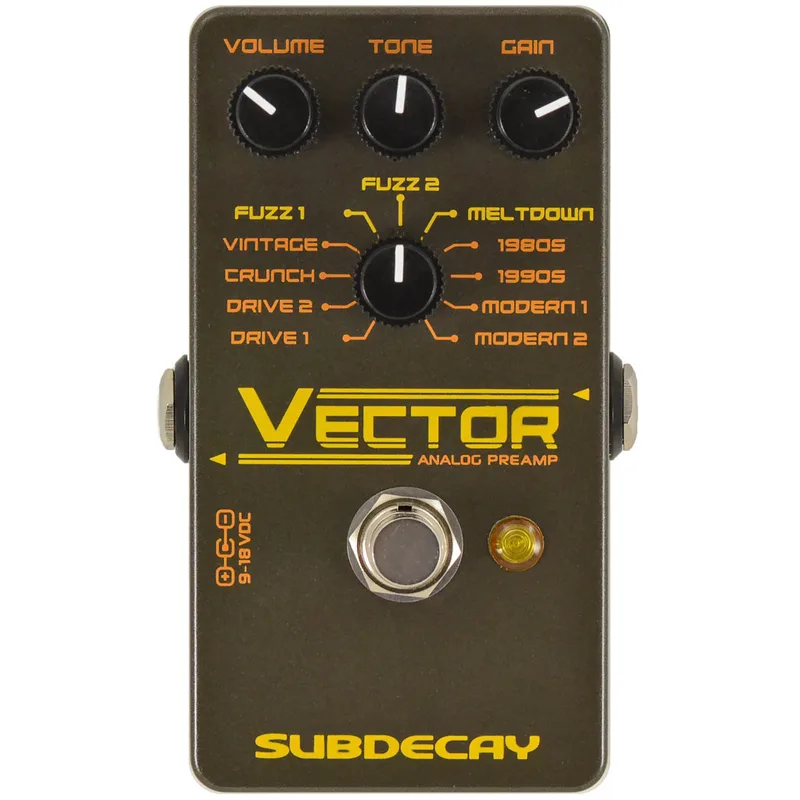


The Subdecay Vector is a compact preamp pedal that packs eleven channels of overdrive, distortion and fuzz into one stompbox. Subdecay launched it on August 24, 2017 at $1791, and MusicRadar reported it the same month as "a staggering 11 types of fuzz, overdrive and distortion" in a single compact box2.
The idea behind the pedal is a hybrid one. Subdecay says the Vector uses digitally controlled analog gain stages and an internal tone stack to deliver its eleven channels1. In other words, the gain that shapes your tone is analog, while digital technology handles the switching and configuration of those gain stages. Delicious Audio noted the tension in the marketing directly, calling it "a pedal dubbed as an 'analog preamp'" that is "actually a lot more than just a preamp"3.
Eleven channels of overdrive and fuzz
The channel list covers the whole gain spectrum, from low gain overdrive to fuzz. Subdecay's launch announcement names them: Drive 1 & 2, Crunch, Vintage, Fuzz 1 & 2, Meltdown, 1980s, 1990s and Modern 1 & 21. MusicRadar's rundown adds context to a few of them, describing the set as "TS-derived Drive 1 & 2; mid-gain Crunch; Vintage (with big bottom-end); '60s-style Fuzz 1 & 2; Meltdown" plus the 1980s, 1990s and two Modern distortion sounds2.
| Channel | Where it sits |
|---|---|
| Drive 1 | Low gain overdrive, TS derived2 |
| Drive 2 | Like Drive 1 with more bass and a less prominent midrange hump4 |
| Crunch | Mid gain, tight bass and harmonic clarity3 |
| Vintage | Big bottom end, overloaded amp character3 |
| Fuzz 1 | '60s style fuzz2 |
| Fuzz 2 | '60s style fuzz2 |
| Meltdown | Fuzz into a cranked amp3 |
| 1980s | Distortion1 |
| 1990s | Distortion1 |
| Modern 1 | Warm, rich high gain rhythm channel3 |
| Modern 2 | Modern high gain1 |
Delicious Audio's channel by channel notes give a player the clearest picture of what each mode does. Drive 1 and 2 are "similar to that well known green overdrive, but without the tubby cleanish signal underneath," which the site says makes them more useful with a clean amp while still pushing a dirty amp hard3. Drive 2 differs from Drive 1 by adding more bass response and softening the midrange hump4. The Crunch channel's "tight bass response and harmonic clarity make it perfect for palm muting and general purpose riff rock"3. Vintage "makes your amp sound overloaded with a big bottom end, yet retains note separation on the higher strings"3. Meltdown "sounds like a fuzz pedal into a cranked amp"3. Modern 1 is "the go to channel for rhythm guitar that works on just about anything, even in super thick mixes. It's warm and rich"3.
The two fuzz channels have a specific lineage. Delicious Audio reports that Fuzz 1 and 2 are "inspired by mainstay fuzz pedal of the 60s garage rock," a pedal that mixed two fuzz circuits via a depth knob3.
How it works and how it is controlled
Subdecay's own description of the circuit is the key to understanding the pedal: "The Vector uses digital technology to control multiple gain stages and a full internal tone stack"4. The analog gain stages do the clipping and saturation, and the digital control layer reconfigures them for each of the eleven channels, along with the internal tone stack that tailors the EQ per mode.
The control surface is deliberately familiar. Subdecay's press release describes "a familiar volume, drive and gain controls"1, while MusicRadar and Delicious Audio both list the knobs as volume, tone and gain, with MusicRadar noting that each channel features these controls23. The two listings name the knob set slightly differently, so it is worth trying the pedal with the channel you use most before committing to a setting.
Delicious Audio summed up the design philosophy as "providing eleven different distortion options in a no frills package"3, and noted the practical benefit for pedalboard space: "The Vector won't get in the way or eat up half of your pedalboard"3.
Power and bypass
The Vector runs on a regulated 9VDC to 18VDC adapter with a negative center 2.1mm barrel style plug4. Subdecay's press release gives the same 9 to 18 volt DC range1, and MusicRadar confirms the 9V to 18V power supply2. The maker's documentation makes no mention of battery power.
The Vector requires a DC adapter; there is no battery option in the maker's specifications. The 9 to 18 volt range means it will run on a standard 9V pedalboard supply, and the higher voltage option is there if your power supply offers it.
Switching is true bypass, which Subdecay lists alongside the all analog signal path in its launch features1. When the pedal is off, your signal passes through untouched.
Where it came from
Subdecay is an Oregon pedal maker, and the company framed the Vector as a synthesis of its history: the press release says the maker "merges their early roots of fuzz and overdrive with their current design ethos"1. The pedal arrived on August 24, 2017 at $1791, and MusicRadar reported it as available now at that price a week later2. Delicious Audio covered it again in December 2017 as part of Subdecay's release cycle3.
Videos
Premier Guitar
Brett Kingman
Dennis Kayzer
Questions
Is the Subdecay Vector analog or digital?
Both, in a way. Subdecay says the Vector uses digitally controlled analog gain stages and an internal tone stack, so the signal path is analog while digital technology switches and configures the gain stages. Delicious Audio described it as a digital pedal marketed as an analog preamp, which is a fair reading of the hybrid design.
Does the Subdecay Vector have true bypass?
Yes. Subdecay's launch press release lists an all analog signal path and true bypass switching among the Vector's features, so the pedal is out of the signal chain entirely when disengaged.
What power does the Subdecay Vector take?
A regulated 9VDC to 18VDC adapter with a negative center 2.1mm barrel plug. Subdecay's press release gives the same 9 to 18 volt DC range. There is no mention of battery power in the maker's documentation.
What are the eleven modes on the Subdecay Vector?
Drive 1, Drive 2, Crunch, Vintage, Fuzz 1, Fuzz 2, Meltdown, 1980s, 1990s, Modern 1 and Modern 2. Together they span low gain overdrive through mid gain crunch to fuzz and high gain distortion, all in one compact pedal.
What did the Subdecay Vector cost at launch?
Subdecay launched the Vector Preamp on August 24, 2017 at $179 USD. MusicRadar confirmed the same $179 price when it reported the pedal as available at the end of August 2017.
What sounds does the Subdecay Vector include?
Eleven channels covering overdrive, distortion and fuzz: TS style Drive 1 and 2, mid gain Crunch, Vintage with a big bottom end, 60s garage rock inspired Fuzz 1 and 2, Meltdown, 1980s, 1990s and two Modern high gain channels.
Sources (4)
- Subdecay launches the Vector Preamp., Subdecay, 2017-08-23
- Subdecay debuts 11-channel Vector analogue preamp pedal, MusicRadar, 2017-08-31
- Subdecay Vector, Delicious Audio, 2017-12-05
- Vector - Analog Preamp - Guitar Effects - Subdecay, Subdecay, 2017-11-14