

The TC Electronic Ditto Looper is a compact looper pedal built around a single footswitch and a single loop level knob. TC Electronic designed it as a 5-minute looper that records in 24-bit uncompressed audio, with unlimited overdubs so you can layer parts over your own playing1. It arrived in 2013 and, according to Guitar World, much of its appeal came from its single-knob simplicity and the fact it offered players infinite overdubs2.
The idea behind the pedal is minimalism. Premier Guitar noted at launch that record, undo/redo, stop and erase are all accessed via different foot commands, so nothing needs a second knob or switch3. Everything a player needs for basic looping is on one button.
The controls: one footswitch, one loop level knob
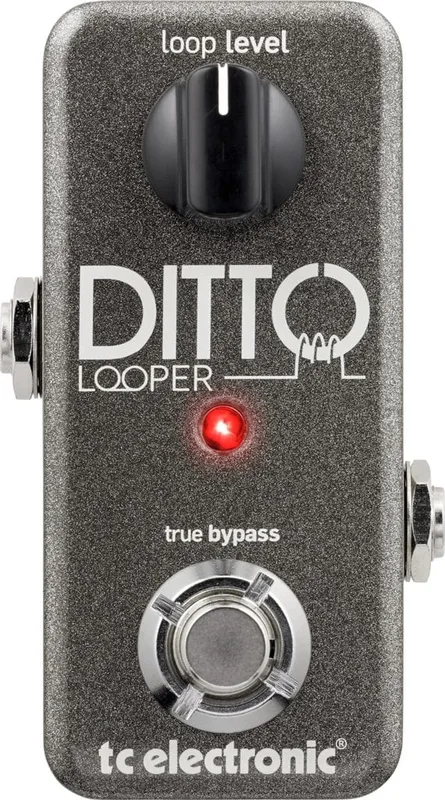
The Ditto's front panel holds one footswitch, one knob, one input, one output and one multi-colored LED8. The knob handles the loop level, which is the volume of the recorded loop against your live playing8. The footswitch controls recording and playback6.
| Control | What it does |
|---|---|
| Footswitch | Press once to record, press once again to play the loop1 |
| Footswitch (stop) | Press twice to stop8 |
| Footswitch (clear) | Press and hold after stopping to erase the loop8 |
| Footswitch (undo/redo) | Reached via foot commands alongside record, stop and erase3 |
| Loop level knob | Sets the level of the recorded loop8 |
| Multi-color LED | Indicates the current mode; on the original there is no visual loop position indicator9 |
That last point is worth knowing before you buy: on the original Ditto there was no way to tell how far through a loop you were visually, and the current play mode was indicated only by a flashing LED9. Later Ditto models addressed this.
Power and connections
Power is provided by a standard 9v power jack6. There is no battery option: MusicRadar's review points out the case is actually too small to enclose a standard PP3 nine-volt battery, and the price does not include a power supply10. Connections are two quarter-inch jacks, one in and one out, with no stereo operation on the original78.
Budget for a power supply. The Ditto has no battery compartment and ships without one, so a 9V supply is needed from day one10.
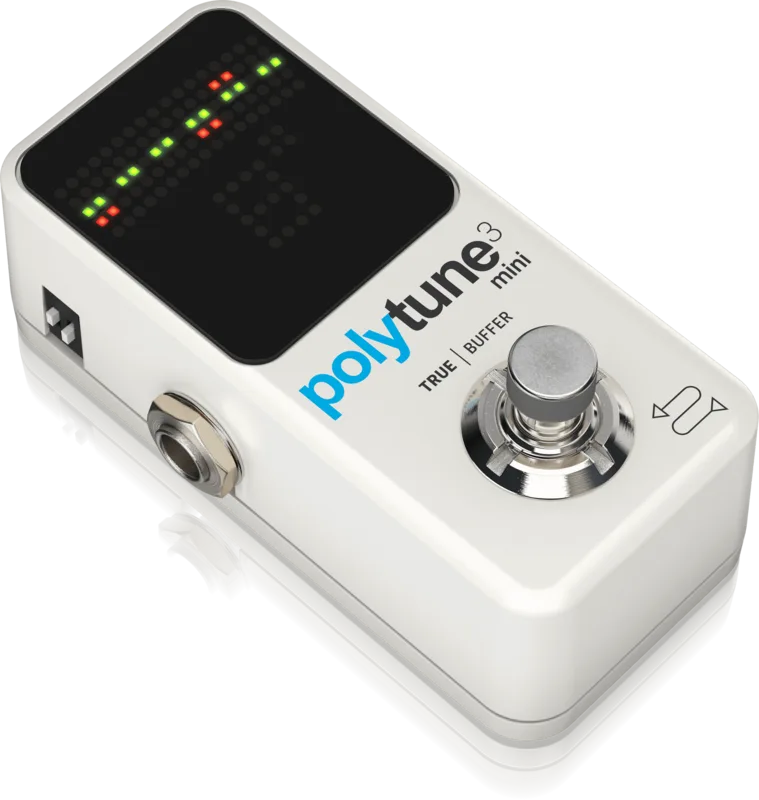
At 92mm in length, the Ditto measures the same as TC's PolyTune Mini, which is what lets it fit on even a crowded small pedalboard10.
Inside the pedal: the footswitch and circuit
A Coda Effects teardown and repair article gives the clearest published look inside. The Ditto is composed of two PCBs linked by connectors, and everything is SMD except some big blue 100uF electrolytic capacitors11.
The footswitch is the part most likely to need attention. The author's own unit, bought used, stopped working after 6 months of intensive use: the LED still worked but the switch required many presses before anything happened11. The article identifies the switching system as the same one used in the Line 6 DL4, famous for switch failure11.
The repair options are straightforward:
- Replace the microswitch with the same component11
- Replace the spring and microswitch system with a real 1PST footswitch, more resistant and easier to replace later; the author used an arcade-type switch that fits the enclosure11
The pedal was guaranteed for 2 years11, so a failure inside that window is a warranty matter rather than a soldering job.
History and versions
The Ditto Looper launched in 20132 and spawned a family of loopers, each adding something the original left out:
| Version | What it adds |
|---|---|
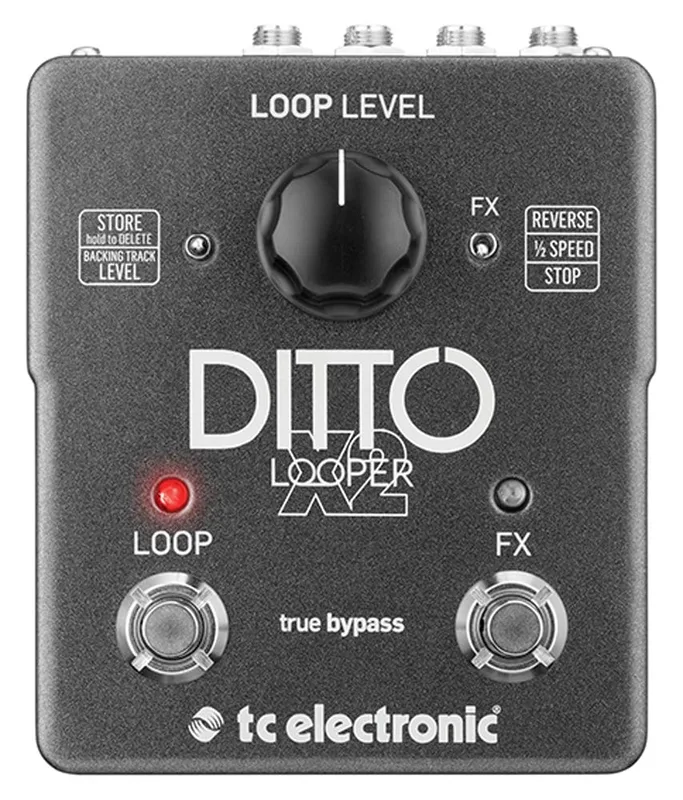
| Ditto X2 | Announced January 2014 as an update to the popular Ditto Looper, with 5 minutes of looping time and a 2-button UI allowing a dedicated stop/clear footswitch and a button for effects12 |
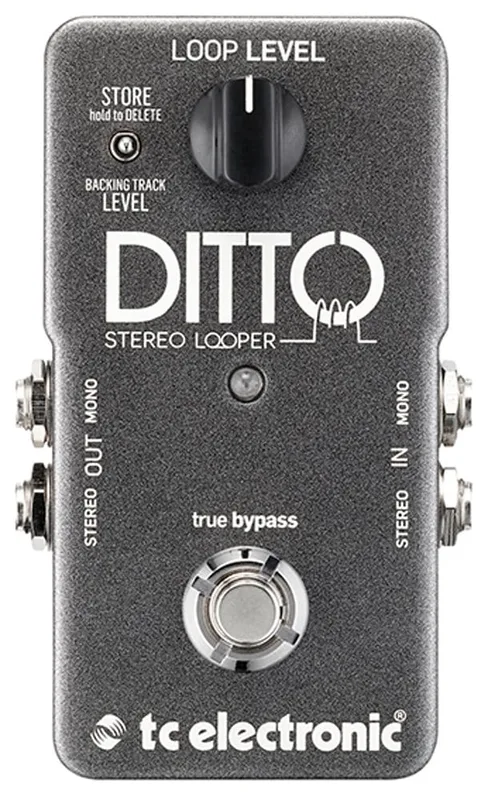
| Ditto Stereo Looper | A brand new version announced April 2015, with Stereo I/O, True-Bypass and Analog-Dry-Through, plus the option of running on a 9v battery13 |
| Ditto+ | Takes the original Ditto Looper and expands it with new features, with the Original DITTO Looper mode still available14 |
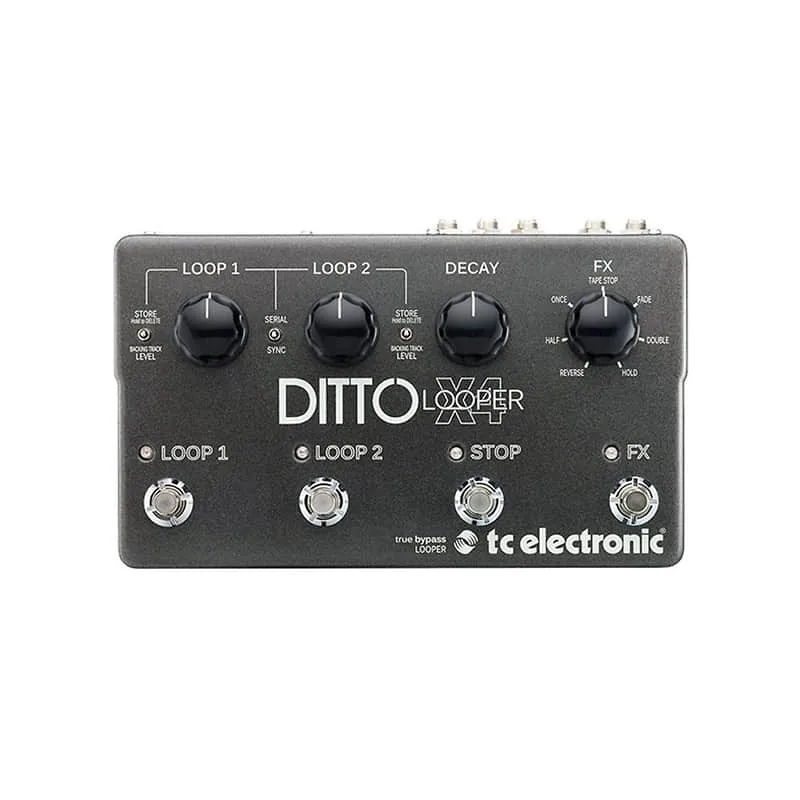
| Ditto X4 | A larger looper where each loop has its own footswitch plus a dedicated stop footswitch |
| Ditto 2 | The second generation, replacing the ageing Ditto; keeps the one-button looping experience with a redesigned larger footswitch featuring a snappy, magnetic mechanism1516 |
There was also a Ditto Looper Gold, a limited edition gold-colored run of only 5000 pedals, available exclusively at Guitar Center in the US from August 24th at $129.99 suggested US retail, with the same true-bypass, analog dry-through design and 24 bit uncompressed audio as the standard pedal17.
Guitar World reports the original Ditto is still available at the time of writing and gives you largely the same functionality as newer models for a lesser price, without smart recognition of loops or a companion app2.
What reviewers said
Reviews of the original were positive about the core looping and honest about the limits. MusicRadar's Simon Bradley summed it up:
"Not without certain compromises, this is a simple, great-sounding and well-conceived looper that'd be ideal to get you started"
The same review highlighted the practical side: you can play the loop and noodle along in real time, or add infinite overdubs to build up parts10. Premier Guitar's reviewer found the hardware almost impossible to get wrong, writing that a pedal "with two quarter-inch jacks, a footswitch and a single knob for loop level is just too simple to screw up!"7. Guitar World's 2013 review credited the analog-dry-through signal routing, which lets your dry sound pass without being converted to a digital signal, ensuring purity and zero latency4.
The recurring criticism is the one you would expect from a one-button design: it is limited compared with other pedal-based loopers10, and the lack of any visual indication of loop position means you keep track of where you are by ear9.
Videos
ProGuitarShopDemos
Sweetwater
TC Electronic
News
Questions
Does the TC Electronic Ditto take a battery?
No. The original Ditto Looper has no battery option, and MusicRadar's review notes the case is actually too small to enclose a standard PP3 nine-volt battery. Power comes from a standard 9V power jack only, and the price did not include a power supply. Later Ditto models such as the Ditto X2 and Ditto Stereo added battery power.
How long can a loop be on the Ditto Looper?
Five minutes, with unlimited overdubs on top. Premier Guitar's review puts it as loops as long as five minutes with endless overdubbing, and TC Electronic designed it as a 5-minute looper. You can play along in real time or stack parts to build up an arrangement.
Is the Ditto Looper true bypass?
TC Electronic describes the Ditto as true bypass with Analog-Dry-Through, so your dry signal stays analog whether the pedal is on or off. A later Guitar World buying guide lists its bypass as buffered. Delicious Audio noted that once a loop is cleared the pedal goes back into true bypass.
What power supply does the Ditto Looper need?
A standard 9V power jack, the same center-negative style supply used by most compact pedals. Performer Magazine's review confirms power is provided by a standard 9v power jack. No battery fits in the enclosure, and the original price did not include a supply, so you need to provide your own.
How do you stop and clear a loop on the Ditto?
Press the footswitch twice to stop the loop, then press and hold to clear it. Once cleared, the pedal returns to true bypass. Recording is one press, playback is another press, and undo and redo are reached through further foot commands on the single switch.
Can the Ditto footswitch be replaced if it fails?
Yes. A Coda Effects repair article shows the pedal opens to two linked circuit boards, and the microswitch can be replaced with the same component, or the spring and microswitch system swapped for a real 1PST footswitch. The author fitted an arcade-type switch that fits the enclosure.
Sources (17)
- DITTO LOOPER, TC Electronic
- TC Electronic Ditto 2 Looper review, Guitar World, 2025-06-04
- TC Electronic Releases the Ditto Looper, Premier Guitar, 2013-01-09
- Review: TC Electronic Ditto Looper Pedal, Guitar World, 2013-04-04
- Best cheap looper pedals 2025: bang-for-your-buck loopers for your 'board, Guitar World, 2022-03-15
- TC Ditto Looper Review, Performer Mag, 2013-06-27
- TC Electronic Ditto Looper Pedal Review, Premier Guitar, 2013-01-30
- Pedal Reviews: TC Electronic Ditto Looper, Delicious Audio, 2013-08-09
- TC Electronic announces next-generation Ditto Looper, the Ditto+, Guitar.com, 2020-06-25
- TC Electronic Ditto Looper review, MusicRadar, 2013-03-05
- Coda Effects, Coda Effects, 2015-04
- NAMM 2014: TC Electronic announces Ditto X2 Looper, MusicRadar, 2014-01-14
- Musikmesse 2015: TC Electronic Unveil Ditto Stereo Looper, Guitar.com, 2015-04-14
- TC Electronic Introduces the Ditto+ Looper, Premier Guitar, 2020-06-25
- DITTO 2 LOOPER, TC Electronic
- “It's transparent when not in operation, crisp when looping, and handles high-gain and complex audio sources with ease”: TC Electronic Ditto 2 Looper review, MusicRadar, 2025-04-01
- TC Electronic Announces Ditto Looper Gold, Guitar Interactive Magazine, 2014-07-23