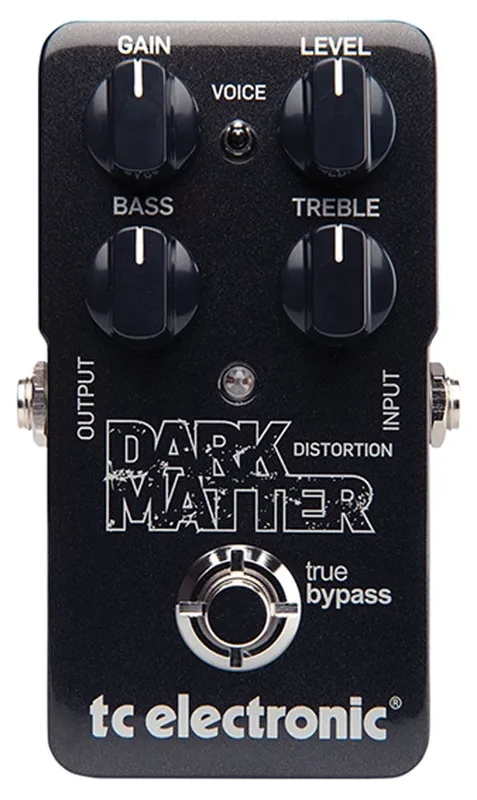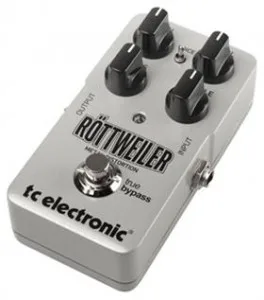


The TC Electronic Röttweiler is an all-analog high-gain distortion pedal aimed at metal and hard rock players. Vintage Guitar magazine described it on its introduction as "an all-analog high-gain pedal with a circuit based on soft clipping for authentic response and tone"1. MusicRadar's reviewer Trevor Curwen described it as "specifically designed with a tonal balance to cut through the mix"2.
What it does
The Röttweiler is built around soft clipping circuitry, which MusicRadar says is there "to recreate the sound of high-gain valve amps"2. The gain range is wide: Curwen wrote that "the range here runs from 'plenty' to 'shedloads' catering for chugging rhythms, taut riffing or lead breaks"2.
The controls
| Control | What it does |
|---|---|
| Voice toggle | Selects between two midrange voicings1 |
| Treble | Fine-tunes the tone, alongside the Bass control1 |
| Bass | Fine-tunes the tone, alongside the Treble control1 |
The Voice switch is the pedal's defining control. MusicRadar described "two very distinct and different voices centring on the amount of midrange available, one scooped for modern metal genres"2. The Treble and Bass controls are widely adjustable, and Curwen noted that the pedal "will project your sound even without using the widely adjustable treble and bass"2.
Build and power
The pedal sits in a custom die-cast aluminum casing1. It takes a battery, behind a one-screw battery-access cover1, and MusicRadar listed easy battery access among its plus points2. Vintage Guitar also lists true-bypass switching among its features1.
What reviewers said
MusicRadar's verdict was that the pedal delivers instant rock and metal sounds: "Pedal to the metal? This one takes you straight there. It barks and it bites." Curwen's overall view was that it barks and bites, but is not really suitable for all music genres2.
Videos
TC Electronic
TC Electronic
MusicStoreLive.com
Questions
What does the Voice switch do on the TC Electronic Röttweiler?
The Voice toggle selects between two midrange voicings. MusicRadar's reviewer, Trevor Curwen, described the two voices as very distinct and different, centring on the amount of midrange available, with one having a scooped sound suited to modern metal genres. In practice it lets you choose between a mid-forward setting that cuts through and a scooped setting for heavier styles.
Is the TC Electronic Röttweiler analog?
Yes. Vintage Guitar magazine described the Röttweiler Distortion as an all-analog high-gain pedal with a circuit based on soft clipping for authentic response and tone.
Is the TC Electronic Röttweiler true bypass?
Yes. Vintage Guitar magazine lists true-bypass switching among the pedal's features, so the pedal is out of the signal path when switched off.
Does the TC Electronic Röttweiler take a battery?
Yes. Vintage Guitar magazine notes a one-screw battery-access cover, and MusicRadar's review lists easy battery access among the pedal's plus points.
Does the Röttweiler use soft or hard clipping?
Soft clipping. Vintage Guitar magazine describes a circuit based on soft clipping for authentic response and tone, and MusicRadar's review says the pedal uses soft clipping circuitry to recreate the sound of high-gain valve amps.
Is the Röttweiler Distortion the same pedal as the Röttweiler?
Yes. Both names refer to the same TC Electronic distortion pedal: an all-analog high-gain design aimed at metal and hard rock players, with a Voice toggle, separate Treble and Bass controls and true-bypass switching.
Sources (2)
- TC Electronic Intros Röttweiler Distortion, Vintage Guitar magazine, 2011-10-31
- TC Electronic Röttweiler review, MusicRadar, 2012-09-28