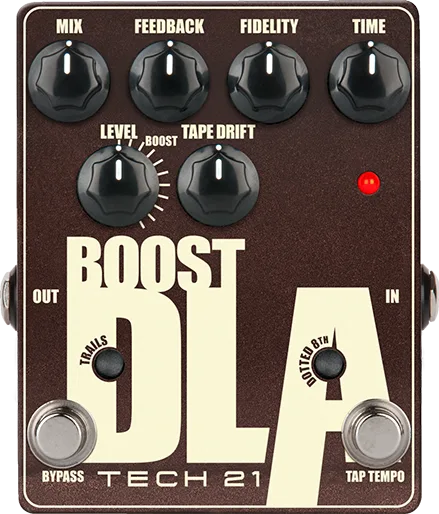


The Tech 21 Boost D.L.A. is an analog delay emulator pedal with a clean boost built in, designed by Andrew Barta for Tech 211. Tech 21 calls it a delay and clean boost combined in one pedal, with up to 9dB of boost on tap so solos jump out with greater dimension2. The company describes its circuitry as user-tweakable, "lo-fi" analog technology that intentionally injects the inherent imperfections of vintage delay units, which Tech 21 says is what makes those units so seductive and nostalgic2.
The pedal packs its controls into what the maker calls an incredibly compact enclosure, with a heavy duty, all-metal build2. Premier Guitar's reviewer found the build quality excellent and concluded that the pedal met or beat all of that reviewer's expectations of a delay unit1.
What it does and how it sounds
The Boost D.L.A. covers delay times from 30 milliseconds to a full second. A single, continuously-variable Time control provides the whole sweep, up to 1000 milliseconds21. Tech 21 says the parameters are engineered so you can explore and custom tailor delay styles including digital, vintage tape and bucket brigade2.
The Tone control is the key to that range. Premier Guitar's reviewer found it very wide ranging, covering everything from the clearest, brightest digital sounds to the warmest analog tones, and was able to duplicate the tones of any delay pedal in that reviewer's collection quickly1. On the delay times themselves, the reviewer reported:
"All delay times had perfect tonality at any setting."
Premier Guitar review, September 20261
That consistency at longer settings is a contrast with older analog delays, where the reviewer noted longer times typically get too dark1.
The Feedback control runs from just one repeat to infinite repeats, and can reach self-oscillation levels like an old Echoplex1. There is also a Flutter control, which the reviewer found works well at simulating tape warble and enables extremely variable chorus tones when paired with just the Tone control1.
Controls
| Control | What it does |
|---|---|
| Time | Delay time, 30ms to 1000ms, continuously variable12 |
| Mix | Sweeps from 100 percent dry to 100 percent wet1 |
| Feedback | From one repeat to infinite repeats, up to self-oscillation1 |
| Tone | From the clearest, brightest digital to the warmest analog tones1 |
| Level | Unity gain around 12 o'clock, up to 9dB of boost without changing the pedal's sound1 |
| Flutter | Simulates tape warble; with Tone, produces variable chorus tones1 |
The gold case carries two footswitches, one for bypass and one dedicated solely to tap tempo1. Above them sit two small buttons labeled "trails" and "triplets"1:
- Trails keeps the delay repeats repeating and fading out after the unit is switched off, rather than cutting them dead1.
- Triplets sets up triplet delay sequences in time with the tapped tempo1.
The tap tempo footswitch can be set even when the pedal is off, which Tech 21 says avoids confusion during a performance2. The supplied manual is informative, easy to understand, and offers sample settings for the types of effects the pedal provides1.
The clean boost
The boost lives on the Level control. Unity gain sits at approximately 12 o'clock on the dial, and up to 9dB of boost is available without changing the pedal's sound1. Tech 21 pitches it as a way to make solos jump out with greater dimension2. Premier Guitar's reviewer found no volume dropouts on solos regardless of the tone type in use, thanks to that boost1.
The reviewer also found the pedal to be the first delay that was truly useable in line before the front end of a distorting or clipping amp1, a spot where many delays struggle.
Bypass and buffering
The Boost D.L.A. uses buffered bypass rather than true bypass. Tech 21 says the buffered design eliminates the shortcomings the company associates with true bypass, including pops and clicks and high-end loss when multiple pedals are connected together, along with the signal loss of other switching circuits2. The pedal also uses a custom, silent-switching actuator2.
The 1kOhm low-impedance output drives long cables without loss of signal integrity, even in bypass2. On the buffered question, Premier Guitar's reviewer wrote:
"because of the choice to offer a properly designed buffered system, I don't see any problems"1
Premier Guitar review, September 20261
The reviewer tested the pedal with no ill effects on a true bypass strip1.
Power and connections
The pedal runs on a 9V alkaline battery, which is not included, or on an optional DC power supply, Tech 21 Model #DC22. The input is a 1megOhm high-impedance 1/4" jack, the same impedance as traditional tube amplifiers, and the output is a 1kOhm low-impedance 1/4" jack23.
Where it came from
Videos
ProGuitarShopDemos
Brett Kingman
GoGuitarLive
Questions
What is the maximum delay time on the Boost DLA?
The Time control sweeps continuously from 30 milliseconds up to a maximum of 1000 milliseconds, a full second of delay. Tech 21 describes it as a single, continuously-variable control with a smooth, full sweep across that whole range.
Can you set tap tempo on the Boost DLA while it is bypassed?
Yes. The pedal has a second footswitch dedicated solely to tap tempo, and Tech 21 states it can be set even when the pedal is off, so you can dial in your tempo before engaging the delay and avoid confusion mid-performance.
What do the trails and triplets buttons do on the Boost DLA?
Trails keeps the delay repeats repeating and fading out naturally after you switch the pedal off, instead of cutting them dead. Triplets sets up triplet delay sequences in time with your tapped tempo, giving you a rhythmic subdivision without re-tapping.
Can the Boost DLA self-oscillate?
Yes. Premier Guitar's reviewer found the Feedback control runs from a single repeat to infinite repeats and can reach self-oscillation levels, comparing the behavior to an old Echoplex tape echo.
Sources (3)
- Tech 21 Boost D.L.A. Pedal Review, Premier Guitar, 2009-11-18
- Boost DLA, Tech 21 NYC, 2019-06-12
- Tech 21 Boost DLA: New Features and Makeover Update, Premier Guitar, 2012-11-29