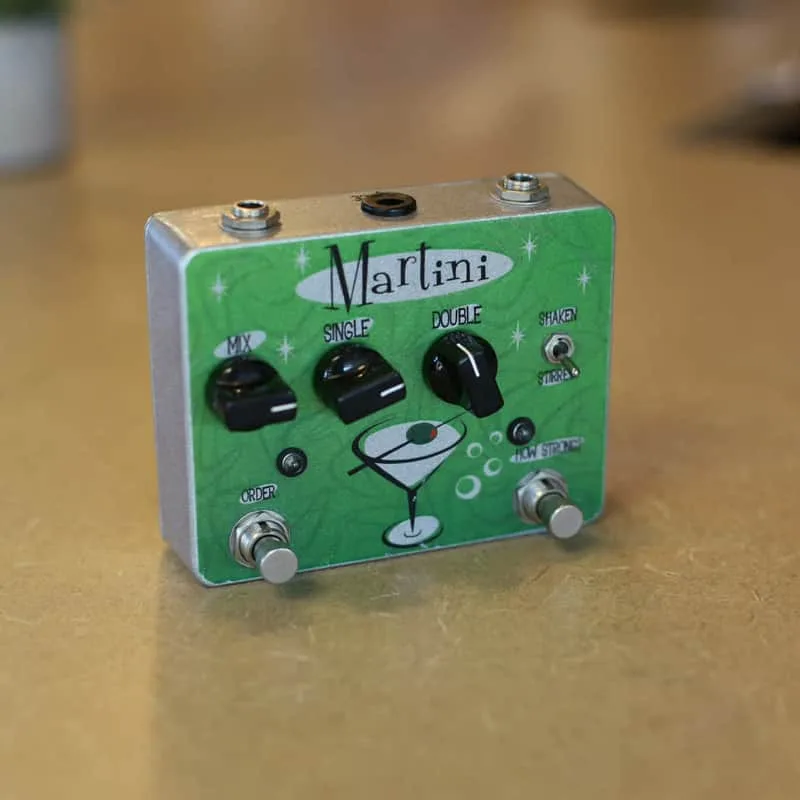


The Martini Dual Analog Chorus and Vibrato is a chorus and vibrato pedal from Tortuga Effects, a one-man shop with an extensive product line. It is a handwired, true bypass, 2-channel pedal built around a bucket-brigade analog chip, finished in candy-apple green with space-lounge graphics1. The idea is simple: two modulation sounds, dialed in separately, ready to alternate between without bending down.
Two channels, one pedal
The Martini's dual channels are devoted to Chorus (Channel 1) and Chorus or Vibrato (Channel 2)1. Each channel is set up independently, so you can have two different sounds ready and alternate between them on the fly2. That is the practical difference from a single-knob chorus: instead of one sound, you keep a pair of them at footswitch reach, for example a subtle chorus on one channel and a deeper setting or vibrato on the other.
The pedal sits in Tortuga's cocktail-named line, alongside pedals like the Manhattan Dual Analog Flanger3.
Controls and switching
| Control | What it does |
|---|---|
| Single knob | Controls the rate for Channel 11 |
| Double knob | Controls the rate for Channel 21 |
| Mix knob | Controls the amount of effected signal, shared by both channels1 |
| Shaken/Stirred toggle | Selects chorus or vibrato on Channel 21 |
| How Strong footswitch | Alternates between the two channels1 |
The two channels share the Mix knob, which controls the amount of effected signal, while the Single and Double knobs control the rate for Channel 1 and Channel 2 respectively1. A footswitch marked How Strong alternates between the two channels1.
The Shaken and Stirred toggle selects the effect type on Channel 2. Premier Guitar describes the switch as Stirred for chorus and Shaken for vibrato1, while Pedal of the Day labels them the other way around, with Shaken as chorus and Stirred as vibrato2. The two reviews disagree on which name goes with which mode, so it is worth trusting the markings on the pedal itself; either way, the switch chooses between chorus and vibrato on Channel 2.
Analog circuit, bucket-brigade chip
The Martini is an analog design. Pedal of the Day describes it as "containing a real bucket-brigade analog delay chip"2, and Premier Guitar likewise calls it "built around a bucket-brigade analog chip"1. A bucket-brigade device (BBD) is the delay chip at the heart of most classic analog chorus and vibrato circuits: the signal is passed along a line of capacitors, and modulating that delay time is what produces the chorus or vibrato effect. For players comparing circuits, this places the Martini in the analog chorus tradition rather than the digital modeling one.
What reviewers said
Pedal of the Day reviewed the Martini in December 2016 and found it delivers lush analog chorus across its range2:
"the Martini™ provides some lush, analog chorus sounds that will add sparkle and pizazz to your sound at almost any setting"2
Premier Guitar reviewed the pedal at a street price of $2991. The reviewer described the pedal as:
"brimming with a universe of deep, lush, and subtle textures that can send songs and performances into interstellar or submarine spaces"1
The same review's overall verdict:
"This is a very addictive pedal that will make an amp sound better, no matter what style of music you play"1
Videos
Tortuga Television
JetCityMusic
docSanchezFX
Questions
Is the Tortuga Martini analog or digital?
It is analog. Both Premier Guitar and Pedal of the Day describe the Martini as built around a real bucket-brigade analog delay chip, the classic circuit approach for analog chorus and vibrato sounds.
What do the Shaken and Stirred settings do?
They are a toggle switch on Channel 2 that selects between the two effect types. One position gives chorus, the other vibrato. The two reviews label the positions differently, so check the switch itself, but the function is choosing chorus or vibrato on that channel.
Can the Martini run two different sounds and switch between them?
Yes. Each channel is set up independently with its own rate knob, giving two separate sounds you can alternate between on the fly using the How Strong footswitch.
Does the Martini have a bucket-brigade chip?
Yes. Pedal of the Day states it contains a real bucket-brigade analog delay chip, and Premier Guitar likewise describes the circuit as built around a bucket-brigade analog chip.
What does the How Strong? footswitch do?
It switches between the two channels. You dial in each channel separately, then use the How Strong footswitch to alternate between them while playing.
Is the Tortuga Martini analog?
Yes. It is a fully analog design built around a bucket-brigade chip, handwired, with true bypass switching.
Sources (3)
- Tortuga Martini Chorus & Vibrato Pedal Review, Premier Guitar, 2010-10-20
- Tortuga Effects Martini™ Dual Analog Chorus Vibrato, Pedal of the Day, 2016-12-02
- Tortuga Manhattan Dual Analog Flanger Pedal Review, Premier Guitar, 2012-09-05