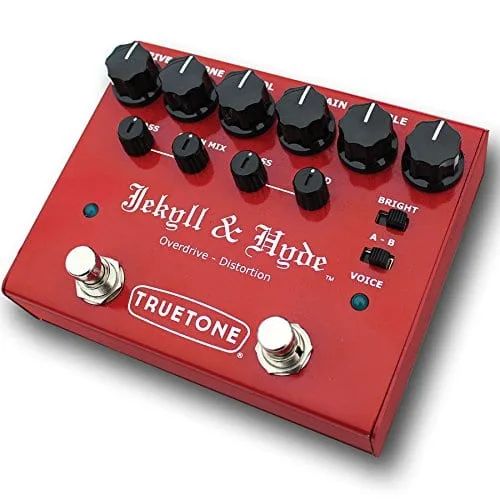


The Truetone V3 Jekyll & Hyde is a dual-channel overdrive and distortion pedal: two completely independent circuits, a warm amp-like overdrive and a thick high-gain distortion, in one home-plate-shaped enclosure1. Each channel works on its own or together, so a player can use the Jekyll side for rhythm, the Hyde side for leads, or stack them for more saturated, sustained tones.
The V3 arrived in 2015 as a complete redesign of the company's flagship dual pedal, and it was the first launch after Visual Sound changed its name to Truetone that year2. Guitar World reviewed it at a street price of $179.95 in August 20152. The pedal now sits in the Truetone Archive alongside the rest of the V3 Series1.
Two independent drives
The core idea goes back to 1997, when the original Jekyll & Hyde became, in Truetone's words, "the first effects pedal to combine overdrive and distortion in a single housing with truly independent channels"3. Each channel of the V3 keeps that independence: separate controls, separate switching, and the option to run one, the other, or both at once1.
Guitar World's Paul Riario described the pairing in his 2015 review as "a more open amp-like overdrive and a beefy distortion with plenty of bottom end that can get downright aggressive when pushed to its maximum limit"2.
The Jekyll overdrive channel
The overdrive side carries five knobs:
| Control | What it does |
|---|---|
| Drive | Sets the amount of overdrive |
| Tone | Shapes the overall brightness |
| Volume | Sets the channel's output level |
| Bass | Adjusts low-end content |
| Clean Mix | Blends in your clean signal |
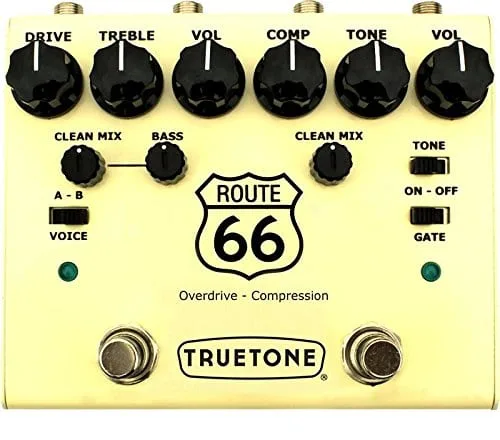
The control set comes from Guitar World's review2. The Clean Mix approach lets some of the guitar's natural dynamics through alongside the overdriven signal, a feature Truetone also added to both channels of the V3 Route 664.
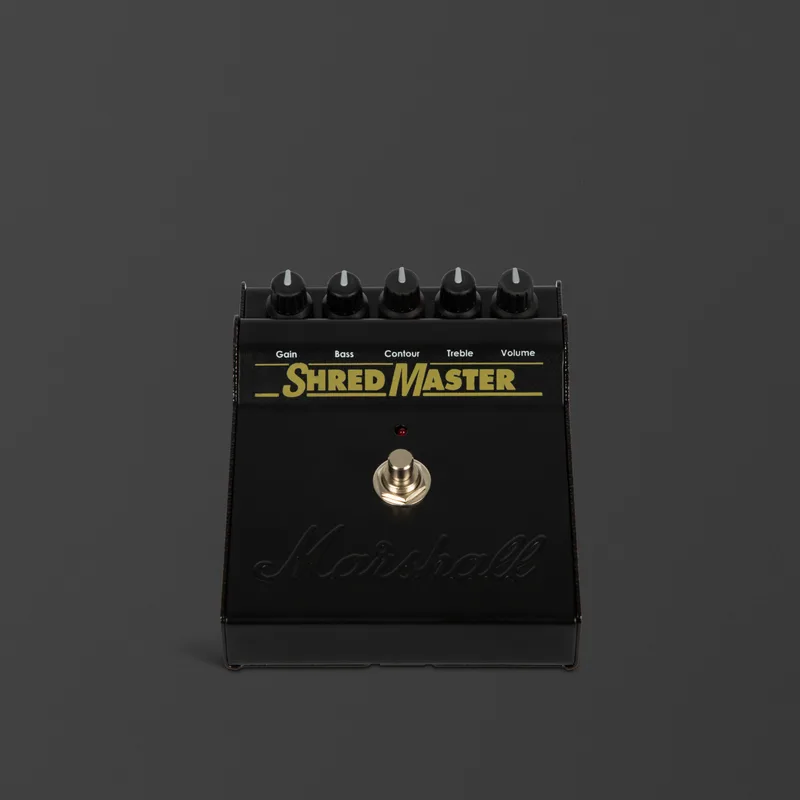
The Jekyll circuit has a family history: on the original V1, the overdrive side was based on the Ibanez TS-808 Tube Screamer circuit, modified with an optional bass boost switch to retain low-end frequencies5.
The Hyde distortion channel
The distortion side is the more fully featured of the two:
| Control | What it does |
|---|---|
| Hi-Gain | Sets the distortion amount |
| Treble | Adjusts high frequencies |
| Mid | Adjusts midrange |
| Bass | Adjusts low frequencies |
| Volume | Sets the channel's output level |
| Bright switch | Selects a brighter voicing |
| Voice A-B switch | Selects between two voicings |
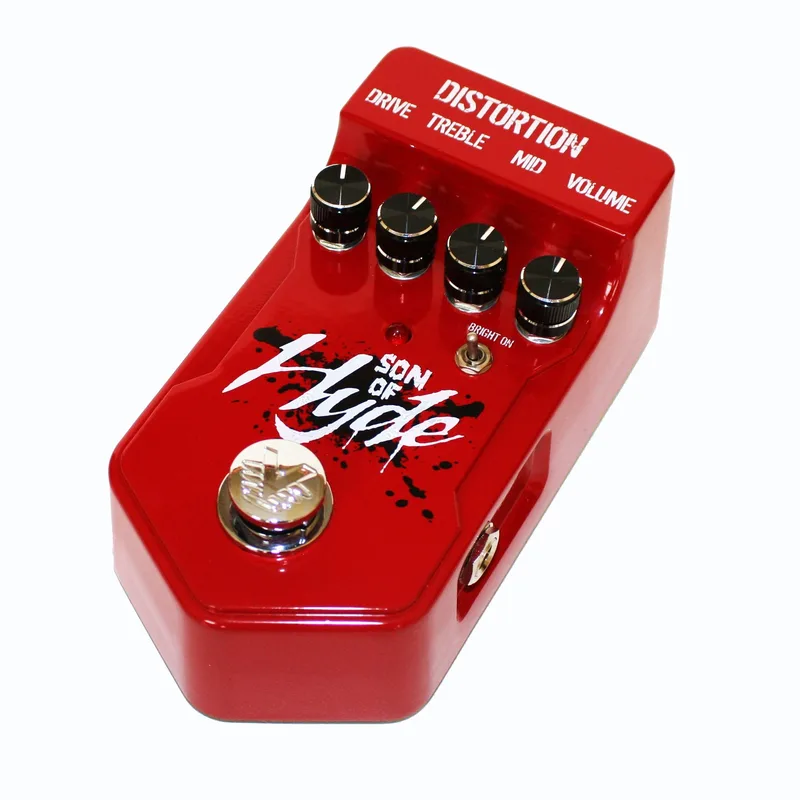
Guitar World also noted "a built-in noise gate for the distortion" on the V32. On the V1, the Hyde side was a heavy distortion circuit inspired by the Marshall Shredmaster, with high-gain tones and extensive EQ controls including a mid-scoop adjustment5. Players who want just this side of the pedal in a single box can also find it as the Truetone Son of Hyde V2, a single-channel distortion with Drive, Treble, Volume and Mid controls plus a Bright switch6.
Power and connections
The V3 draws 49mA max1. Its jacks are front-mounted, with separate inputs and outputs for each channel1. That layout is what makes loop integration possible: because each channel has its own input and output, you can patch the overdrive and the distortion into different loops, or reorder them in your chain, instead of being locked into a fixed internal series order1.
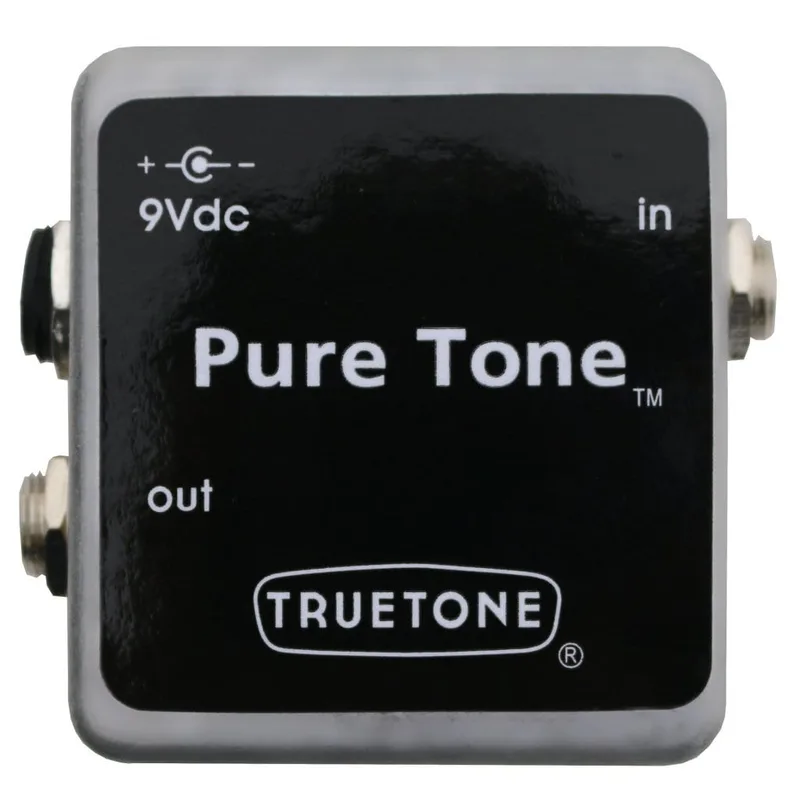
Each channel's bypass is independently selectable between true bypass and a buffered mode using Truetone's Pure Tone circuit1. For players with long cable runs or many pedals in front of the Jekyll & Hyde, the buffered option keeps the signal strong; for those who want the pedal fully out of the path when off, true bypass is there per channel.
The pedal ships with a black velvet carrying bag1.
What reviewers said
Guitar World's Paul Riario reviewed the V3 in August 2015, calling it "a complete redesign of their flagship dual effect pedal that offers even more versatility" and noting its "indestructible metal chassis"2. On the overdrive side, his verdict was favorable:
"you can hang on the overdrive side all day long because it's so transparent and fluid in response to your touch"
He found the overdrive "transparent and fluid in response to your touch," delivering "more gain with crunchy-rich character and just the right amount of compression"2.
Versions and editions
The Jekyll & Hyde has gone through three versions:
| Version | Key points |
|---|---|
| V1 (1997, Visual Sound) | First pedal to combine overdrive and distortion with truly independent channels; house-shaped metal enclosure; Jekyll based on the TS-808, Hyde inspired by the Marshall Shredmaster; hybrid circuit; 9V DC center negative, 30mA35 |
| V2 (Visual Sound) | Same format with an added integrated noise reduction system, triggered by signal presence on each channel independently; analog circuit; 9V DC center negative, 22 to 30mA37 |
| V3 (2015, Truetone) | Complete redesign; selectable true bypass or Pure Tone buffered mode per channel; separate front-mounted I/O per channel; Forever Footswitches; 49mA max12 |
The V1 was originally released under the Visual Sound brand, and its distinctive house-shaped metal enclosure with heavy-duty switches became a hallmark of the company's early designs5. The V2's noise reduction system drops the noise floor when you stop playing, and Truetone states it does so without affecting attack or sustain3. DIY builders have also documented the older Visual Sound circuits in detail, including a true bypass version wired with two separate 3PDT footswitches in series and a Gray Version layout with a Bass Boost switch borrowed from the V28.
Videos
Truetone
Lian GS
Doctor McFarland Studios
Questions
Can you run the Jekyll and Hyde channels at the same time?
Yes. The two circuits are completely independent, and each channel has its own controls, so you can use either one alone or run both together. Stacking the overdrive into the distortion was part of the design from the original 1997 pedal, which Truetone describes as the first to combine overdrive and distortion in one housing with truly independent channels.
Is the Truetone Jekyll & Hyde true bypass?
On the V3, each channel can be set to either true bypass or buffered bypass using Truetone's Pure Tone buffer circuit, and the choice is made independently per channel. That means you can run one channel true bypass and the other buffered, whichever suits your signal chain.
Does the V3 Jekyll & Hyde have a noise gate?
Guitar World's review of the V3 notes a built-in noise gate for the Hyde distortion channel. The V2 Series took a different approach, with an integrated noise reduction system triggered by signal presence on each channel independently, which Truetone says drops the noise floor when you stop playing without affecting attack or sustain.
What is the difference between the V2 and V3 Jekyll & Hyde?
The V3 is a complete redesign of the flagship dual pedal, launched in 2015 as the first Truetone-branded product after Visual Sound changed its name. It adds per-channel true bypass or Pure Tone buffered modes, separate front-mounted inputs and outputs per channel, Forever Footswitches rated for 10 million actuations, and a higher 49mA maximum current draw versus the V2's 22 to 30mA.
Can I use the two channels in separate effects loops?
Yes. The V3 has separate front-mounted inputs and outputs for each channel, so each effect can be patched into its own loop or reordered in your signal chain rather than running strictly in series inside the pedal.
What is the difference between the Jekyll & Hyde V1, V2 and V3?
The V1, released under the Visual Sound brand in 1997, put a Tube Screamer-based overdrive and a Shredmaster-inspired distortion in one house-shaped enclosure. The V2 Series kept the format and added an integrated noise reduction system. The V3, from 2015, is a complete redesign with new controls, selectable bypass per channel, and separate I/O per channel.
Sources (8)
- V3 Jekyll & Hyde, Truetone, 2026
- Review: Truetone V3 Jekyll & Hyde Overdrive Distortion Pedal, Guitar World, 2015-08-13
- V2 Jekyll & Hyde, Truetone, 2026
- V3 Route 66, Truetone, 2026
- Jekyll & Hyde V1 by Truetone, RockBoard PedalPedia, 2026
- V2 Son of Hyde, Truetone, 2026
- Jekyll & Hyde V2 by Truetone, RockBoard (rockboard.de PedalPedia), 2026
- Guitar FX Layouts: Visual Sound Jekyll & Hyde, Guitar FX Layouts (tagboardeffects.blogspot.com), 2016-09-24